Travel Affiliate Tax Forms: A Practical Travelpayouts System
Affiliate commissions can look simple until tax season arrives. You have clicks, pending bookings, approved rewards, reversals, payouts, and a dashboard that doesn’t match your bank balance. Travel affiliate tax forms are easier to ma...
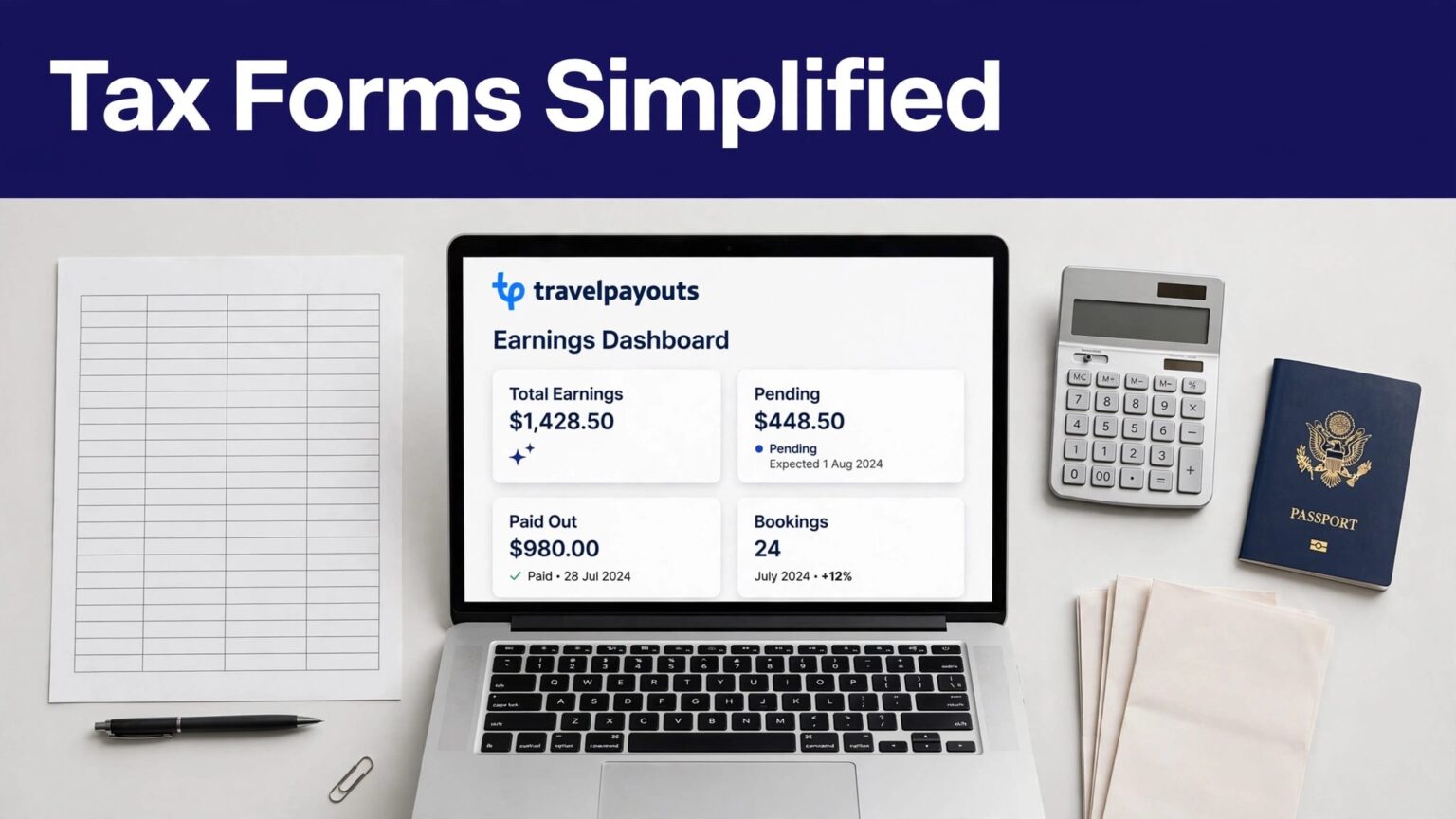
Affiliate commissions can look simple until tax season arrives. You have clicks, pending bookings, approved rewards, reversals, payouts, and a dashboard that doesn’t match your bank balance.
Travel affiliate tax forms are easier to manage when you treat them as a recordkeeping process, not a once-a-year scramble. Your Travelpayouts account tracks performance, but you still need your own tax record and the right taxpayer details.
Set up the records early. Then your year-end work becomes a review, not a reconstruction project.
Start With the Income You Actually Earn
Travelpayouts is an affiliate platform that connects publishers with travel brands and programs. Its travel affiliate network can show clicks, bookings, rewards, and payout activity in one account.
Those numbers don’t all mean the same thing for your records.
Separate potential rewards from approved earnings
A pending reward is not confirmed income. A traveler may cancel a hotel stay. A supplier can reject a booking. A program may apply its approval period before the commission becomes available.
Use three separate values:
- Pending rewards are commissions still under review.
- Approved rewards are commissions the program has confirmed.
- Paid earnings are funds sent through your selected payout method.
Keep reversals separate too. If a $40 approved commission later becomes a $0 commission after a refund, add an adjustment row. Don’t overwrite the original record.
This gives you a clean answer when a dashboard total changes months later.
A large pending balance is not money you can treat as available cash. Approval rules and cancellations can change the final result.
Use Travelpayouts reports as source records
Download or save your reports at least once each month. Program terms, commission rates, booking windows, and payout thresholds can change. Your record needs the conditions that applied when you promoted the offer.
For each program, save the report date, offer name, commission condition, clicks, approved earnings, reversals, and payment status. A screenshot can help, but a downloaded report and spreadsheet entry are easier to review.
Travel affiliate tax forms work better when every total has a source. Don’t estimate income from a single strong month or an old dashboard screenshot.
Choose the Right Taxpayer Form First
The form you provide depends on your tax status. It does not depend on where your readers live, where a hotel is located, or which currency appears in your Travelpayouts account.
A tax identification number, or TIN, is the number a tax authority uses to identify you. For a U.S. individual, this is often a Social Security number. A business may use an Employer Identification Number, or EIN.
Use this simple distinction as a starting point.
| Your status | Form usually requested | What it communicates |
|---|---|---|
| U.S. person, including many resident aliens | Form W-9 | Your legal name and U.S. TIN |
| Foreign individual | Form W-8BEN | Your foreign status and beneficial ownership |
| Foreign business or entity | Form W-8BEN-E may apply | The entity’s foreign status |
When a W-9 applies
Form W-9 is for U.S. persons. It provides the payer with your correct legal name, tax classification, address, and TIN. The IRS publishes the current Form W-9 instructions and certification.
Complete the form with the name connected to your tax return. If you run a sole proprietorship, that often means your personal legal name, even if you use a site name or brand.
Don’t send a W-9 to a random email address. Submit tax details only through the payment process or support channel you have verified.
When a W-8BEN applies
Form W-8BEN is for foreign individuals who need to document foreign status with a U.S. payer or withholding agent. The IRS describes Form W-8BEN and its purpose on its official site.
Tax residency means the country whose tax rules treat you as a resident. It is not always the same as citizenship or passport country. Where you live, work, maintain a home, and spend time can matter.
A W-8BEN is not a U.S. tax return. It is documentation for the payer. It can also support a treaty claim when one applies, but treaty rules require careful review.
If you operate through a company, trust, or partnership, don’t assume the individual form is correct. Foreign entities often need a different W-8 form.
Build a Fixed Affiliate Earnings Record
Your dashboard is useful. It is not your complete accounting system. Create one spreadsheet or database that stores every reporting period in the same format.
Use one row per program, campaign, content page, or payout batch. Keep the structure fixed through the year.
Store the fields that explain each payment
Your record should include:
- Content URL, traffic source, and Travelpayouts program name.
- Offer or reward condition, plus the date you checked it.
- Clicks, bookings, pending rewards, approved rewards, and reversals.
- Booking period, approval date, payment date, and payout method.
- Currency shown in the report and the amount received in your bank or wallet.
- Report file name, download date, and a link to the source file.
Use this calculation for your operating report:
Net affiliate earnings = approved percentage rewards + approved fixed rewards – reversals
That number helps you compare pages. Your tax reporting method may use a different timing rule, particularly if you use accrual accounting. Most beginner creators should keep the operational report simple and get accounting advice before changing methods.
Preserve corrections instead of hiding them
Don’t replace a previous commission figure when something changes. Add a new adjustment entry with the reversal amount, date, reason, and source report.
This creates an audit trail. You can see what Travelpayouts first reported, what later changed, and what you received.
The same control helps when you pay a virtual assistant, accountant, or business partner. Everyone works from the same confirmed record instead of different dashboard views.
Reconcile Travelpayouts Reports Against Payouts
A commission report and a bank deposit will not always match in the same month. Approval delays, payout thresholds, payment schedules, currency conversion, and provider fees can create timing differences.
That is normal. Missing records are not.
Run a monthly payout check
Set one monthly review date. Download the Travelpayouts report. Check the payment details in your account. Then compare approved earnings against actual deposits.
Use this sequence:
- Record approved earnings for the period.
- List reversals and any earnings still pending.
- Match each payout to a bank, PayPal, or other payment-provider transaction.
- Record the gross payout, any visible fee, and the net amount received.
- Mark unmatched items for follow-up.
Keep your payout receipt with the report. Don’t rely on bank statement descriptions alone. They may use an abbreviated sender name that is hard to identify six months later.
Don’t mix reporting currencies
A dashboard can show earnings in one currency while your bank receives another. Record both amounts when they differ.
Use the platform amount as the affiliate source record. Use the received amount and transaction date as the cash record. Your accountant can then apply the correct conversion method for your return.
Don’t invent an exchange rate after the fact. Save the payment-provider receipt or bank transaction that shows the actual amount.
Understand 1099s and Withholding Without Guesswork
A 1099 is an information form a payer may send to report certain payments to the IRS and the recipient. It is not a tax bill. Receiving one does not create income that was not already taxable.
For affiliate income, the payer’s business location, your tax status, the payment classification, and the applicable reporting rules affect which form may be issued. Don’t assume every Travelpayouts commission will produce a 1099, or that no form means no reporting duty.
A missing 1099 does not erase income
If you are a U.S. taxpayer, you generally need to report taxable business or self-employment income even when no 1099 arrives. Your own records are the control.
Use your annual payout total, monthly reports, and adjustment log to prepare a full income figure. Then compare it against any form you receive. Investigate a major difference before filing.
Keep the form, but don’t copy it blindly if your records show a problem. Ask the issuer for a correction when needed.
Know what withholding means
Withholding is money a payer holds back and sends to a tax authority. In the U.S., backup withholding can apply to certain reportable payments when a U.S. payee fails to provide a valid TIN or gives incorrect information.
The IRS states that backup withholding can be 24% in applicable cases. A properly completed W-9 helps the payer document your information.
Foreign people who give valid W-8 documentation are generally outside the U.S. backup withholding and 1099 process for those payments. That does not settle tax obligations in their home country.
Avoid the Tax Mistakes That Create Cleanup Work
Most affiliate tax problems begin with incomplete records. The rest come from choosing a form based on a guess.
Use legal details, not your creator brand
Your blog may operate as “Weekend Rail Routes.” Your W-9, W-8BEN, bank account, and tax return need names that match your legal and business structure.
A mismatch can delay verification or payment. It can also create extra work when a tax form arrives under a name you don’t use in your books.
Review your profile after a legal name change, move, business formation, or change in tax residency.
Keep taxes separate from content performance
Approved earnings per click are useful for deciding which travel pages to improve. They are not a tax calculation.
Track content performance in one report. Track tax records in another. They can use the same source data, but they answer different questions.
Use approved earnings to judge whether an offer performs. Use payout records and professional guidance to prepare tax reporting.
Complex cases need qualified advice. This includes dual residency, treaty claims, a non-U.S. company, U.S. citizen status abroad, VAT or GST obligations, and earnings across several countries. A tax professional who understands cross-border creator income can prevent an expensive filing error.
Final Check Before Tax Season
The practical fix for travel affiliate tax forms is a monthly system. Capture program reports, separate pending rewards from approved earnings, preserve reversals, and match payouts to your financial account.
Choose W-9 or W-8 documentation based on your real tax status, not your payment currency. Then keep your legal name, TIN, reports, and receipts in one controlled record.
Good tax records do not guarantee a tax outcome. They give you and your adviser the evidence needed to report affiliate income correctly.
