How I Turn Exploding Topics Into a Keyword Brief
Exploding topics are useful only when I can turn them into something I can publish. Otherwise, I’m just staring at a trend line and hoping it means something. That’s why I treat every promising trend as the start of an exploding...

Exploding topics are useful only when I can turn them into something I can publish. Otherwise, I’m just staring at a trend line and hoping it means something.
That’s why I treat every promising trend as the start of an exploding topics keyword brief, not the final idea. I want one clear search problem, one audience, and one angle I can write around without guessing.
When I do that well, the topic stops feeling vague. It becomes a real plan with a title, an outline, and a reason to exist.
I start by checking whether the trend is worth shaping
I never turn the first shiny trend into a brief. I look for movement that feels steady, useful, and connected to a real business pain.
A trend needs more than attention. It needs a path to a searcher’s problem. If people are only curious, the content may get clicks but not trust.
So I ask three simple things. Is the topic rising over time? Does it connect to software, money, time savings, or risk? Can I picture a buyer, not just a browser?
A trend only becomes content when I can name the searcher’s problem.
When I want a second pass, I compare the topic with Exploding Topics’ keyword research guide and its methodology page. I also cross-check my idea against my trend spotting guide and my low-competition keyword process.

That first filter saves me time. It keeps me from building briefs around topics that only look exciting for a week.
I turn the trend into a search problem, not a guess
Once I trust the trend, I translate it into the words a searcher would use. This is where the brief starts to take shape.
I don’t start with a title. I start with the question behind the search. Then I narrow the topic until it feels specific enough to rank and broad enough to matter.
Here’s the structure I usually fill in:
| Brief field | What I write | Why it matters |
|---|---|---|
| Primary keyword | The main search phrase I want the article to win | Keeps the piece focused |
| Supporting keywords | Related terms people use around the same topic | Helps me cover the topic naturally |
| Search intent | Informational, commercial, or mixed | Shapes the format |
| Audience | The exact reader I’m serving | Prevents generic writing |
| Angle | The point of view or promise | Gives the article a reason to exist |
| Title direction | A few possible headline styles | Speeds up drafting |
| Outline inputs | H2s, examples, and proof points | Makes writing easier |
| Internal link ideas | Related pages on my site | Helps readers keep moving |
I like this part because it turns a fuzzy trend into a work order. If I can fill these fields, I can write the article. If I can’t, the idea isn’t ready yet.
The best briefs also name the business context. For B2B topics, that might mean budgets, setup time, switching costs, or team size. For software topics, it might mean integrations, reporting, or workflow control. Those details keep the article grounded.
My example: turning “AI agents” into a publishable brief
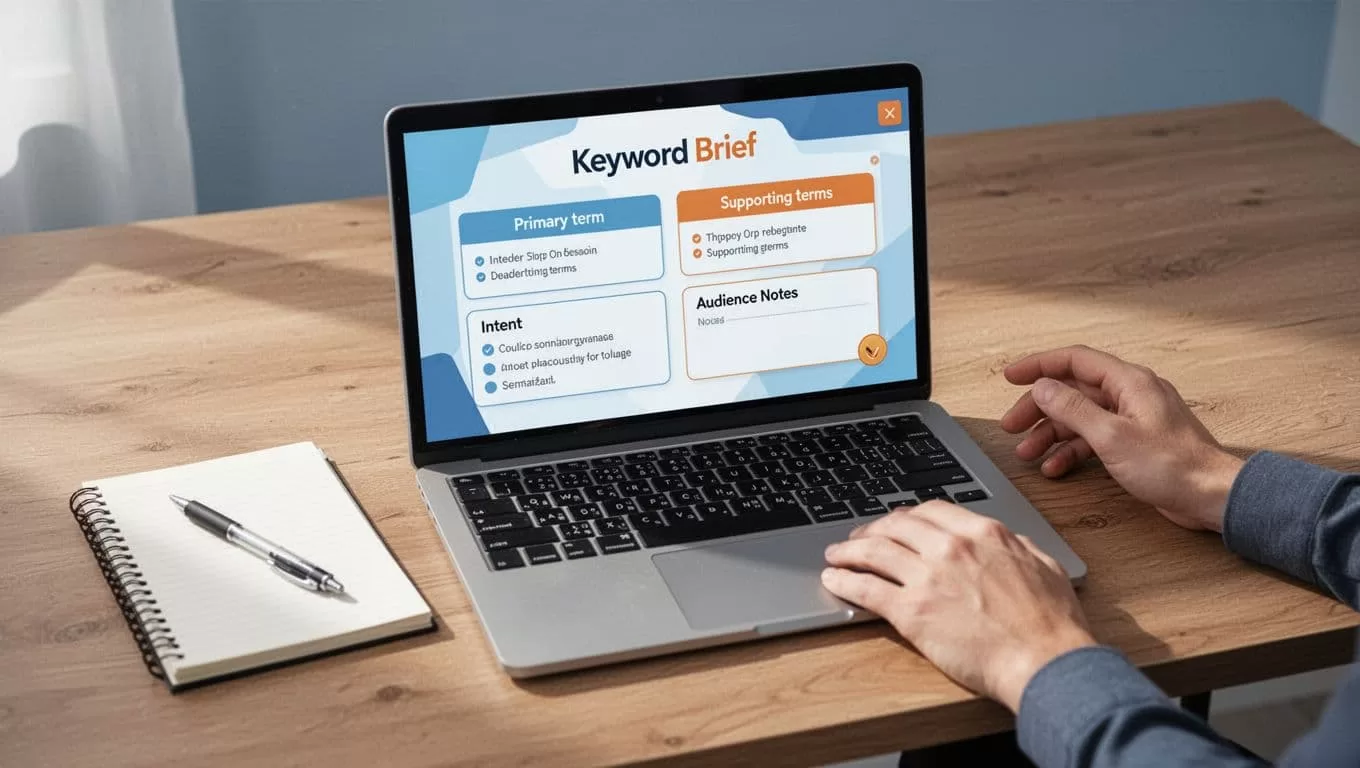
Let’s say I spot AI agents rising on Exploding Topics. I don’t write about the trend in that broad form. It’s too wide, and it’s too easy to drift.
Instead, I narrow it to AI agents for sales teams. That gives me a real reader and a real use case. Now the brief becomes practical.
My draft brief might look like this:
- Primary keyword: AI agents for sales teams
- Supporting keywords: AI sales automation, AI agent software, autonomous AI tools, sales workflow automation
- Search intent: Mixed informational and commercial investigation
- Audience: Sales ops leads, RevOps managers, and founders at small B2B teams
- Angle: I show where AI agents help, where they fail, and how much control I want to keep
- Title direction: How I Use AI Agents for Sales Teams Without Losing Control
- Outline inputs: What AI agents do, best sales workflows, setup limits, costs, and common mistakes
- Internal links: A guide on trend spotting, a post on low-competition keywords, and an automation-related article
That brief gives me a clean lane. It tells me what to say, what to skip, and what proof I need.
I also like the title direction because it has a clear promise. It doesn’t sound like theory. It sounds like something I’ve tested.
The outline follows from there. I’d open with the pain point, explain the use cases, then get into limits and fit. After that, I’d add a quick comparison of tool types or workflow options.
I keep the brief tight enough to use
A brief gets messy fast when I try to include everything. So I cut anything that doesn’t help the article rank or help the reader decide.
I usually remove three things right away:
- Overbroad keywords that could mean five different things
- Extra angles that fight the main point
- Nice-sounding claims I can’t support
I also decide my internal links before I write. That way, the article fits into the site instead of floating alone. If the topic touches a related system, process, or tool, I plan that link while the idea is still fresh.
This step matters because trend-based content can spread fast. One topic can branch into many posts, but each post still needs one job. If I keep the brief narrow, the draft stays sharp.
The brief is where trend hunting becomes useful
A rising topic only helps me when I can pin it to a searcher’s need. That’s the shift from trend watching to publishing.
When I build the brief this way, I get a clear primary keyword, supporting phrases, intent, audience, angle, title direction, outline inputs, and internal links. That’s enough to write with confidence.
The trend is the spark. The brief is the map.
