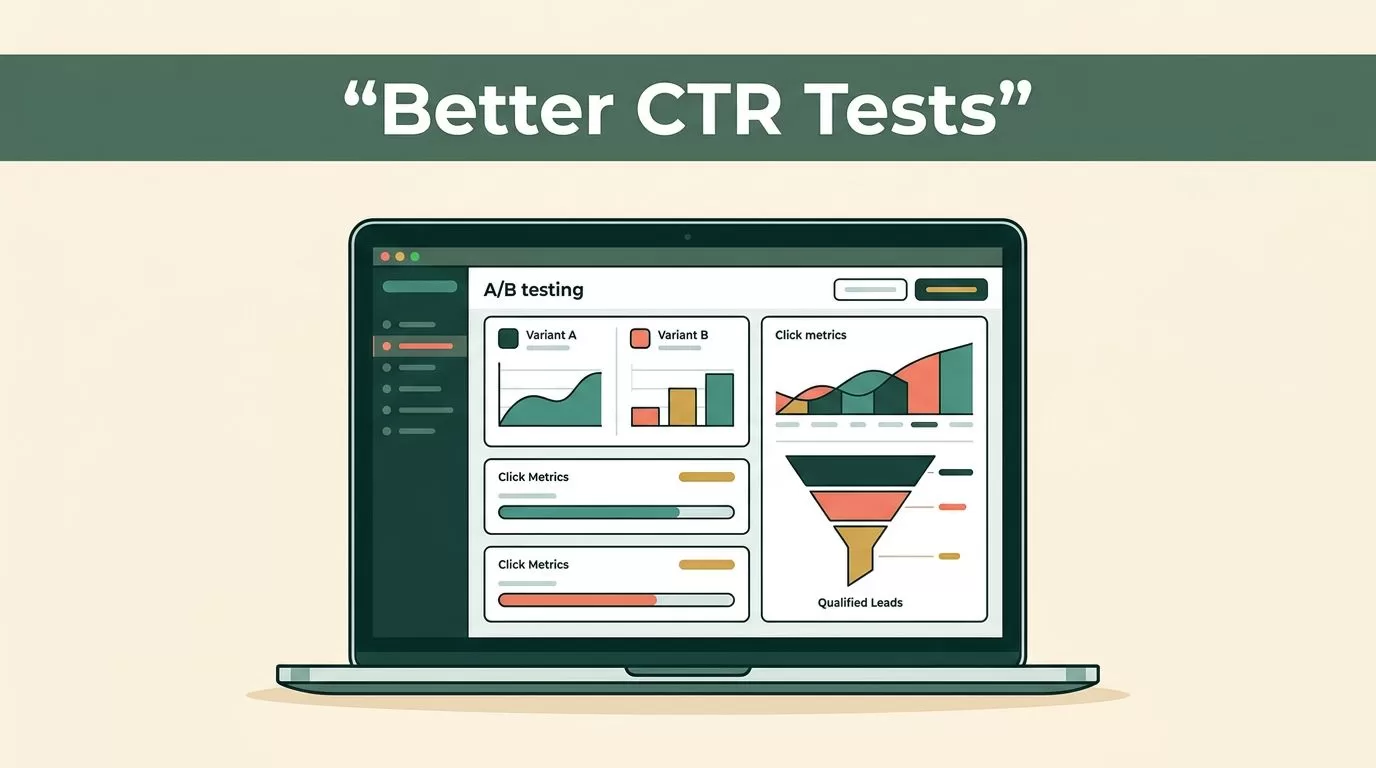
A higher click-through rate doesn’t always mean a better page. You can increase clicks and still send fewer qualified leads into your funnel.
The reliable approach is simple. Set a clean baseline in Mida.so, identify the reason people hesitate, test one clear change, and measure what happens after the click. Use that process every week instead of relying on one redesign.
Key Takeaways
- Define one click event and one denominator before reviewing CTR.
- Diagnose message, visibility, trust, and device problems before changing the page.
- Run focused experiments with a clear hypothesis and a downstream quality metric.
- Treat CTR as an entry metric, not proof that the page is producing better customers.
- Record every result so your next Mida.so test starts with evidence.
Set a Reliable CTR Baseline in Mida.so
Click-through rate is a ratio. The basic formula is:
CTR = clicks divided by eligible views, multiplied by 100
The formula is easy. The denominator causes most reporting mistakes.
A landing page might report clicks per session. A campaign report might use impressions. A product page might use unique visitors. These measures answer different questions. Don’t compare them as if they are the same.
Start by choosing the action that matters. This could be a pricing-page click, a demo-request button, a signup link, or a product-tour CTA. Then define the eligible audience. Record the date range, traffic source, device mix, page version, and total eligible views.
Open the relevant Mida.so report and capture the current result before making a change. Keep the baseline in a simple experiment log. Include the page URL, CTA location, click definition, audience, and any active campaigns.
Your tracking setup must also identify the click consistently. If the same CTA uses different links or event names across pages, your data becomes difficult to compare. Review your event naming with the Google Analytics events documentation if GA4 is part of your measurement stack.
Segment the baseline before you plan a test. Desktop visitors may respond differently than mobile visitors. Paid search traffic may have a different intent than visitors from a product comparison page. A single blended CTR can hide both problems.
Use the same reporting rules for the control and the variation. If the control counts sessions and the variation counts users, the result isn’t usable.
A CTR baseline is only useful when the click, audience, and denominator stay consistent.
Don’t chase a benchmark without context. A 4% CTR can be excellent for one action and weak for another. Your first target is a trustworthy measurement system. Your second target is a repeatable improvement.
Find the Friction Before You Change the Design
A low CTR is an outcome, not a diagnosis. Changing button color won’t fix a weak offer or a headline that attracts the wrong audience.
Review the page in four areas: relevance, clarity, visibility, and trust.
Relevance starts with message match. The words in the ad, email, or referring page should connect with the headline and CTA on the landing page. If a visitor expects “SOC 2 compliance software” and reaches a page that says “Business automation platform,” the page creates work before it creates interest.
Clarity answers three questions quickly:
- What does the product do?
- Who is it for?
- What happens after the click?
Remove vague CTA labels such as “Learn More” when a more precise action is available. “See pricing,” “Book a security review,” and “Start the free audit” set clearer expectations. Use language that matches the next screen.
Visibility depends on layout and device. Check whether the primary CTA appears before the first major scroll. Inspect mobile spacing, font size, contrast, and sticky elements. A CTA can be present in the code but absent from the visitor’s attention.
Trust reduces hesitation. Add proof near the decision point when the claim needs support. This may include customer names, security documentation, implementation details, or a clear explanation of what the visitor receives.
The Nielsen Norman Group usability heuristics provide a useful review lens. Visibility of system status, consistency, error prevention, and recognition over recall all apply to CTA paths.
Use Mida.so results to locate the weak page or audience. Then inspect the page experience with the other analytics, recording, survey, or session tools your team already uses. Don’t assume the report tells you why users hesitate. It tells you where the problem is concentrated.
Write the diagnosis in one sentence before creating a test:
“Mobile visitors understand the offer but miss the CTA below the first scroll.”
That statement gives you a stronger starting point than “We need a better button.”
Build Focused Experiments That Improve CTR Consistently
A useful test has one central hypothesis. It also has a defined success metric and a guardrail.
Use this structure:
If we change [one page element] for [one audience], [the target behavior] will improve because [the visitor problem].
For example, your hypothesis may focus on replacing a generic CTA with a specific action that matches the visitor’s intent. The change is the CTA copy. The reason is message mismatch. The primary metric is CTA CTR. The guardrail is signup completion after the click.
Test one major variable at a time when you need a clear lesson. You can test a headline, CTA copy, offer framing, form position, trust proof, or page layout. Combining all five changes may produce a lift, but it won’t tell you which decision caused it.
Prioritize tests that sit close to the click and connect to a known problem. A useful order is:
- Fix broken tracking, links, and mobile usability.
- Test message match and CTA clarity.
- Test offer framing and supporting proof.
- Test layout changes after the earlier results establish a direction.
Create a consistent naming system in Mida.so. Include the page, audience, element, and test number. “Pricing-Mobile-CTA-004” is easier to audit than “New Test Final 2.”
Before launch, record the control version, variation, traffic allocation, start date, primary goal, and stop conditions. Use the experiment settings available in your Mida.so account. Keep the test scope narrow enough that the result can be explained.
Don’t stop a test because the first few days look positive. Early results often reflect traffic mix, campaign launches, weekday patterns, or a small number of visitors. Let the test collect enough data for a stable comparison, then review the size and consistency of the difference.
Don’t run a test indefinitely either. Set a review date before launch. If traffic is low, combine the test with a longer observation period rather than making a decision after a handful of clicks.
A good testing program doesn’t need constant visual changes. It needs a steady supply of clear questions.
Separate CTR Gains From Conversion Quality
CTR is an entry metric. It tells you whether more people took the next step. It doesn’t tell you whether those people were a good fit.
Track at least one downstream measure with every important test. Depending on the funnel, that measure may be signup completion, qualified demo rate, activated accounts, sales acceptance, or revenue per visitor.
Consider a simple result:
- Control: 10,000 page views and 500 CTA clicks, a 5% CTR
- Variation: 10,000 page views and 650 CTA clicks, a 6.5% CTR
- Control: 50 completed signups after the click
- Variation: 52 completed signups after the click
The variation produces 30% more clicks. It produces only two additional signups. Its post-click completion rate is lower. The new CTA may attract curiosity without improving intent.
That doesn’t automatically make the test a failure. The variation may still help if sales quality, activation, or revenue improves later. It means you need the next stage of data before calling it a business win.
Review results by source, device, new versus returning visitor, and campaign when the sample supports those comparisons. A blended lift may come from one paid campaign while organic visitors perform worse. Roll out the change to everyone and you can erase the useful detail.
Check for side effects. A louder CTA may increase clicks while causing more accidental taps. A shorter form may increase submissions while lowering lead quality. A stronger claim may raise CTR while creating more refund requests or sales objections.
Use a decision table to keep the review consistent.
| CTR result | Downstream result | Action |
|---|---|---|
| Higher | Higher or stable | Roll out and monitor |
| Higher | Lower | Review audience quality and message |
| Flat | Higher | Keep the change if the business metric matters |
| Lower | Higher | Check sample size, segments, and implementation |
| Lower | Lower | Retire the variation |
The Optimizely A/B testing glossary is a useful reference for control groups, variations, and experiment structure.
Call a test a win only when it improves the metric that supports the business goal. A higher CTR is useful when it moves qualified visitors into a better conversion path.
Turn Mida.so Results Into a Weekly Operating Rhythm
Consistency comes from the operating process around your tests. Set a fixed review schedule and keep the work visible.
Each week, review completed tests, active tests, new page issues, and the next three hypotheses. Record the result in the same format every time:
- What changed
- Which audience saw it
- How CTR changed
- How the downstream metric changed
- Whether the result was consistent across key segments
- What the team will do next
Mark each test as rolled out, retained for a segment, inconclusive, or retired. Add one sentence about the lesson. A test that loses can still improve the backlog if it removes a weak assumption.
Use campaign tracking consistently. UTM parameters help separate traffic sources when they are applied with a shared naming system. Google’s Campaign URL Builder can help teams create those parameters without manual formatting errors.
After a winning result, monitor the page again. Traffic sources change. New campaigns change visitor intent. Product positioning changes. A CTA that performed well during a launch may not perform the same way with evergreen traffic.
Don’t treat a winning variation as a permanent answer. Treat it as evidence. Use the evidence to create the next focused test, such as a stronger supporting message, a more specific offer, or a better post-click step.
Your Mida.so workflow should produce a history of decisions, not a pile of isolated percentages. That history helps marketers avoid repeated tests and helps founders see which page changes improve actual pipeline.
Conclusion
To improve click-through rate consistently on Mida.so, start with clean measurement and a specific diagnosis. Test one meaningful change at a time, then compare CTR with signup, activation, lead quality, or revenue data.
A page with more clicks isn’t automatically a better page. The strongest result is a repeatable increase in qualified action, supported by experiments your team can understand and run again.


