Track Recurring Referral Commissions With Rewardful
An affiliate program can look profitable until renewal invoices, cancellations, and payout disputes start piling up. Recurring referral commissions need a billing record behind every payout, not a spreadsheet built from clicks and memory. R...

An affiliate program can look profitable until renewal invoices, cancellations, and payout disputes start piling up. Recurring referral commissions need a billing record behind every payout, not a spreadsheet built from clicks and memory.
Rewardful connects affiliate attribution to Stripe billing activity. That gives SaaS teams a practical starting point, but your campaign rules and review process still decide whether the numbers are right.
Build the commission policy first. Then test the full path from referral click to paid renewal.
HOW RECURRING REFERRAL COMMISSIONS ARE CREATED
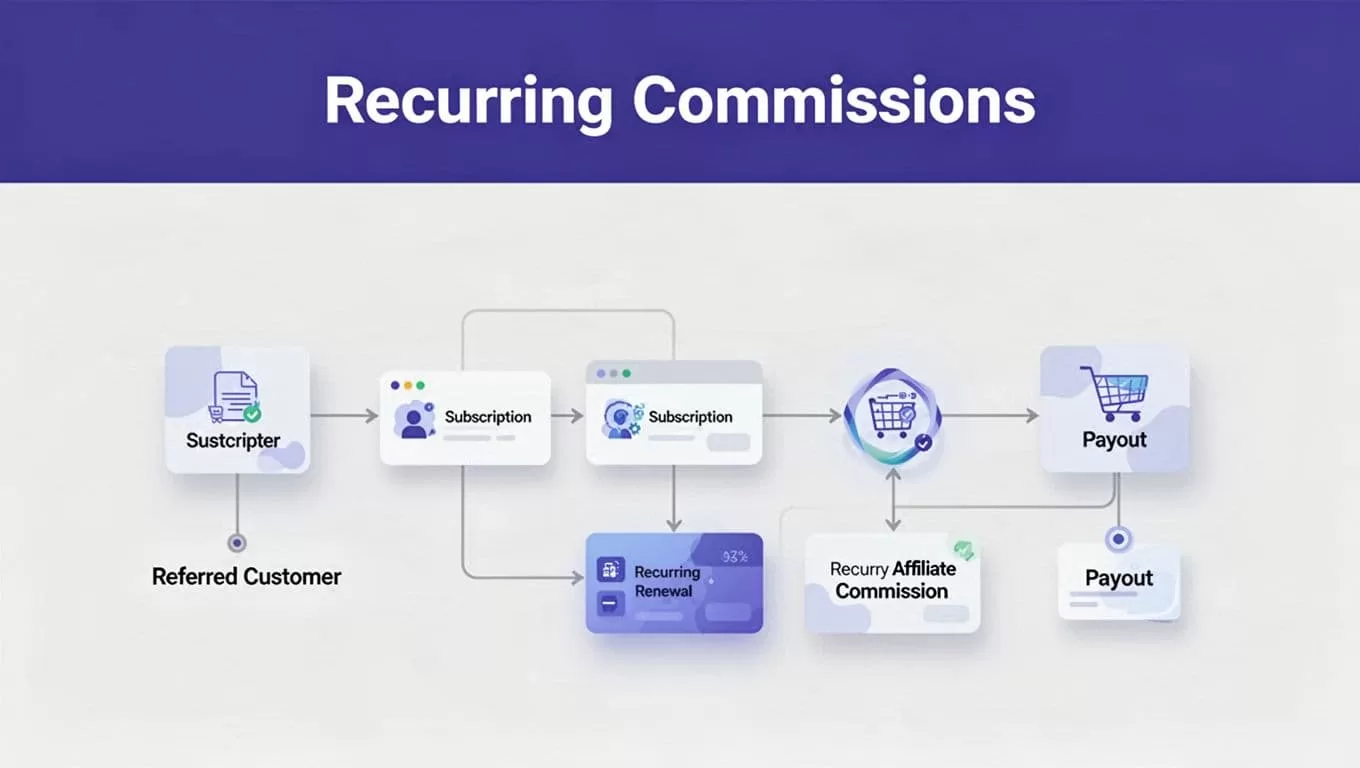
Rewardful creates eligible commissions when Stripe records an invoice as paid for a referred customer. That includes the first subscription payment and later renewals. Its affiliate payout flow ties commission creation to Stripe invoice payments, not manual renewal entries.
Use this division of work when you set up the program.
| Billing event | Rewardful tracks automatically | Your team must configure or verify |
|---|---|---|
| Referred customer pays an invoice | Creates an eligible commission from the paid invoice | Confirm the customer is attributed to the correct affiliate and campaign |
| Subscription renews | Creates a new commission for each eligible paid renewal | Set the commission rate, duration, and hold policy |
| Plan changes or cancellation | Tracks billing changes from Stripe | Review unusual proration, reactivation, and cancellation cases |
| Refund or reversal | Adjusts the commission record when Stripe changes the billing outcome | Define recovery rules if an affiliate was already paid |
| Affiliate payout | Keeps payout data connected to commission activity | Approve the batch, collect payee details, and keep payment evidence |
A browser click establishes an attribution claim. A paid Stripe invoice is the financial proof.
Rewardful can automate the billing connection. It cannot decide whether a self-referral is valid, whether a refund has cleared your policy window, or whether an affiliate’s payout details are complete.
SET THE COMMISSION RULE BEFORE YOU INVITE PARTNERS
A vague offer creates a vague payout process. Write one operating rule that finance, support, and affiliates can read the same way.
Calculate from the paid invoice, not list price
If your campaign pays 25% recurring commission and a customer pays a $200 invoice, the affiliate earns $50. If the customer downgrades and the next paid invoice is $150, the commission is $37.50.
Discounts matter too. A 25% reward on a $160 paid invoice is $40, even when the list price was higher. Rewardful calculates from the final invoice amount Stripe records as paid, as explained in its comparison of Stripe affiliate tracking methods.
You can use a percentage or a fixed amount. A $40 fixed reward per paid renewal is easier to forecast. A percentage better follows plan changes. Pick one method based on your margin and partner model.
Put duration and exclusions in plain language
Recurring by default does not have to mean forever. You can cap rewards after a fixed number of paid invoices or months. A common approach is to pay for the first 12 paid subscription invoices, then stop.
Your recurring referral commissions policy should state:
- Whether the reward is a percentage or fixed amount, and what invoice value it uses.
- When a commission becomes eligible for payout after payment, cancellation, or refund risk.
- Whether self-referrals, employee purchases, coupon sites, or paid-search activity are prohibited.
- What happens when a customer cancels, returns, disputes a charge, or reactivates later.
Publish the same rules in your affiliate agreement, program page, and onboarding emails. Retroactive changes create avoidable disputes.
CONNECT ATTRIBUTION TO THE STRIPE CUSTOMER
A campaign can be configured correctly and still fail if referral data disappears before checkout. Test the complete customer path before traffic reaches the program.
Keep the referral record through signup and payment
Start by connecting the Stripe account that receives your subscription invoices. Rewardful’s Stripe affiliate software overview describes Stripe as the billing connection that tracks recurring subscription activity.
Next, use a real test referral link. Open it in a clean browser session. Create a new account, complete checkout, and confirm the new customer is attached to the expected affiliate.
Don’t assume the referral survives redirects, subdomains, authentication screens, or a custom checkout. A browser records intent. The paid invoice confirms revenue.
For a custom app, check every handoff. The referral needs to survive landing page, signup, account creation, and Stripe payment creation. A backend update that replaces referral data can remove attribution without producing an obvious error.
Test the billing cases you will pay for
Run controlled tests before launch. Create one standard paid subscription. Then test a trial conversion, renewal, upgrade, downgrade, cancellation, refund, and reactivation.
Use the same test affiliate where possible. Record the Stripe customer ID, invoice ID, amount paid, expected commission, and outcome. This gives your team a baseline when a real partner asks why one invoice earned a different amount.
Do not test only the first sale. Most commission errors appear after the customer changes plan or reaches a second billing cycle.
RECONCILE RENEWALS, UPGRADES, AND CANCELLATIONS
Track the invoice lifecycle, not only the customer lifecycle. A customer can remain in Stripe while their billing state changes several times.
Match each renewal to one paid invoice
Each eligible renewal should have a customer, affiliate, paid invoice, campaign rule, and commission record. If one of those links is missing, investigate before the next payout batch.
Rewardful’s public product information says it automatically tracks recurring commissions, upgrades, downgrades, and cancellations once connected to Stripe. Its Stripe Marketplace listing also states that it adjusts commissions for refunds and subscription changes.
Proration needs extra care. An upgrade can create a partial invoice. A downgrade may reduce the next payment. Don’t calculate the reward from the change in monthly recurring revenue. Use the amount Stripe actually recorded as paid.
Treat refunds and cancellations as payout controls
A cancellation should stop future recurring rewards when no new eligible invoice is paid. It does not mean you should erase prior paid billing history. Keep the original invoice and commission record intact.
Refunds need a written recovery rule. If the commission has not been paid, remove it from the payout batch. If it has been paid, offset the amount against future earnings or follow the recovery terms in your affiliate agreement.
Test partial refunds and delayed refunds in a controlled account. Check the exact commission result instead of guessing. This protects both the business and the affiliate.
BUILD AN APPROVAL AND PAYOUT ROUTINE
An affiliate balance is an operations queue. It is not a payment instruction until your team checks the underlying revenue.
Review a small sample every week
Review a sample of new and recurring commissions against Stripe. Check the affiliate, customer, invoice ID, paid amount, campaign rate, reward amount, and refund status.
Keep a fixed commission ledger with these fields:
- Affiliate ID and payout contact.
- Stripe customer ID and paid invoice ID.
- Campaign or rate used for the reward.
- Invoice paid date, commission amount, and current status.
- Refund, reversal, or exception decision.
- Payout batch ID, payment date, and payment method.
Track pending, due, paid, and voided commissions separately. Pending rewards are not earnings. Clicks are not customers. A completed software sync does not prove the payout record is correct.

Select a payout method after approval
Rewardful supports PayPal and Wise mass payouts for approved affiliate batches. Its payout process also lists Managed Payouts and one-click PayPal options. Check the live terms, fees, countries, and payee requirements before you select a method.
Collect payment and tax information before an affiliate reaches the payout threshold. Do not ask for missing documents after the batch is ready. That creates manual exceptions and delayed payments.
Keep the payout confirmation with the batch record. If a payment fails or needs reissue, preserve the first attempt. Do not overwrite it.
If you need help assigning the Stripe, affiliate, and finance handoffs before launch, Book A Call.
MEASURE RETAINED REFERRALS, NOT DASHBOARD ACTIVITY
High click volume can hide low-quality referrals, self-referrals, and customers who cancel after one invoice. Measure paid retention and net revenue after refunds.
Use a monthly scorecard that finance can check
Track paid customers with confirmed affiliate attribution. Track missing or duplicate attribution records. Track refund-related reversals and the time needed to resolve payout disputes.
Your most useful cost measure is:
Net paid commissions divided by retained paid referrals.
Use the same retention definition every month. For example, a customer only counts after the refund window passes and at least one valid invoice remains paid. This gives you a number that sales, partnerships, and finance can discuss without changing the rules.
Keep a recovery path for broken attribution
Set a review trigger for sudden drops in attributed customers after a checkout release. Also investigate duplicate claims, missing commissions, or commission totals that do not match Stripe invoices.
Keep the last trusted commission report. Store source invoice IDs, report date, reviewer decision, and corrections separately from the original record. If tracking breaks, pause affected payouts and reconcile the gap before sending money.
A workflow that creates more correction work than manual tracking has failed its business test.
KEEP THE PAYOUT TRACEABLE
Reliable recurring referral commissions come from one simple discipline: every payout must trace back to a valid referred customer and a paid Stripe invoice.
Rewardful handles the recurring billing connection. Your team owns the rate rules, exception decisions, approval standard, and payment records. Keep those controls fixed, and renewals stop being a monthly reconciliation problem.
