Pricing Tier Testing With Mida.so: A Practical SaaS Guide
A pricing page can attract plenty of visitors and still lose revenue through unclear plans, weak packaging, or the wrong value metric. Pricing tier testing gives SaaS teams a controlled way to test those decisions before changing the offer...
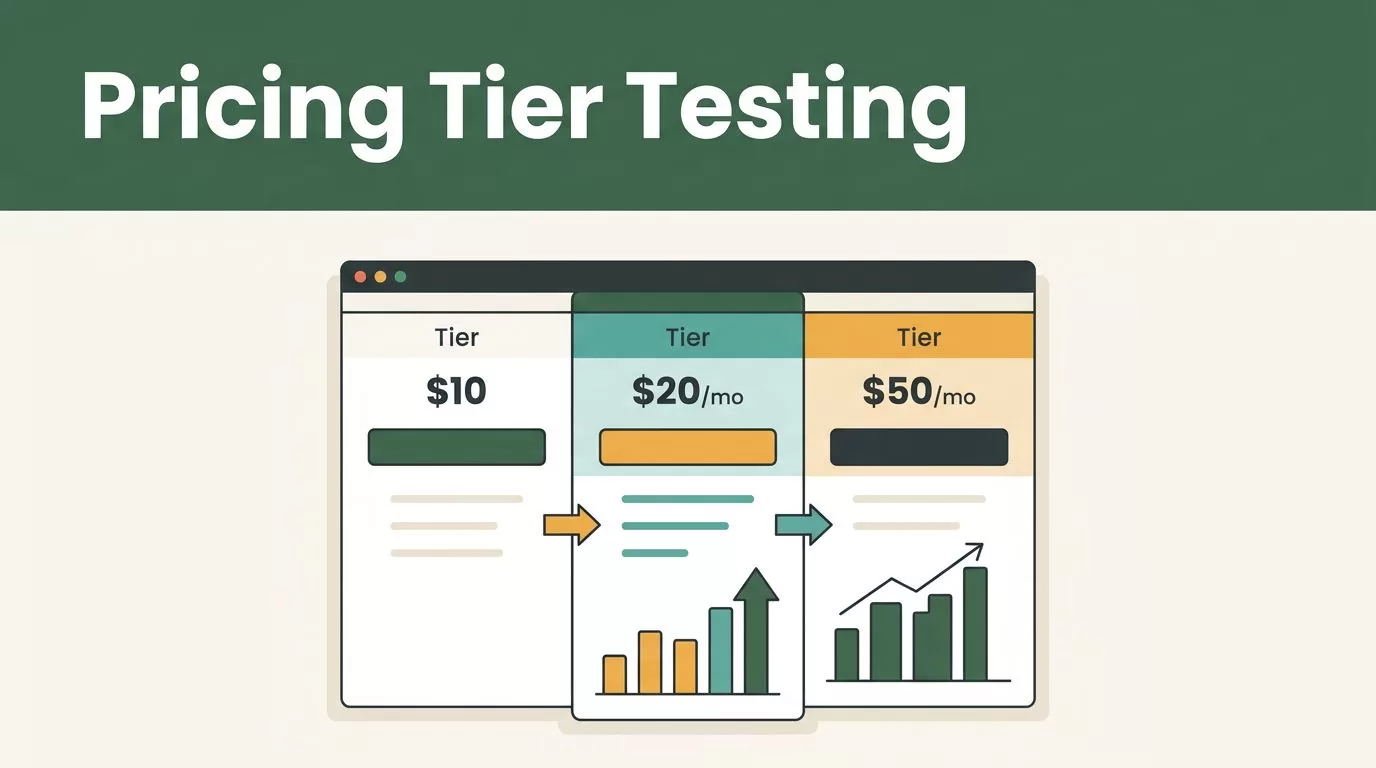
A pricing page can attract plenty of visitors and still lose revenue through unclear plans, weak packaging, or the wrong value metric. Pricing tier testing gives SaaS teams a controlled way to test those decisions before changing the offer for every customer.
Mida.so provides the implementation layer for these experiments. You can route visitors into different pricing experiences, track conversion events, and compare results without treating every design change as a pricing decision. The process starts with a clean hypothesis and ends with a business decision supported by reliable data.
Key Takeaways
- Test one pricing decision at a time, such as tier count, feature packaging, or price presentation.
- Separate pricing experiments from landing-page and product A/B tests.
- Use Mida.so to control traffic, track events, and review performance by segment.
- Compare revenue quality and absolute conversion counts, not percentage lifts alone.
- Wait for the planned sample size and confidence threshold before making a permanent change.
What Pricing Tier Testing Should Measure
Pricing tier testing changes the commercial offer. It can compare three plans against four, move a feature into a higher tier, adjust usage limits, or test monthly and annual payment options.
A landing-page A/B test changes how an offer is presented. It may compare two headlines, page layouts, forms, or calls to action while keeping the underlying prices and packages unchanged. A product test changes the user experience after sign-up, such as onboarding steps or feature discovery.
These tests can interact. They still need separate hypotheses and decision rules.
| Test type | Main question | Typical primary metric |
|---|---|---|
| Pricing test | Which offer produces better commercial results? | Paid conversion, revenue per visitor, or qualified upgrades |
| Landing-page test | Which presentation creates more intent? | Demo requests, trial starts, or completed forms |
| Product test | Which workflow improves adoption? | Activation, feature use, or retained accounts |
A pricing test should not stop at button clicks. A cheaper plan may increase trial starts while reducing average contract value. A premium tier may reduce total purchases but increase revenue per customer.
Define the business outcome before building the test in Mida.so. The primary metric should match the decision. Secondary metrics should expose trade-offs. These may include trial-to-paid conversion, average revenue per account, upgrade rate, churn risk, lead quality, and sales-qualified pipeline.
For practical SaaS A/B testing guidance, review the relationship between test structure, funnel stage, and downstream conversion. A pricing experiment needs that same discipline.
Build a Pricing Hypothesis Before Opening Mida.so
Avoid starting with, “Let’s see which pricing page wins.” That question is too broad. Write a statement that connects a customer problem to a packaging change and a measurable result.
A usable hypothesis follows this structure:
If we move advanced reporting into the Pro tier, more growing teams will select Pro because the feature matches their workflow. Pro plan selection should increase without reducing total paid conversion.
This statement gives your team a clear test boundary. You aren’t changing the headline, form length, and pricing table at the same time. You are testing one packaging decision.
Start by documenting your baseline. Record current traffic, plan selection, paid conversion, average revenue per visitor, and the distribution of mobile and desktop traffic. Include traffic sources. Paid search visitors may behave differently from organic visitors or returning users.
Your baseline should also include the current number of conversions. A conversion rate without its underlying count can create false confidence. A 20% relative lift from five conversions doesn’t carry the same weight as a 5% lift from hundreds of conversions.
Choose the audience before launch. You may test new visitors only, target traffic from a defined campaign, or restrict the experiment to a pricing page template. Keep the audience rule stable during the test.
Set the decision rules before viewing the results. Define:
- The minimum sample size for each variation.
- The minimum test duration, including a complete business cycle.
- The confidence threshold required for a decision.
- The minimum practical uplift worth implementing.
- The secondary metrics that cannot show a serious decline.
Pricing experiment design guidance also recommends starting with a hypothesis instead of a hunch. That rule prevents attractive dashboard numbers from controlling the strategy.
Configure Mida.so for a Clean Experiment
Add the Mida.so script through your CMS, site template, or Google Tag Manager container. Publish it to staging first. Use browser developer tools to confirm that the script loads without errors and that the target page is available in the visual editor.
Keep the script in a global template when the experiment may involve visitors who enter through another page. Use separate Mida projects for different brands, domains, or environments. Keep staging and production access separate so an unfinished test doesn’t appear on the live site.
Connect Google Analytics 4 if your reporting process uses GA4 as its primary source. Use Mida.so for experiment routing and reporting, then cross-check important outcomes against your analytics, CRM, and billing data.

A standard test uses a 50/50 traffic split. Equal exposure makes the comparison easier to interpret. Use a different allocation only when you have a clear risk-management reason and document it before launch.
Configure the target URL and audience parameters before sending live traffic. Exclude internal company traffic, automated bots, and visitors already enrolled in conflicting experiments. Check that every successful action fires one event, not zero and not twice.
For a pricing page test, the event structure might include:
- Pricing page exposure.
- Plan selection.
- Trial or checkout start.
- Completed payment.
- Upgrade or downgrade.
- Sales-qualified conversion.
Use a narrow URL pattern when the experiment applies to one pricing page or device group. Loading unnecessary experiment code across the entire site can add performance overhead. Track page speed, error rates, and layout stability as guardrails.
Google’s Core Web Vitals documentation explains the performance metrics that matter for user experience. Monitor Largest Contentful Paint and Cumulative Layout Shift during the test. A pricing variant that increases conversion while delaying the main content or moving the page during load may create a poor long-term trade.
Mida.so also provides API access through Dashboard > Settings > API. Use it when your team needs to create, launch, retrieve, or deactivate experiments through a programmatic workflow.
Read Mida.so Results Without Chasing Noise
Open the report in a fixed order. Start with traffic allocation. If the plan called for a 50/50 split, confirm that both variations received comparable exposure. Uneven routing weakens the comparison.
Next, check event quality. Confirm that conversions match the actions you intended to measure. Compare the Mida.so totals with your CRM and billing records. A higher form completion rate means little if the added leads never become qualified opportunities or paying customers.
Then review the primary metric under identical test conditions. Calculate conversion rate as:
Conversion rate = conversions / visitors x 100
Review the absolute numbers beside the percentage change. A small rate increase based on a few transactions can lead an eager team to deploy a losing variant.
Segment the results by the audiences that affect revenue. Review mobile visitors, paid search traffic, organic visitors, returning users, browser type, and customer size when that data is available. Also inspect paid search cost per acquisition, lead quality, and downstream sales value.
A plan may win among organic visitors and fail among paid mobile traffic. A higher-priced package may reduce total conversions but improve revenue from sales-assisted accounts. An overall winner isn’t automatically the right choice for every segment.
Monitor form usability and layout shifts. Check whether a pricing table creates friction on mobile. Review navigation for returning visitors. A layout that works for a first-time visitor may make repeat navigation slower or harder.
Do not stop the test every time the dashboard crosses a threshold. Repeated stopping increases the chance that random movement looks like a stable effect. Wait until the required sample size, test duration, and confidence rule are met.
A result can be inconclusive. That doesn’t prove the variant has no value. It means the current evidence isn’t strong enough for a confident change. Record the outcome as won, lost, inconclusive, or technically invalid, then attach the original hypothesis and recommendation.
Prevent Common Pricing Experiment Mistakes
The most expensive mistakes often happen before analysis.
Don’t run overlapping tests on the same pricing page unless you have enough traffic for a planned multivariate design. If one experiment changes the headline while another changes the call to action, visitors may receive combinations that your team never planned to evaluate.
Don’t change the control during an active test. Editing the original pricing copy, changing traffic rules, or modifying the conversion goal creates a new test condition. If the change is necessary, stop the experiment, document the reason, and restart measurement.
Don’t treat a click as a commercial win. A prominent button can raise engagement while attracting low-intent users. Connect Mida.so outcomes to your CRM and billing system when possible. Track whether trials activate, leads become qualified, and customers select sustainable plans.
Don’t ignore absolute revenue. A 0.05 percentage-point lift may not cover the cost of implementation and maintenance. A smaller percentage lift can still matter when it applies to high-volume traffic or a high-value plan.
Don’t change audience rules mid-stream. If the test begins with new visitors and later includes returning users, the sample no longer represents one stable condition. Keep traffic allocation, targeting, pricing logic, and event definitions fixed until the decision point.
Store the final result with the implementation decision. If the test wins, define the permanent pricing change and rollout owner. If it loses, record what the result rules out. If it is inconclusive, document the evidence gap and the next test needed.
Make Pricing Tier Testing a Repeatable System
A single test can answer one question. A repeatable program improves how your team asks the next one.
Create a test record with the hypothesis, audience, control, variant, primary metric, guardrails, sample target, launch date, and owner. Add links to the Mida.so experiment and related CRM or billing reports. This gives product, marketing, sales, and finance the same reference point.
Prioritize tests by expected business value and implementation cost. Packaging changes often require coordination across the pricing page, checkout, entitlement logic, invoices, sales materials, and customer support. Confirm that every system can handle the proposed offer before launch.
Use results to update your pricing model, not only your webpage. If customers consistently choose a usage-based tier over a seat-based tier, investigate whether the value metric matches how they buy. If a feature move causes upgrades to fall, review whether the feature is visible enough, valuable enough, or placed in the wrong plan.
Run broader product and landing-page tests separately. Pricing tier testing should answer commercial questions. Landing-page testing should improve message clarity and intent. Product testing should improve activation and adoption. Keeping these purposes distinct makes each result easier to act on.
Conclusion
Pricing decisions should not depend on a dashboard’s largest percentage. Use Mida.so to control exposure, capture reliable events, and compare pricing experiences against metrics that connect to revenue.
Set the hypothesis first. Keep the test conditions stable. Review mobile traffic, paid acquisition, lead quality, and downstream sales value alongside conversion rates. When the evidence meets your decision rules, pricing tier testing gives you a defensible path to better packaging without guessing.
