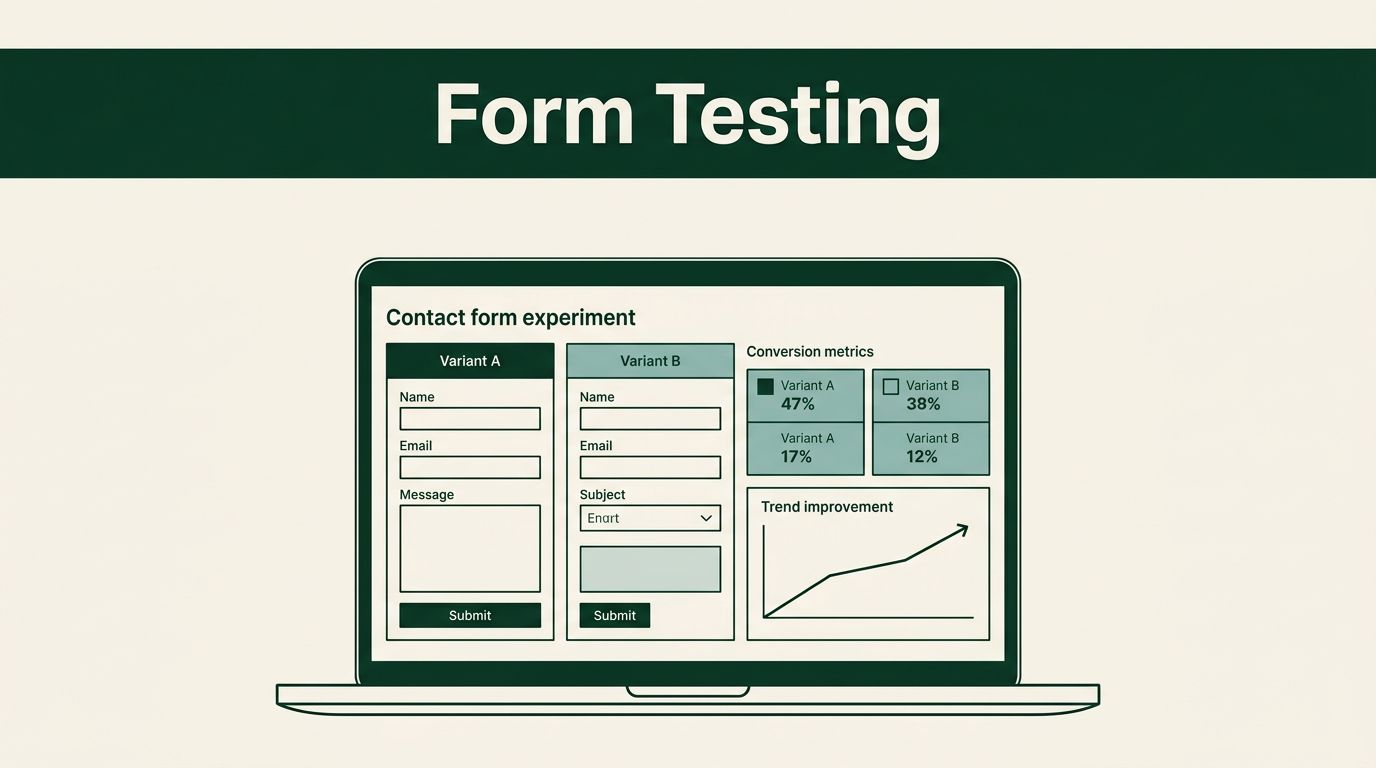
Most websites leak potential leads before anyone ever fills out a form. You drive traffic through paid ads and search engines, yet visitor counts rarely translate into qualified inquiries. Bumping up conversions isn’t about guessing what color button works best today. It requires a systematic approach to user behavior, rigorous testing, and structured experimentation. Contact form testing gives you the rigorous data you need to turn casual visitors into active pipeline.
Mida.so gives you the testing infrastructure you need, but tools only work when you pair them with a disciplined process. Setting up an experiment requires careful preparation, clear baseline metrics, and strict guardrails. This playbook covers how to run consistent form tests without breaking your site or chasing misleading data.
Key Takeaways
- Establish baseline conversion rates and traffic stability before launching any new experiment on your pages.
- Formulate clear hypotheses based on user friction points rather than random design tweaks.
- Monitor segment performance across mobile devices and paid traffic sources instead of relying solely on aggregate totals.
- Define strict decision rules and statistical confidence thresholds before checking live test results to prevent false positives.
- Track downstream lead quality and page performance guardrails to ensure conversion lifts don’t mask technical regressions.
Establishing Your Baseline Conversion Metrics
You cannot improve what you refuse to measure. Before you touch a single line of code or draft a new headline, pull your current conversion metrics directly from your analytics suite. Industry benchmarks show that performance varies wildly by traffic source, device type, and industry vertical. Mobile visitors rarely convert at the same rate as desktop users, and paid search traffic behaves differently than organic social clicks. Look past your blended average and inspect specific funnel steps. Calculate your drop-off rates from pricing page views to trial form starts, and from trial form starts to completed signups. When your baseline data is noisy or incomplete, your experiment analysis will yield unreliable conclusions.
Record your baseline speed, conversion rate, and traffic profile before you add any experiment script. Run several checks instead of relying on one automated scan. Lab tools can show how a page behaves under ideal conditions, but real users face network latency and device constraints. Document your current conversion rate, bounce rate, and core traffic distribution across mobile and desktop devices. If your baseline data is noisy or incomplete, your experiment analysis will yield unreliable conclusions.
Traffic allocation controls how visitors enter your test. A standard setup uses a fifty-fifty split, giving both experiences equal exposure. Keep your targeting rules precise. If your form update specifically targets mobile visitors or paid search traffic, configure those audience parameters before launching. Keep your traffic distribution steady and avoid changing audience rules while the test is active. Altering the targeting mid-stream creates a new test condition, corrupting your sample purity and forcing you to restart the measurement period.
Formulate a Precise Testing Hypothesis
A useful hypothesis connects an observed user problem to a measurable change. Avoid statements such as, “A shorter form will improve the experience.” That claim is too broad to test. Use a structure that names the audience, change, mechanism, and expected result: If mobile visitors see a streamlined form with fewer required fields, completed submissions will increase because they won’t need to pinch and zoom on small screens.
You can use Mida.so to test website changes and measure their effect on conversion outcomes without slowing down your page. Review results across specific audience segments and guardrail metrics to protect down-funnel lead quality and page load speed. When your test applies to one specific landing page or device group, use a narrow URL pattern to keep your code clean. Loading unnecessary experiment code across the entire site adds performance overhead.
Track page speed, error rates, and layout stability as guardrails. Google’s Core Web Vitals documentation explains the performance metrics that matter for user experience. Monitor Largest Contentful Paint and Cumulative Layout Shift during the test. A form variant that increases conversion while delaying the main content or moving the page during load may create a poor long-term trade.


Configure the Campaign in Mida.so
Before creating your variant, document the current page state. Record your conversion rate, bounce rate, traffic volume, and the split between mobile and desktop visitors. Include main traffic sources, such as paid search, organic search, email, and referral traffic. A noisy baseline weakens the test. If traffic changes sharply due to a seasonal campaign, wait for a stable period before routing visitors into new experiences.
Traffic allocation controls how visitors enter your test. A standard setup uses a fifty-fifty split, giving both experiences equal exposure. Keep your targeting rules precise. If your menu update specifically targets mobile visitors or paid search traffic, configure those audience parameters before launching. For a deeper look at how leading platforms manage deployment workflows, explore no-code live deployment for websites to understand how visual changes deploy safely. Keep your traffic distribution steady and avoid changing audience rules while the test is active. Altering targeting parameters mid-stream creates a new test condition and corrupts your sample purity.
Prevent common implementation mistakes before you launch your campaigns. Running several overlapping experiments on the same page can contaminate your results. If one test changes the form headline and another changes the submit button, you may not know which experience each visitor received. Schedule related tests sequentially or use a planned multivariate design when your traffic volume supports it.
Read Results With Practical Business Context
Too many teams declare a test winner based entirely on a raw statistical significance percentage. A report needs more than a headline lift to justify permanent deployment. Compare your control group against the variant under identical conditions, and check whether the winning metric holds steady across key audience segments.
| Metric Type | What It Measures | Common Pitfall Exposures |
|---|---|---|
| Exposures | Number of users entering each variation | Uneven traffic splits skewing confidence |
| Conversion Rate | Percentage of visitors completing the primary goal | Relying on tiny sample sizes |
| Guardrail Metrics | Page load speed, error rates, and bounce rates | Ignoring negative side effects on mobile |
When evaluating your findings, you must look beyond top-line numbers. A variant that wins overall may underperform for mobile users or specific traffic sources that matter most to your bottom line. Check whether your results remain consistent across important audience segments. You should also review absolute numbers alongside rates. A small percentage difference based on a handful of conversions should never drive a site-wide redesign.
Guardrail metrics protect your bottom line from shallow wins that sacrifice long-term user retention for short-term form submissions. Suppose a new lead capture form increases short-term submissions while slowing down page rendering across mobile devices. Your overall conversion rate might tick upward, but your long-term bounce rate will climb as frustrated shoppers abandon slow loading screens. Monitor your core metrics closely to ensure that a conversion win doesn’t mask a technical regression.
Segment Performance Across Key Channels
An overall result can hide important differences that dictate whether a test actually scales. Mida lets you inspect performance by useful audience dimensions when those dimensions are available in your experiment setup and report. Start with segments that match your specific test hypothesis. For a responsive form update, compare desktop and mobile users directly. For a paid acquisition test, compare traffic sources or specific campaign groups. For a pricing experiment, review new visitors separately from returning users.
Segment analysis answers questions that the overall report completely misses. Does the variation improve mobile conversion but decline on desktop? Does paid search respond differently from organic traffic? Define your audience narrow enough to explain. Visitors from enterprise ad campaigns who viewed high-tier services provide useful signal. Broad groups like all high-value visitors remain too vague until you define them with precision.
Open your Mida.so report after launch and inspect the data in a fixed order. This prevents an attractive uplift figure from distracting you from a tracking problem. First, check the traffic split. If your plan is a fifty-fifty test, the visitor counts should remain reasonably close over time. Small differences are normal. A large gap can point to targeting rules, device restrictions, or an implementation issue. Next, check total visitors and conversions. A test with twelve visitors and three conversions has a twenty-five percent conversion rate, but that rate has little decision value. Your interpretation must account for the small sample.
Conclusion
Rigorous experimentation requires discipline, patience, and a refusal to chase short-term statistical noise. Start with a clean baseline, isolate one variable at a time, and protect your page performance with strict guardrails. Segment your performance data by device type and traffic channel to confirm that your wins hold up where they matter most.
The winning form variant is the one that improves your primary business metric without degrading lead quality or mobile usability. Document your outcomes, maintain consistent decision rules, and let your data guide your long-term growth strategy.