How I Track Fast-Growing Drone Markets With Exploding Topics Data
Drone markets are splitting into smaller markets faster than most reports can keep up. Consumer drones still matter, but commercial, industrial, defense, and software-linked segments are where I see the sharpest movement in April 2026. That...

Drone markets are splitting into smaller markets faster than most reports can keep up. Consumer drones still matter, but commercial, industrial, defense, and software-linked segments are where I see the sharpest movement in April 2026.
That split matters. A trend in mapping can grow while hobby sales flatten, and delivery can move on a different clock than inspection. I use Exploding Topics data to catch those shifts early, then I test them against regulation, buyer intent, and real use.
If I want to find the next useful opening, I start with the signal, not the sales pitch.
Why I Start With Trend Signals, Not Market Hype
I treat Exploding Topics as an early warning system. It helps me see where attention is gathering before a category feels crowded.
That habit fits my broader trend process with Exploding Topics, and I use it the same way across fast-growing industries via Exploding Topics. I am not looking for a pretty chart. I am looking for movement that keeps showing up in related searches, tools, and buyer language.
I still read formal market research too. Reports like the IDTechEx drone market report help me compare the signal with a larger market view. That matters because drone growth is uneven. One segment can surge while another stalls.
In practice, I watch for words that repeat around drone markets, such as inspection, autonomy, delivery, mapping, and software. When those terms climb together, I pay attention.
The Drone Segments I Watch Closely in 2026
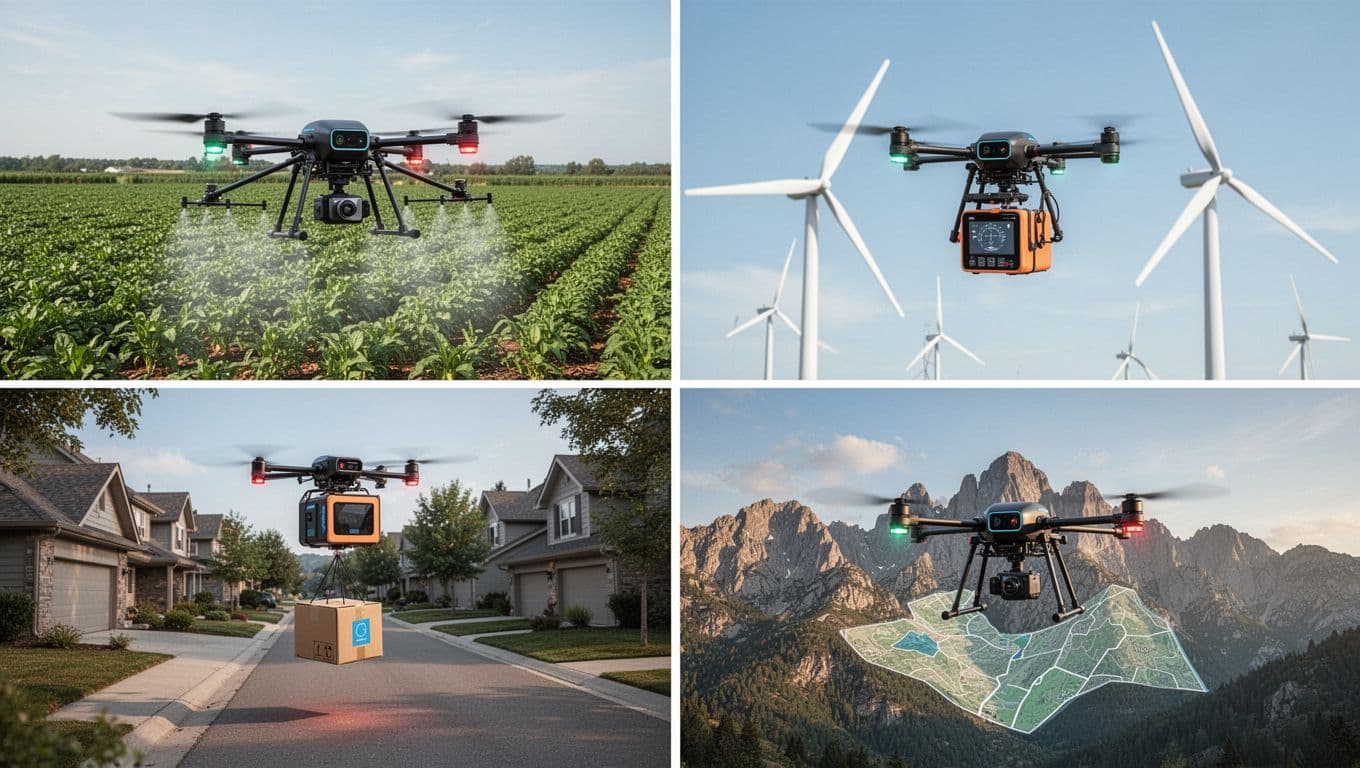
I sort drone demand by use case, because each segment moves for different reasons.
| Segment | What I watch | What it tells me |
|---|---|---|
| Consumer | hobby drones, creator kits, accessories | a mature market, but useful for accessory signals |
| Commercial | filming, real estate, local service shops | demand from small businesses |
| Industrial | utilities, mining, energy, plants | repeat work and larger budgets |
| Defense | ISR, training, counter-UAS | policy-driven spend and faster procurement |
| Agricultural | spraying, crop health, large-acreage use | seasonal and fleet-based demand |
| Delivery | BVLOS routes, parcel pilots, logistics partners | regulation matters as much as tech |
| Mapping | survey work, GIS, site capture | tied to construction and land records |
| Inspection | wind, solar, pipelines, bridges | often the strongest near-term growth signal |
| Software | fleet tools, image analysis, planning apps | higher margins and stickier revenue |
The pattern I trust most is simple, the closer a segment sits to recurring work, the stronger the case. That is why inspection and software catch my eye first.
A dedicated AI drone inspection software report is a good clue here. It tells me the market is not just buying hardware. It is buying analysis, workflow, and asset tracking too.
Consumer drones still matter, but I treat them as a slower signal. Industrial inspection, agricultural operations, and delivery trials tend to reveal real buying pressure sooner.
How I Read Momentum Before It Turns Into Noise

I do not trust a spike by itself. I want a slope, a cluster, and a reason.
If “inspection drone software” rises beside “drone-in-a-box” and “thermal imaging drone,” I see a market forming. If the trend only flashes once, I stay cautious. That is where future tech trends with Exploding Topics helps me, because drone demand often rides alongside AI, automation, and field software.
I also watch for geography. Agricultural drones can surge in one region long before they spread elsewhere. Delivery can look exciting in headlines, but local rules often slow the real rollout. Defense can move faster, yet procurement cycles still shape timing.
A steep chart is interesting. A steady climb with a clear buyer is where I pay attention.
I care about repeat use most of all. One-off novelty sales rarely tell me much. Fleet tools, service contracts, recurring inspections, and crop work usually give me a better read.
Where I See Real Opportunity First
Inspection is the segment I watch most closely. Utilities, wind farms, pipelines, and solar sites all need regular checks. Drones cut risk and save time, so the demand can repeat month after month.
Delivery comes next, but I keep my expectations grounded. Companies like Zipline and Wing have shown the model can work, yet regulation and route design still control growth. That makes it a real market, but not an easy one.
Agricultural drones also have strong logic. Farmers care about labor, coverage, and timing. A drone that sprays, scouts, or maps fields can solve a direct problem. That makes adoption easier to track.
For defense, I look for procurement signals more than social buzz. Policy changes, counter-UAS needs, and training budgets can move the category quickly. Still, this segment follows a different rhythm from civilian markets.
Software is the quiet layer that often tells the truth first. If buyers want better image review, fleet control, or site reporting, the hardware market usually has room to grow behind it. That is where I see the most durable margin.
When I validate a drone market, I ask three things. Who pays, how often, and what could slow adoption? If I can answer all three with confidence, I keep watching. If I cannot, I wait.
What I Do With the Signal
Exploding Topics does not tell me to buy into every rising drone idea. It helps me spot where demand is waking up, then I test whether the market has real use behind it.
That approach keeps me from chasing consumer hype when the bigger money sits in inspection, agriculture, mapping, delivery, or software. It also helps me time the market with more care. When the search curve, the buyer, and the rules all point the same way, I know I am tracking a real shift.
That is the part I trust most, early signal with enough discipline to ignore the noise.
