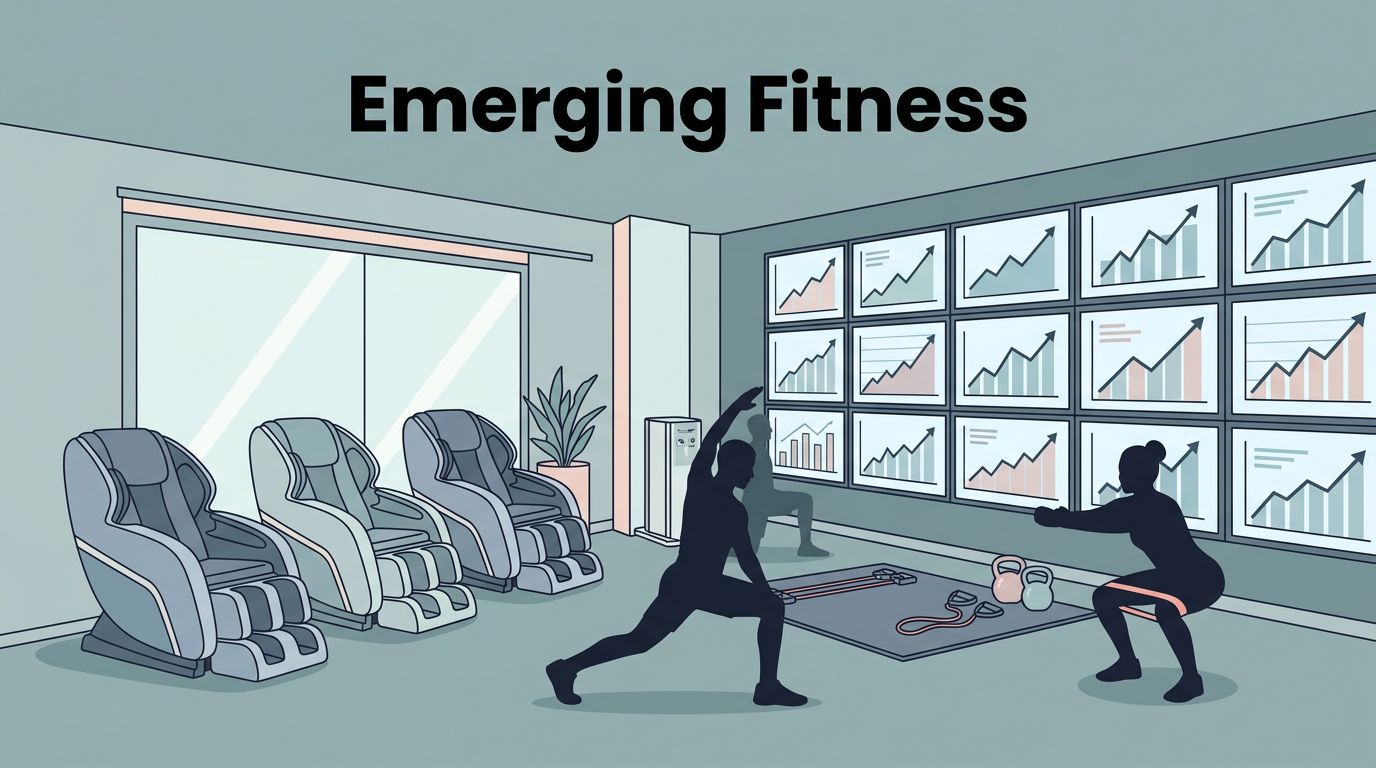
Fitness franchising moves in waves. In April 2026, I keep seeing the strongest momentum around recovery studios, short functional workouts, and tech-backed training.
That matters because many people look at franchise lists too late. I’d rather spot the rise early, then test the business from every angle. I use Exploding Topics as my first screen, and then I check the trend curve, nearby categories, buyer behavior, local demand, competition, and franchise economics before I get excited.
I start with the trend page, not the pitch deck
My first stop is the fitness trend page on Exploding Topics, especially Trending Fitness Topics (April 2026). I’m looking for clusters, not one loud keyword. If recovery, mobility, low-impact training, and longevity keep showing up together, I pay attention.
That’s where I also compare what I see with 25 Top Fitness Startups (April 2026). Startup lists help me separate real business motion from casual interest. If a topic appears in both places, I treat it as a stronger signal.

I also compare what I find with my own notes on how I use Exploding Topics to spot trending business ideas. That keeps me from mistaking a fun chart for a real market.
I read the curve before I read the brand
A fitness franchise can look exciting on the surface and still be too early, too crowded, or too narrow. So I study the shape of the trend line.
A steady climb tells me more than a quick spike. A spike often comes from social buzz, a celebrity post, or short curiosity. A slow rise across months suggests people are building a habit.

Here’s how I read the curve:
| Curve shape | What I think | What I do next |
|---|---|---|
| Sharp spike | Interest may be temporary | I wait and watch for follow-through |
| Steady climb | Demand may be forming | I check related searches and buyer intent |
| High plateau | The idea may already be mature | I look for sub-niches or better positioning |
| Small but rising line | Early signal, still thin | I test with low-cost validation |
A sharp spike gets my attention. A steady slope gets my time.
When I want a second opinion, I use starting with Exploding Topics over search volume tools to remind myself that early trend detection should come before keyword volume. Search data is useful, but it often shows up after the crowd has noticed.
I compare adjacent categories before I commit
This step saves me from chasing the wrong version of a trend. For example, pickleball, EMS training, recovery studios, Pilates, and short bootcamp formats can sit close together, but they don’t all behave the same way.
A category might be hot because it feels social. Another might work because it solves pain. A third might win because it fits a busy schedule. I want the one with the strongest buying logic.

In April 2026, the most promising concepts I keep seeing are recovery and wellness studios, short functional group workouts, and premium specialty formats. That matches what I see in best fitness franchises to own in 2026, where concepts like Restore Hyper Wellness, StretchLab, Fit Body Boot Camp, Burn Boot Camp, and Beem Light Sauna keep showing up as useful comparables.
I don’t treat those names as guarantees. I use them to answer a better question: which adjacent category has the clearest path to recurring demand?
I validate the idea with real buying signals
Once a fitness concept looks promising, I slow down and check the business behind it. This is where the trend becomes a market test.
I look at five signals side by side:
| Signal | What I check | What I want to see |
|---|---|---|
| Search demand | Rising interest over time | More than one brief spike |
| Consumer behavior | Reviews, forums, social comments | Real pain, time pressure, or repeat use |
| Location trends | Dense suburbs, affluent pockets, wellness-heavy areas | Places where memberships can stick |
| Competition | Strong players versus copycat clutter | Room for a clear position |
| Franchise economics | Fee structure, build-out, staffing, royalty load | A model that can support the unit |
I use this same habit when I compare a franchise idea with investment trends in 2026. The point is simple, a hot category still needs decent economics.
I also cross-check with fast-growing industries in 2026. If fitness demand lines up with broader wellness or consumer behavior shifts, I take the idea more seriously.
My quick checklist for an emerging fitness franchise
Before I move forward, I ask myself these questions:
- The trend line is rising for months, not days.
- The category solves a clear problem, like pain, time, or recovery.
- Nearby categories show the same customer need.
- The local market can support memberships or repeat visits.
- The franchise model leaves room after fees and build-out costs.
- The competition has gaps I can explain in one sentence.
If I can’t answer those cleanly, I keep looking.
Emerging fitness franchises are easiest to spot when the trend is still forming, but the buying pattern already makes sense. That is why I start with Exploding Topics, then I work outward into curves, neighbors, customers, and unit economics.
The best franchise ideas rarely shout first. They usually look small, useful, and slightly ahead of the crowd.