How I Analyze Emerging Tech Startups Early With Exploding Topics
Most startup lists arrive late, when the crowd already knows the name. I use Exploding Topics to spot movement earlier, then I test whether that movement points to a real business or just a loud week online. That matters with emerging tech...

Most startup lists arrive late, when the crowd already knows the name. I use Exploding Topics to spot movement earlier, then I test whether that movement points to a real business or just a loud week online.
That matters with emerging tech startups. A few months can change entry price, content difficulty, partner access, and product timing. My rule is simple: first, find a rising topic; next, find the startup inside it; then, validate traction with outside proof.
How I spot startup trends before they look obvious
I start with Exploding Topics’ Trending Startup Topics, not company names. Categories usually move before brands do. If I search for a startup first, I can miss the bigger wave behind it.
Then I compare those themes with the current technology startup list. I want overlap, but I treat each list as a dated snapshot, not a live market report. I record when I checked it and revisit the examples before acting. The useful question is which technologies solve a costly task, not whether a category looks popular this month.
That last part matters. I don’t get excited by broad buzz alone. I want startups tied to a painful task. AI voice agents for customer service fit. So do AI research tools, forecast engines, and warehouse AR workflows. They save time, cut labor, or reduce error. That’s where budgets usually appear first.
Retell AI is a useful example of how to investigate a signal, not proof that a company is a good investment or a fit for every business. Retell’s documentation describes tools to build, test, deploy, and monitor voice and chat agents. Its integration guide lists CRM, support, knowledge, and scheduling connections. Its public changelog gives reviewers a place to check product and policy updates. These are useful first-party product signals. They do not, by themselves, prove customer retention, broad adoption, revenue, or independent security certification. Treat company-published customer stories and performance figures as claims to verify with the customer or another independent source.

Before I go deeper, I run a fast first-pass checklist:
- Real pain: Does the startup solve a costly, annoying problem?
- Trend shape: Is growth steady for months, not one sharp spike?
- Buyer clarity: Can I name the team or budget that would buy it?
- Strategic fit: Does the product solve a known problem that matters to a real buyer?
I don’t chase a curve by itself. I chase a curve tied to a clear problem.
My framework for separating hype from sustainable traction
A rising chart is only the first clue. I use the checks below to compare interest, product progress, customer demand, business fit, and risk. The table is a prompt for investigation, not a pass score. I give more weight to independent evidence than to several reports repeating the same company claim.
Here is the framework I use:
| Signal | Evidence to collect | Warning sign or next question |
|---|---|---|
| Market interest | Search interest over time, category demand, buyer questions | One spike, unclear search intent, no named buyer |
| Product progress | Working product, dated releases, integrations, test results | Demo only, roadmap promises, no independent test |
| Customer adoption | Repeat use, renewals, customer references, detailed reviews | Logo list without usage, one-off pilot, no baseline |
| Team and funding | Dated hiring plans, credible funding reports, roles tied to delivery | Funding treated as revenue, stale roles, unclear source |
| Business fit | Clear problem, buyer, budget owner, measurable outcome | No workflow owner or expected return |
| Cost and risk | Total setup and operating cost, security and legal review | Hidden integration work, unclear data or IP terms |
| Competition | Direct alternatives, differentiation, customer switching costs | Many similar products with no clear reason to choose one |
The takeaway is simple: one signal tells me interest exists; several independent signals give me a stronger reason to investigate. I do not treat a fixed signal count as proof. Search growth, press coverage, and social posts can all come from the same launch or viral moment, so I ask whether each piece of evidence has a separate source.
Look beyond trend databases for early technology signals
A trend database is a discovery tool. It can show that attention is rising, but it cannot tell me whether the technology works, who will pay for it, or whether a company can deliver it. I use other sources to test those questions:
- Academic papers and university labs: Search Google Scholar for new methods, repeated research results, and active research groups. Papers can show technical progress or a research bottleneck. They do not prove a product is reliable, affordable, or ready for customers.
- Patents: Search the USPTO patent database or WIPO PATENTSCOPE for patent filings and related claims. A cluster can show where organizations are seeking intellectual property protection. It does not show that a patent will be granted, that the invention works at scale, or that customers want it.
- Standards bodies and industry groups: Check groups such as NIST Standards.gov and relevant trade associations. Draft standards, shared test methods, and interoperability work can signal that an industry is preparing for a technology. Standards activity is not the same as market adoption, and a standard can take years to settle.
- Trade shows, demos, and vendor conversations: Watch for products that can be tested, not only described in a pitch. Ask what works today, what is still on the roadmap, and what a deployment needs. A polished demonstration proves that a demo ran. It does not prove safe performance in a real customer’s environment.
- Industry reporting and established-company activity: Look for independent reporting, acquisitions, partnerships, and documented pilots. These can reveal buyer interest and strategic pressure. A press release or investment announcement is a lead to verify, not evidence of product-market fit.
- Public pilots and real deployments: Seek named customers, deployment dates, defined use cases, and results with a clear baseline. A pilot can confirm that a system was tested in a limited setting. Ask whether the customer renewed, expanded, or stopped the project before calling it adoption.
I also compare Google Trends with the trend platform’s own graph, company product updates, job listings, customer reviews, and funding announcements. These sources measure different things. Search interest measures queries, not sales. Hiring can suggest a team’s priorities, not prove that a product works. Funding shows investor commitment, not customer demand. The goal is not to find one perfect metric. It is to see whether independent evidence points in the same direction.
Separate startup traction from technology readiness
A startup can attract attention before its product is ready. A mature technology can also sit inside a company with weak sales or poor customer retention. I score these questions separately so one strong area does not hide a weakness in the other.
- Technical readiness: Can the product perform the core task in the setting where it will be used? Look for a working prototype, measured test results, a pilot, or repeated deployments. Ask about reliability, failure handling, speed, support, and integration needs.
- Customer adoption: Are customers returning, renewing, expanding usage, or connecting the product to daily workflows? Look for customer-side references, repeat use, reviews with detail, integrations, and case studies that explain the baseline and time period. A logo wall alone is weak evidence.
- Business fit: Does the product solve a known problem on your roadmap? Name the owner, buyer, budget, and outcome before evaluating a vendor. A useful technology can still be the wrong priority for a particular company.
- Economics and operations: Estimate total cost, including software, setup, data cleanup, hardware, training, support, and ongoing oversight. Compare that with a specific expected benefit. Include the staff time needed to monitor and maintain the system.
- Risk: Ask technical, legal, security, privacy, and procurement teams to review data flows, access controls, regulatory duties, vendor dependencies, and intellectual property terms. A company’s website is not a substitute for a security review or contract review.
For a simple scorecard, rate each area from 1 to 5 and attach a source to every score. Mark unknowns as unknown, not as a neutral 3. If adoption looks promising but security evidence is missing, the next step is to close that gap, not average the scores and declare a win.
Use a decision path: watch, investigate, pilot, adopt
A signal becomes useful when it leads to a clear next step. I use four stages, with an owner and a reason to move forward at each one:
- Watch: Put the topic or company on a list when attention is rising or a credible technical signal appears. Record what would change your view, then review it on a set date. Do not spend money just because a chart moved.
- Investigate: Move forward when more than one independent source supports the problem and the product. Speak with potential users, check the product yourself where possible, and ask the vendor for customer references, technical limits, pricing, and deployment requirements. A product or research lead can own this stage with input from the teams affected.
- Pilot: Run a small, time-limited test when the problem matters, the core function works, and the main risks have an owner. Set a baseline, success measures, budget cap, data rules, and stop conditions before the test starts. Include the users who will do the work, not only the project sponsor.
- Adopt or stop: Expand only when the pilot meets its agreed targets, the full cost makes sense, and technical, legal, security, and operational reviewers accept the remaining risks. If results miss the mark, stop or revise the test. A pilot is not a success just because it launched.
This review helps limit hype and groupthink. A technical reviewer can challenge product claims. A customer-facing team can test whether the problem is real. Security and legal teams can flag data or contract issues. Finance or operations can check cost and rollout effort. For a small team, one person may cover several roles, but the questions should still be asked.
Make the research workflow repeatable
Set aside an hour each week for discovery, then hold a monthly review for items on the watchlist. Use the same record each time: company or technology, problem, source, date checked, evidence, uncertainty, risk, owner, and next decision. This makes changes visible and stops old screenshots from looking like current proof.
- Scan themes: Review trend categories and note a few changes that connect to a real customer or business problem.
- Find companies: Identify startups in those categories. Record what each product does, who buys it, and the source for those claims.
- Check activity: Review product updates, hiring, funding, customer evidence, integrations, and signs of repeat use. Note the date and whether each source is company-produced or independent.
- Challenge the signal: Look for evidence that could disprove the idea, such as failed pilots, declining use, high implementation cost, poor reviews, technical limits, or a regulatory barrier.
- Choose a next step: Assign watch, investigate, pilot, adopt, or stop. Name the person responsible and the date to review again.
Worked example: what the public evidence says about Retell AI
Retell AI makes the process concrete. Its product documentation describes a platform for building, testing, deploying, and monitoring voice and chat agents. The integration guide lists connections across CRM, support, knowledge, and scheduling tools. The company’s changelog lets a reviewer inspect product and policy updates over time. Together, those sources support a limited conclusion: the product has documented functions, integration options, and ongoing public updates.
They do not answer the next questions for a particular buyer. Can an agent handle your call types accurately? What happens when it cannot? How does it handle consent, sensitive information, and escalation to a person? What are the true costs per completed interaction? Does the customer renew after a pilot? A buyer should test these with call samples, a controlled pilot, customer references, and a review of current security and contract documents.
My decision from public materials alone would be investigate, not adopt. That is a conclusion about the evidence available in this example, not a verdict on Retell AI. A real company should choose its stage based on its own use case, current documents, and independent checks. Verify time-sensitive product, pricing, and compliance details directly before relying on them.
Match the analysis to the reader’s decision
Investors can use trend research to build an early screening list, then examine customers, financials, market size, competition, and company-specific risks. A rising topic is not proof of company value and this process is not investment advice. Operators and product teams should focus on workflow fit, integration, total cost, security, and measurable pilot results. Marketers should use trend signals to test audience interest and plan useful content around a buyer problem, not to assume a startup will become a market leader.
In every case, keep observations separate from interpretation. “The company lists an integration” is an observation. “The integration proves enterprise demand” is an interpretation that needs more evidence. That distinction makes the final decision easier to explain and revise.
I also cross-check with the latest fast-growing companies roundup. If a startup theme appears there too, I ask why. Is the market broadening, or is one winner soaking up all demand?
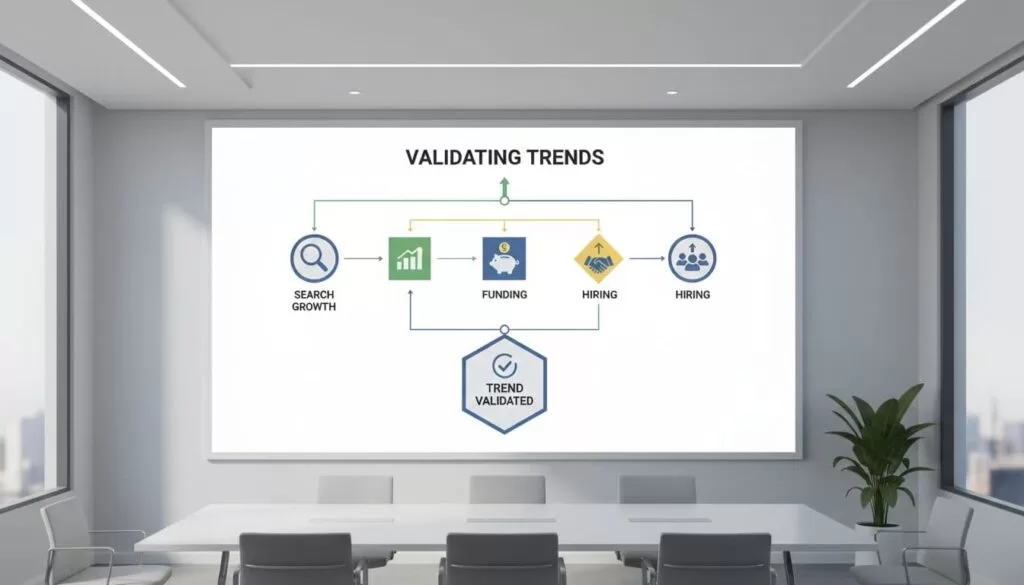
This is where hype usually cracks. A flashy demo may get social shares, yet have no repeat product use, product updates, or sign of a budget owner. Funding totals can add context, but only when a source defines the year, geography, and market category. Even then, funding is not the same as customer demand. I leave out totals I cannot verify and look for evidence tied to the specific company and use case.
AI cybersecurity and automation tools often sit in the middle. They can spike fast, so I watch for proof that the startup is moving past a clever demo. Are teams hiring sales staff? Are they shipping product updates? Are buyers talking about them without being prompted? That’s when I start taking the signal seriously.
How I use early startup signals in real work
For investing decisions
If I’m building an investment watchlist, this is an early screening step, not a way to estimate a company’s value. Exploding Topics helps surface a theme. I then examine company-level evidence such as customers, financials, market size, competition, leadership, and risks before making any investment decision.
Rising search interest, hiring, and funding can help me decide which companies deserve more research. They do not prove fair value, predict a return, or replace independent due diligence. I record the source and date for each signal, then check whether it reflects current activity.
For operators and product teams
When I work like an operator, I use this process to spot adjacent products and partner ideas. If AI voice agents rise, I don’t only look at the agent company. I look at QA tools, compliance layers, workflow routing, and data security around it.
That helps me avoid building in the dark. A trend map becomes a roadmap filter.
For marketers
If I’m planning content or category pages, I want topics before they harden into crowded keywords. Exploding Topics helps me see that window. Then I write around the buyer problem, not just the startup name.
For example, a marketer can create content around AI customer support quality, secure voice automation, or warehouse AR workflows before the market gets packed with lookalike articles. If social chatter is loud but product proof is thin, I wait. If the conversation is smaller but buyers sound serious, I move early.
Conclusion
Exploding Topics gives me the first signal, not the final answer. I still need to test search growth, funding, hiring, launches, discussion, and competition. When those signals line up, emerging tech startups stop looking like guesses and start looking like opportunities I can explain, defend, and act on.
