Hunter.io Email Validation API: Developer Guide 2026
Bad bounces kill campaigns. You build a lead list, hit send, and watch your sender score tank because half the emails flop. I fix that with Hunter.io’s email validation API. It checks addresses in real time so I send only to live mail...


Bad bounces kill campaigns. You build a lead list, hit send, and watch your sender score tank because half the emails flop. I fix that with Hunter.io’s email validation API. It checks addresses in real time so I send only to live mailboxes. Developers love it for clean data flows.
This guide shares my exact setup. I cover API calls, responses, and production tips. You’ll integrate it fast and cut risks.
Why Hunter’s Email Verifier Fits My Stack
Hunter’s API stands out because it stacks checks like MX records, SMTP pings, and catch-all flags. I use it after finding emails via domain search. No more guessing deliverability.
It flags disposables and role accounts too. For example, info@ bounces less but replies even less. The tool scores confidence from 0 to 100. Higher means safer sends.
Plans run on credits. Each verify costs one. Free tier gives 50 monthly. Paid starts cheap for teams. I check Hunter.io’s full review for B2B verification to track changes.
Bulk UI helps tests, but API shines for apps. I pair it with CRMs or forms. Results cut my bounces below 1%.
Set Up Authentication Quick
Grab your API key from Hunter’s dashboard. It’s free to start. Add it to every call like this: ?api_key=YOUR_KEY.
Endpoint stays simple: https://api.hunter.io/v2/email-verifier. Pass the email param. GET requests work fine. No SDK needed yet.
Test in curl first. I script it for loops later. Credits deduct per call, so watch quotas.
Making Your First API Call
Paste this curl and swap your key:
curl -G "https://api.hunter.io/v2/email-verifier"
  --data-urlencode "email=patrick@stripe.com"
  --data-urlencode "api_key=YOUR_KEY_HERE"
It pings in seconds. I run it on scraped leads before CRM sync. Success returns JSON with status.


Node.js example next. Fetch wraps it easy:
const response = await fetch(`https://api.hunter.io/v2/email-verifier?email=${email}&api_key=${apiKey}`);
const data = await response.json();
Python uses requests. Same pattern. I log calls for audits.
Parsing the API Response
Responses pack details. Core fields: status, score, email. Status hits valid, invalid, accept_all, disposable, unknown.
Sample for a good one:
{
  "data": {
    "status": "valid",
    "score": 100,
    "email": "patrick@stripe.com",
    "is_disposable": false,
    "sources": ["public sources"],
    "mx_records": true,
    "smtp_provider": "Stripe's server"
  }
}
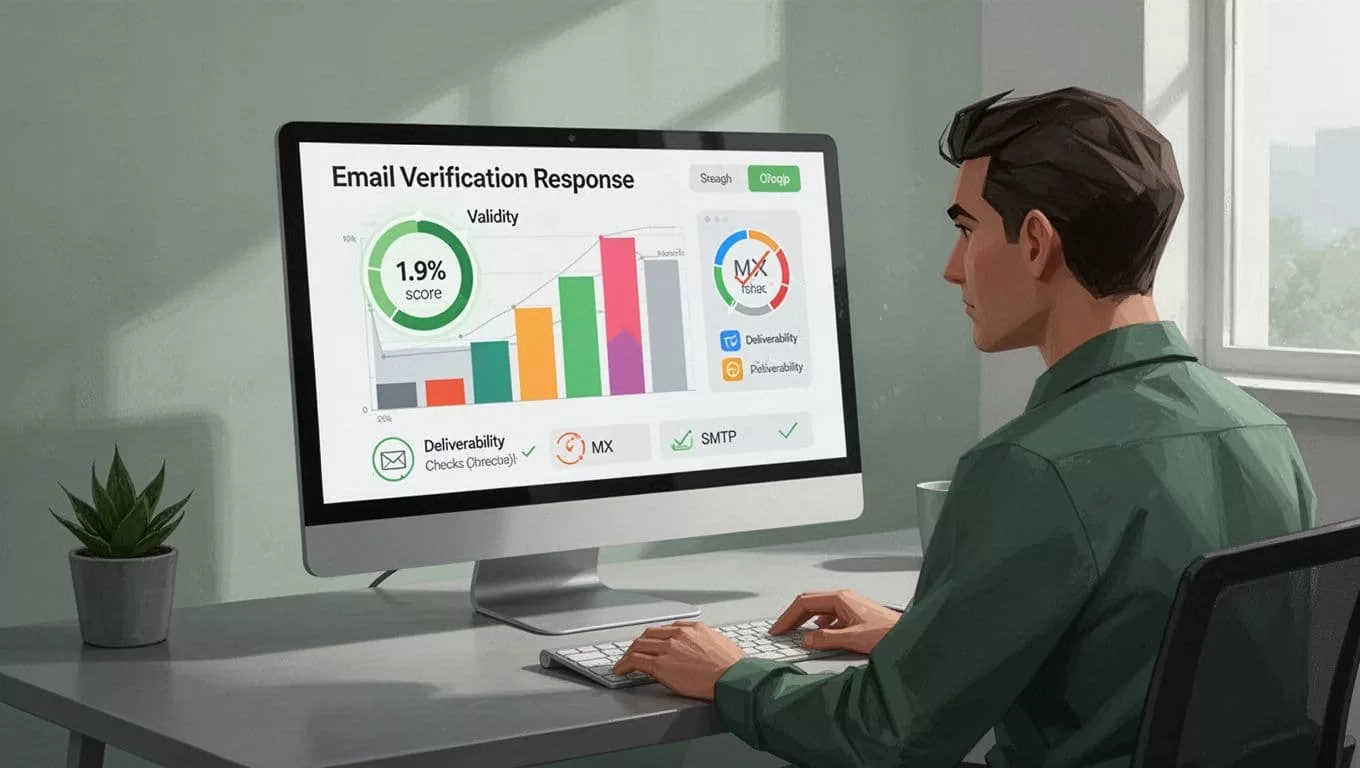
Parse score first. Above 80? Send. Below? Review. accept_all needs caution; servers eat all inputs.
I map statuses to actions: valid goes live, invalid suppresses forever.
Key Fields Every Developer Tracks
Focus on these for logic:
| Field | What It Means | My Use |
|---|---|---|
| status | Valid/invalid/etc. | Gatekeeper for sends |
| score | 0-100 confidence | Tier lists by risk |
| is_disposable | True/false | Block temp mails |
| webmail | True/false | Flag free providers |
| catch_all | True/false | Slow-roll high-value |
MX and SMTP confirm servers. Sources show origins. I store them in databases.
For bulk, loop calls. But check my Hunter.io bulk email verification workflow for CSV tips.
Errors hit 400 for bad input, 402 for no credits, 401 for wrong key. Retry 429s exponential.
Production Best Practices I Follow
Rate limits tie to credits, not seconds. High plans handle volume. I batch small, cache results 30 days.
Wrap in try-catch. Retry failed SMTP on unknowns. Log everything.
Integrate at capture: forms call API before save. I use it post-domain search too.
Compare via Hunter Email Verifier API docs. Test edges like Gmail.
Scale with webhooks if needed. Always verify docs for 2026 tweaks.
Hunter’s email validation API slots into pipelines clean. I cut bounces, protect reps, and scale outreach. Start with your key today. Test a list, watch scores rise.
What pains you most on validation? Drop it below.
(Word count: 982)

