How I Use Hunter.io as a Free Email Verifier Online in 2026
A list can look clean and still hold dead inboxes. One typo, one closed mailbox, or one catch-all domain turns a good outreach plan into bounces. An email verifier online checks each address before you send. Hunter.io offers one of the simp...

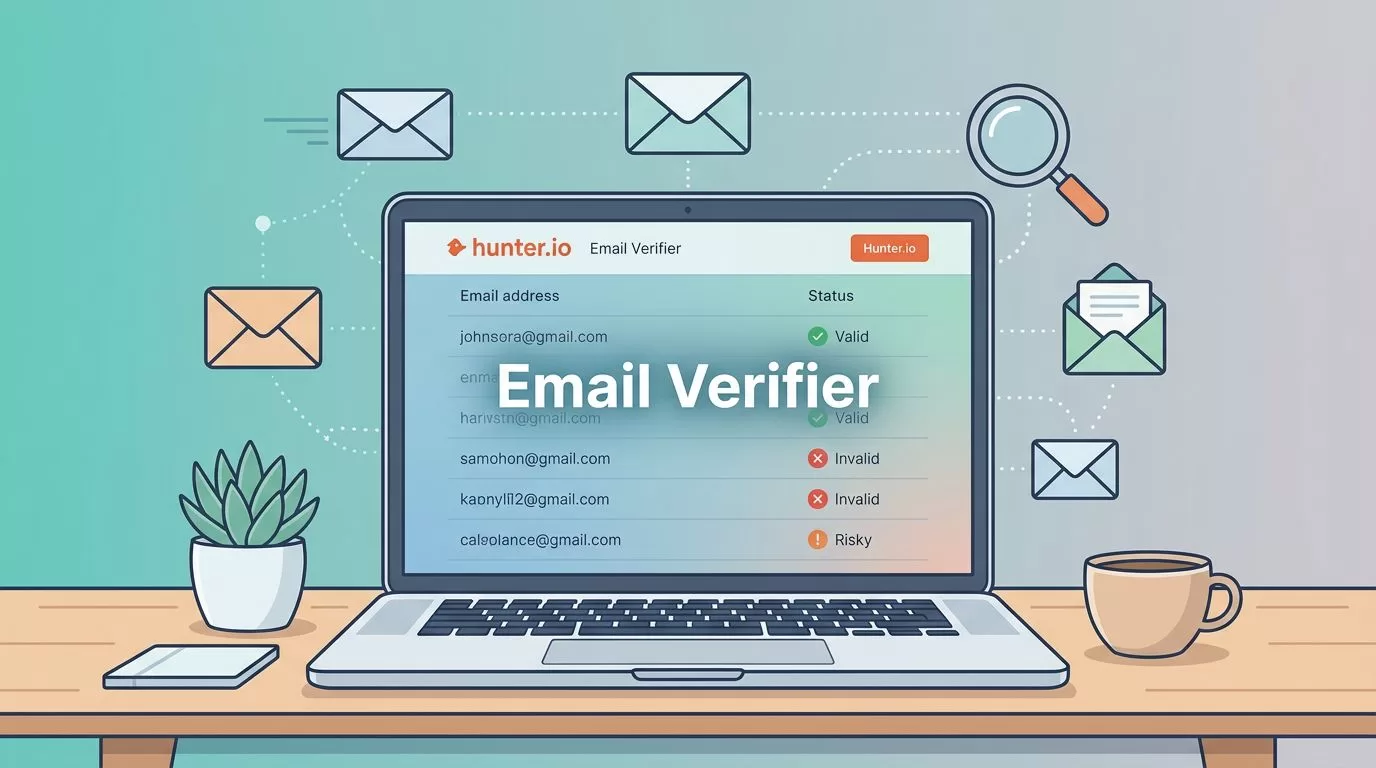
A list can look clean and still hold dead inboxes. One typo, one closed mailbox, or one catch-all domain turns a good outreach plan into bounces. An email verifier online checks each address before you send. Hunter.io offers one of the simplest options.
This guide explains what the Hunter verifier checks, how to read each status, and what to do next. You also get a credit plan for the free tier, a bulk workflow, a worked example, and a bounce response routine.
Why verify email addresses before you send
Hunter lists the risks on its email verification guide. Typos, inactive domains, server rejections, and spam traps all damage deliverability. Verification lowers sending costs, protects sender reputation, and keeps campaign stats accurate.
Verification is risk reduction and not a guarantee. Hunter states verification does not remove all bounces, because an invalid recipient address is not the only reason for a bounce. Full inboxes and server blocks also cause failures.
What verification cannot do
- Guarantee a reply or a click.
- Guarantee inbox placement. Message content, sending setup, and past engagement also matter.
- Prove a mailbox exists on an accept-all domain.
- Replace consent and privacy checks.
- Keep a list clean for months without a recheck.
Keep these limits in mind when you set goals. Use verification to cut obvious waste. Do not expect verification to fix a weak offer or a poor message. Good outreach needs a clean list, a clear reason to write, and a respectful tone.
What the Hunter email verifier checks
Hunter explains its method on a page about how email verification works. The tool runs several checks in sequence.
| Check | What Hunter does | Result when the check fails |
|---|---|---|
| Syntax | Tests the format, such as a single @ sign | Invalid |
| Gibberish detection | Flags random character strings | Invalid |
| Address type | Detects webmail providers such as Gmail and Outlook | Webmail flag |
| MX records | Looks for a mail exchanger record on the domain | Invalid |
| SMTP check | Connects to the mail server and asks whether the server accepts the address | Valid, invalid, or accept-all |
The SMTP check does the heavy lifting. Hunter calls the method SMTP tickling. The tool never sends a message. The tool only asks the server whether the server would accept the address.
How to verify a single email in five steps
Hunter documents the flow in its help guide on verifying addresses. Follow the same steps.


- Open the Verifier tool in your Hunter account, or use the public Email Verifier page.
- Enter one email address.
- Click Verify.
- Wait a few seconds. Hunter keeps checking in the background when a server responds slowly.
- Read the status and decide to use, review, or drop the address.
Check fresh leads before the first message. Check older lists again before you upload them to a campaign. Addresses go stale as people change jobs and companies close domains.
A worked example with three addresses
Take a fictional list from North Peak Labs. You hold three addresses and need a decision for each.
| Address | Likely status | Decision |
|---|---|---|
| jane.miller@northpeaklabs.com | Valid | Send in the first batch |
| info@northpeaklabs.co | Invalid, domain has no MX record | Remove and check the domain spelling |
| sam@northpeaklabs.com | Accept-all with a mid confidence score | Hold for a small test batch |
The second address shows a common error. A single wrong letter in the domain produces a dead address. The MX check catches this fast. The third address shows why accept-all needs a plan. Send the valid contacts first and watch the bounce count.
Bulk email verification for lists
Large lists need a batch workflow. Prepare the file first, then run the job, then sort the output.

- Export contacts to a CSV file with one email per row.
- Remove exact duplicates and obvious typos such as gmial.com.
- Run the batch through Hunter bulk tools.
- Sort results by status.
- Import valid contacts only. Hold accept-all contacts in a separate segment.
Read the current Hunter documentation for file limits and credit use before you upload a large file. Credit costs differ by tool, and Hunter updates the rules over time.
How to read each verification status
The Hunter help guide describes four outcomes in the app. The Hunter API documentation lists more detailed statuses for developers. Use the table to match each result with an action.

| Status | Meaning | Your action |
|---|---|---|
| Valid | Passed all checks and is deliverable | Add to your list |
| Invalid | Failed one or more checks | Remove the address |
| Accept-all | Server accepts every address at the domain | Treat with care, send a small test batch |
| Blocked | Server blocked the check, with no credits charged per the help guide | Retry later or find another source |
| Unknown | Verification failed, often because of a slow or protected server | Retry, then drop or source another address |
| Webmail | Personal provider such as Gmail | Decide whether a personal address fits your outreach |
| Disposable | Temporary address service | Remove the address |
\n\nAn accept-all result is not a green light. Treat the result as a yellow light.
\n\n\n
The confidence score for accept-all domains
Accept-all domains hide the truth. The server says yes to every address, so no verifier can prove a mailbox exists. Hunter suggests using the confidence score for these results. Scores of 90 to 95 percent or higher usually point to better deliverability. Hunter also calls the score an indication and not a guarantee.
- Send accept-all contacts in small batches.
- Watch bounces after each batch.
- Prefer contacts with a high score and a pattern match on the domain.
- Drop contacts with a low score unless the contact has high value.
Hunter free plan limits and credit costs
The free account gives you 50 credits per month, per the Hunter pricing page. Credits are shared across tools. Verifying an email costs 0.5 credit. Finding an email costs 1 credit. Duplicate searches count once per billing period.
| Plan | Monthly price | Annual, per month | Credits per month |
|---|---|---|---|
| Free | $0 | Not applicable | 50 |
| Starter | $49 | $34 | 2,000 |
| Growth | $149 | $104 | 10,000 |
| Scale | $299 | $209 | 25,000 |
At 0.5 credit per check, 50 credits cover about 100 verifications if you use no other tool. Plan your month before you start. The Starter plan adds auto-verification and lead enrichment, per the pricing page. Check the official page for current terms.
A bounce response routine
Even verified lists bounce sometimes. Build a routine before your first send.
- Send a small first batch of 20 to 50 contacts.
- Record every bounce and the reason.
- Remove hard bounces from your list at once.
- Pause the campaign when bounces rise.
- Re-verify the rest of the list after a spike.
- Check the domain pattern for the company when several addresses fail.
Treat each bounce as data. A cluster at one domain often points to a wrong pattern or a closed company.
Pre-send checklist
Run this list before every campaign. The list takes two minutes and saves your sender reputation.
- Confirm every address carries a valid status from a recent check.
- Separate accept-all contacts into their own batch.
- Remove disposable and invalid addresses.
- Decide how to handle webmail addresses.
- Review your message for a clear reason to write and an opt-out line.
- Set a stop rule, such as pausing when bounces climb.
Common mistakes with email verifiers
- Treating valid as a promise of a reply. Valid means deliverable, nothing more.
- Ignoring accept-all results and sending at full volume.
- Verifying once and sending months later.
- Skipping typo checks on signup forms.
- Burning free credits on addresses you will not use.
Verification also helps at the signup point. Hunter recommends capturing verification when contacts join your list, then cleaning your list on a regular schedule. Hunter gives no fixed interval, so choose an interval to match your send volume.
Use cases beyond sales outreach
- Recruiting: check work addresses before you send a candidate note.
- Partnerships: confirm a press or partner address still exists.
- Newsletters: filter bot signups and typos from your list.
- Link building: test addresses found on author pages.
- Event invites: clean attendee lists before a mass send.
Respect privacy rules for each use. CAN-SPAM, GDPR, and CCPA differ by country and by use. Confirm requirements with official sources or a lawyer.
Frequently asked questions
Is the Hunter email verifier free?
The free account gives you 50 credits per month. Verification costs 0.5 credit per email, per the pricing page. Paid plans add more credits.
What does accept-all mean?
The server accepts mail for any address at the domain. Hunter cannot confirm the individual mailbox. Use the confidence score and send small batches.
Does a valid status guarantee delivery?
No. Hunter states verification does not remove all bounces. Full inboxes and server rules can still block mail.
Does verification send an email to the person?
No. The SMTP check asks the mail server whether the server accepts the address. The check does not send a message.
How often should you re-verify a list?
Hunter advises regular cleaning and gives no fixed interval. Re-verify before every large campaign, and sooner for lists with high job turnover.
Can you verify emails in bulk?
Yes. Hunter offers bulk tools. Check the current help pages for file limits and credit rules before you upload.
Conclusion
An email verifier online protects your sender reputation before you send a single message. Hunter checks syntax, gibberish, address type, MX records, and SMTP acceptance. Read each status with care and treat accept-all as a yellow light. Plan your 50 free credits, verify before every campaign, and keep a bounce routine ready. Check the Hunter pricing and help pages for current limits.

