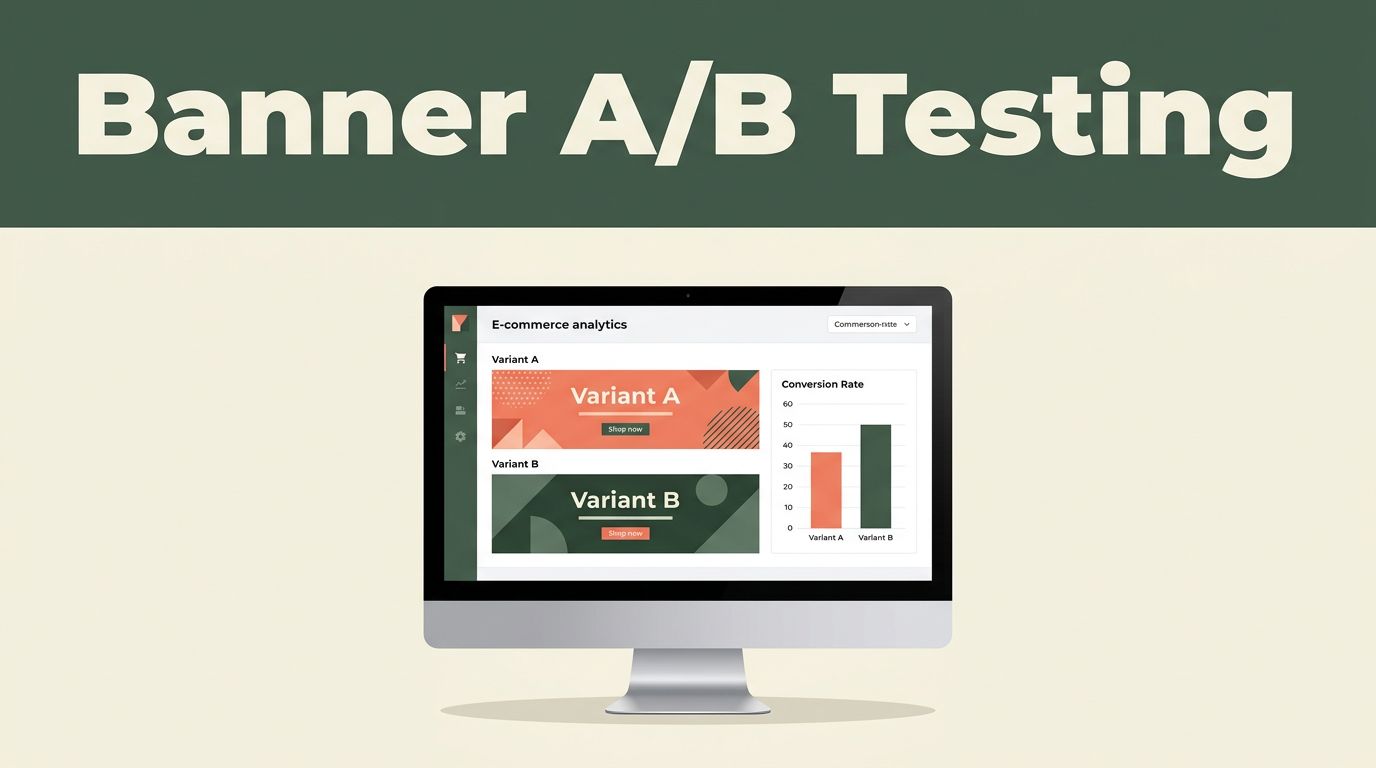
A banner can increase purchases, or it can cover the content customers need to make a decision. Promotional banner A/B testing helps you separate useful offers from visual noise before rolling a change across your store.
Mida.so gives ecommerce teams a way to test banner copy, offers, placements, and calls to action without waiting for a full development cycle. The tool only provides useful evidence when your goal, audience, tracking, and decision rules are set before launch.
Key Takeaways
- Test one clear banner hypothesis at a time.
- Compare purchases, revenue, and qualified actions, not clicks alone.
- Review mobile, desktop, paid, organic, and returning visitor segments.
- Check traffic allocation and event tracking before reading conversion rates.
- Treat early results as directional until the test meets your sample and duration rules.
Start With a Banner Problem, Not a Design Preference
“Make the banner stand out” isn’t a useful testing brief. It doesn’t identify a customer problem or a business outcome.
Start with the behavior you want to change. Customers might miss a free-shipping threshold, overlook a seasonal offer, or reach checkout without understanding delivery timing. Each problem supports a different test.
A practical hypothesis looks like this:
Changing the announcement bar from “New arrivals are here” to “Free shipping on orders over $75” will increase completed purchases because it gives shoppers a clear financial reason to continue.
The hypothesis contains three parts:
- The exact banner change.
- The primary action you expect to improve.
- The reason the change should affect that action.
Keep the first test narrow. Compare one control against one meaningful variant. If you change the headline, color, offer, icon, and placement together, you may get a result without knowing which change caused it.
Mida’s public announcement bar page describes customizable banners that can be created without coding. Use that capability to test focused changes such as:
- Control: “Shop our latest collection”
- Variant: “Get 15% off orders over $100”
- Control CTA: “Shop now”
- Variant CTA: “Claim the offer”
- Control placement: Top announcement bar
- Variant placement: Sticky bar near the bottom of the mobile viewport
The offer must be valid and easy to understand. Don’t promote free shipping if the customer must search through several pages to find the threshold. Don’t use “Claim the offer” when no code, discount, or visible benefit exists.
For ecommerce teams reviewing the full purchase path, Mida’s checkout conversion guidance provides useful context for reducing friction after the banner earns the click.
Choose the Right Banner Variable to Test
A promotional banner can change several parts of the customer experience. Prioritize the variable linked to your hypothesis.
Copy is useful when the current message is vague. Test a clear benefit against a general announcement. “Free returns for 30 days” gives customers more information than “Shop with confidence.”
Offer framing matters when the same incentive can be presented in different ways. Compare “Save $20 on orders over $100” with “Get 20% off your next order.” Keep the actual economic value comparable before comparing the wording.
Call to action affects the next step. Use action-oriented language that matches the landing page. “Shop women’s jackets” is stronger than “Learn more” when the banner links to a jacket collection.
Placement controls visibility and interruption. A top bar is easy to scan but may be ignored. A sticky mobile bar stays visible but can block content or checkout controls. Test placement only when the location is the likely cause of poor performance.
Audience determines who should see the message. New visitors may need a first-order incentive. Returning customers may respond better to early access, loyalty points, or a replenishment reminder.
Don’t test an offer against a message with no offer and then assume the wording caused the entire lift. That comparison measures incentive strength, copy, and urgency at once. It can still be useful, but label the test accurately.
Before launch, record the current baseline. Include conversion rate, revenue per visitor, banner click rate, traffic mix, and the percentage of visitors using mobile devices. A blended site average can hide a weak mobile experience or a paid channel with poor customer quality.
Build Promotional Banner A/B Testing in Mida.so
Mida.so is positioned as a no-code A/B testing and CRO platform. Public product information lists visual editing, conversion tracking, goals, audience targeting, reporting, and GA4 integration among its capabilities. Workspace settings and plan availability can differ, so confirm the exact options in your account before promising a workflow to stakeholders.


Use this implementation sequence:
- Select the target URL. Start with a page where the banner has a clear job, such as a product collection, product detail page, or cart entry point.
- Create the control. Use the current banner without changing its existing copy, placement, or display rules.
- Create one variant. Change the single element named in your hypothesis.
- Define the primary goal. Select a completed purchase when the banner is intended to generate revenue. Use a product view, email signup, or checkout start only when that action matches the test stage.
- Set the audience rules. Include the device, URL, geography, campaign, or visitor type that fits the hypothesis.
- Check exclusions. Remove internal traffic, bots, conflicting experiments, and visitors who should not see the promotion.
- Set traffic allocation. A 50/50 split gives both experiences similar exposure. Small differences are normal. A large gap requires investigation.
- Launch without changing the conditions. Don’t edit the offer, audience, traffic allocation, or goal during the active test.
Your event setup needs the same discipline as your banner setup. Confirm that the view, click, and purchase events use consistent definitions across the control and variant. If you build a custom tracking pixel or event, inspect the browser tools and confirm it fires once and only once for each successful action.
Duplicate purchase events can make a weak banner look profitable. Missing events can make a strong banner look ineffective. Test a successful purchase, a failed payment, a page refresh, and a return visit before trusting the report.
Measure More Than Banner Clicks
Banner clicks are useful diagnostic data. They aren’t always the business result.
A message can increase clicks by attracting bargain hunters who abandon the cart. Another banner can produce fewer clicks but generate more completed orders and higher revenue per visitor. Your primary metric should match the commercial purpose of the banner.
Use this calculation for the basic conversion rate:
Conversion rate = conversions / visitors x 100
Keep the underlying counts visible. A variant with 25 conversions from 500 visitors has a 5% conversion rate. A variant with 2 conversions from 20 visitors has a 10% rate, but the second result is much less stable.
Track supporting metrics beside the primary goal:
| Metric | What it helps you check |
|---|---|
| Banner view rate | Whether the audience actually received the banner |
| Banner click rate | Whether the message and CTA earned attention |
| Add-to-cart rate | Whether the landing experience supports purchase intent |
| Purchase conversion rate | Whether the test generated completed orders |
| Revenue per visitor | Whether the lift created commercial value |
| Average order value | Whether the offer changed basket size |
| Refund or cancellation rate | Whether the promotion attracted poor-fit orders |
| LCP, INP, and CLS | Whether the banner harmed page performance |
Set guardrails before launch. For example, keep the variant only if purchase conversion improves without a material drop in revenue per visitor, mobile checkout completion, or Core Web Vitals.
Mida is marketed as a lightweight experimentation platform with a focus on page performance. That doesn’t remove implementation risk. Extra scripts, poorly sized images, or unstable banner insertion can still slow rendering or move content. Treat Largest Contentful Paint and Cumulative Layout Shift as hard limits, especially on mobile.
A banner that increases clicks while causing layout shifts near the add-to-cart button is not a successful test.
Read Mida.so Results Without Chasing Noise
Open the report in a fixed order. This prevents a temporary uplift percentage from distracting you from a tracking or allocation problem.
First, check whether the control and variant received comparable traffic. If the planned allocation was 50/50 but one experience receives most visitors, inspect targeting rules, device restrictions, and event delivery.
Next, review total visitors and conversions. Then compare conversion rates, revenue, and the trend over time. A single spike can come from a paid campaign, weekday traffic, an outage, or a tracking change.
Use Mida’s confidence or significance indicator as one input. It doesn’t replace sample size, conversion volume, or test duration. Don’t check the dashboard every hour and stop the test when the variant takes a temporary lead. Repeated stopping increases the chance that random movement becomes a permanent rollout.
Review the result by useful segments:
- Mobile and desktop: Check whether the banner blocks content or controls on smaller screens.
- Paid and organic traffic: Confirm that an offer works for the channel that funds the traffic.
- New and returning visitors: Separate first-order incentives from retention messages.
- Campaign groups: Compare visitors who arrived through different ad promises.
- Geography: Check whether shipping or tax rules change the offer’s value.
Mida’s targeting and reporting capabilities are described across public product listings, but the available segments depend on the data passed into your experiment and workspace configuration. Don’t claim that a segment is available until you can select and validate it in your account.
A winning average can hide a losing audience. If the banner increases desktop conversion but reduces mobile purchases, don’t roll it out site-wide. Fix the mobile version or create a device-specific follow-up test.
Apply Clear Decision Rules
Set the rules before reviewing live results. A simple framework prevents stakeholders from choosing the most attractive number.
Classify each experiment as won, lost, inconclusive, or technically invalid.
A test is won when the primary metric improves, the result meets your required evidence threshold, and guardrail metrics remain acceptable. A test is lost when the variant performs worse under reliable conditions. An inconclusive test needs more traffic or a sharper hypothesis. A technically invalid test has broken tracking, uneven routing, or a major condition change.
Don’t confuse statistical confidence with commercial value. A tiny lift may be reliable but too small to cover development, maintenance, or discount costs. A large lift may look promising while remaining uncertain because the sample is limited.
Compare absolute results with percentage changes. Then connect the outcome to downstream data. If the banner increases email signups, check qualified leads in your CRM. If it increases orders, check revenue, margin, refunds, and repeat purchases.
Document the result with:
- The original hypothesis
- Control and variant details
- Audience and traffic allocation
- Start and end dates
- Visitor and conversion counts
- Segment differences
- Guardrail results
- Final decision and rollout owner
If the variant wins, define the permanent implementation. If it loses, record what the result rules out. If it is inconclusive, don’t force a rollout because a stakeholder wants a clear answer.
Mida’s direct-to-consumer strategy material covers related CRO areas such as upselling, cross-selling, and product bundles. Use those ideas to form later hypotheses, not to bundle several untested changes into one banner experiment.
Avoid the Mistakes That Ruin Banner Tests
Changing active test conditions is one of the fastest ways to damage your data. Don’t rewrite the offer halfway through the test. Don’t alter the audience rules after paid traffic starts arriving. If the business needs a new promotion, end the current test and document the change.
Avoid overlapping experiments on the same page when both can change the banner, header, hero, or checkout path. Visitors need a known experience. Your analysis needs a known cause.
Don’t use a site-wide banner when the offer applies only to one audience. A free-shipping message for domestic buyers can confuse international visitors. A first-order discount can waste margin when shown to existing customers.
Test the mobile layout separately during quality assurance. Check whether the banner covers navigation, reduces the visible product area, shifts the page, or places the CTA too close to another control.
Finally, don’t call a banner successful because it looks better. The correct question is whether it improves the chosen business outcome under clean test conditions.
Conclusion
Promotional banner A/B testing works when the banner has a defined job, the audience receives a controlled experience, and the tracking records each action correctly. Mida.so can support no-code banner changes, goals, targeting, and reporting, but your team still needs to validate the exact capabilities and data quality in its workspace.
Use one hypothesis, one primary metric, and clear guardrails. Review raw counts, revenue, mobile behavior, traffic sources, and downstream quality before you deploy the winner. A banner earns a permanent place on your store through reliable evidence, not a temporary lift on a dashboard.