Build a Practical Framework for Risk Assessment Automation Using Twin.so
Manual risk reviews bottleneck operations when compliance teams spend hours moving data between legacy web portals, disconnected spreadsheets, and review queues. Every manual step introduces human error, slows down response times, and drain...
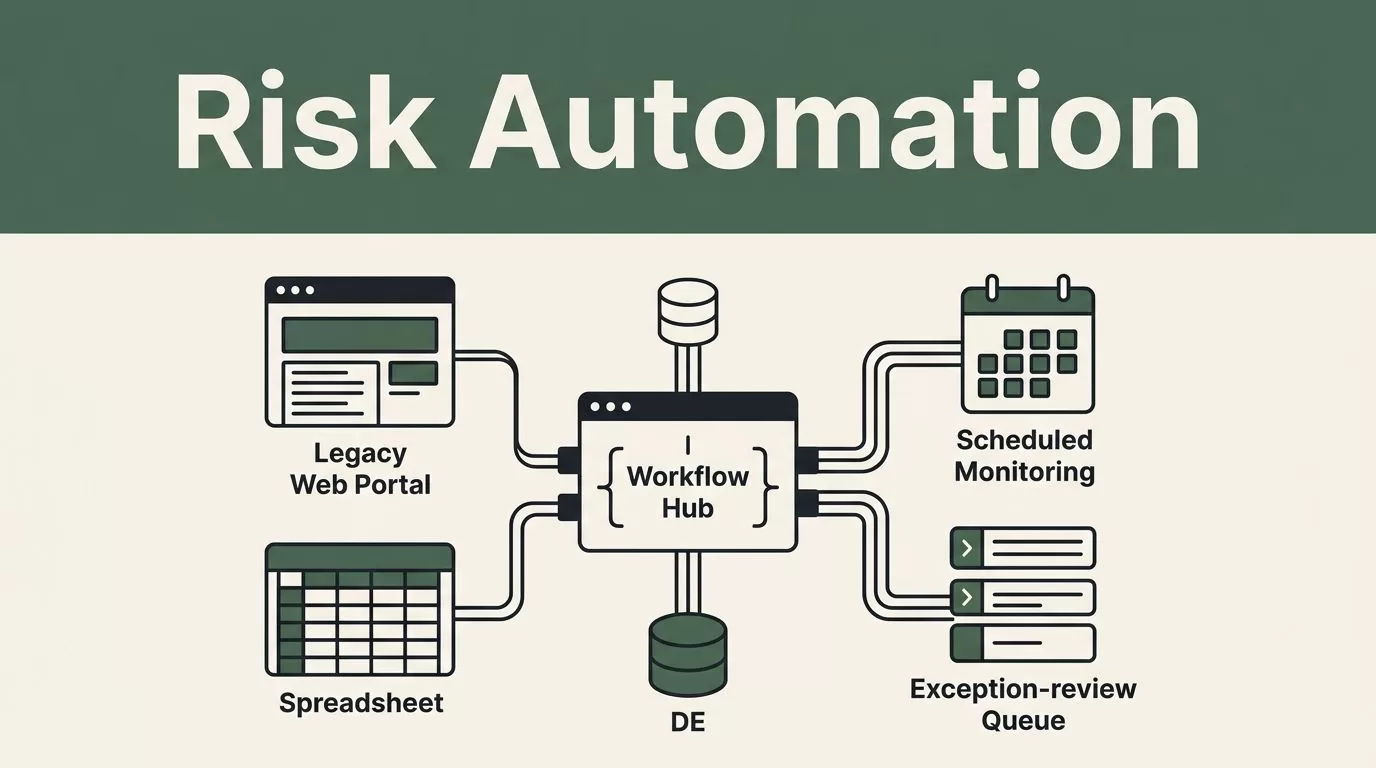
Manual risk reviews bottleneck operations when compliance teams spend hours moving data between legacy web portals, disconnected spreadsheets, and review queues. Every manual step introduces human error, slows down response times, and drains valuable staff hours that should go toward strategic mitigation. You need a reliable path toward risk assessment automation that handles data intake, scheduled monitoring, and exception routing without requiring custom software development. Twin.so provides an agentic workflow platform that bridges the gap between rigid enterprise software and repetitive manual tasks.
Getting bogged down in administrative data collection prevents security and risk leaders from focusing on actual threat analysis. When analysts spend their mornings copying figures from vendor directories into local tracking sheets, productivity stalls. Building automated review pipelines removes this friction by letting software handle the repetitive data gathering.
Deploying intelligent workflows changes how your department handles recurring evaluations. Instead of relying on manual reminders and static checklists, you establish continuous operational loops that run in the background. This guide walks you through the exact architecture, setup steps, and governance controls needed to deploy reliable agents for your compliance stack.
Understanding the Twin.so Engine for Risk Operations
Before you build your first workflow, you need to understand how Twin.so operates under the hood. Unlike traditional enterprise risk platforms that rely entirely on rigid APIs and pre-built compliance modules, Twin functions as an AI agent builder capable of interacting with both APIs and web interfaces. It translates natural-language goals into structured execution plans, allowing your team to orchestrate complex tasks across multiple systems. For a broader look at how governance tech has evolved, review this guide on compliance automation explained.
Twin combines browser automation with scheduled triggers and event-driven webhooks. When an external vendor portal lacks an API, the agent logs in, navigates menus, and extracts required compliance documents automatically. This capability removes the physical friction of manual data retrieval. You set the rules once, and the platform executes the underlying steps on a reliable schedule.
Traditional robotic process automation tools break the moment a button moves or a web element changes its ID. Twin handles these layout shifts by using contextual AI reasoning to locate fields and complete forms. That resilience is crucial when dealing with external vendor portals that update their interfaces without warning. Your compliance pipelines keep running smoothly even when source sites undergo minor redesigns.

Designing Your Risk Assessment Automation Pipeline
Successful deployment starts with clean intake architecture. You can’t automate a messy process and expect reliable output. Begin by mapping out the exact data inputs your risk team reviews weekly, such as vendor questionnaires, security certifications, or regulatory updates. Define the source URLs, document formats, and required output fields before configuring your workspace.
Map out specific data attributes like vendor risk ratings, audit dates, and remediation statuses during this planning phase. Clear attribute definitions ensure your downstream reporting remains consistent and auditable. The platform structures workflows around distinct operational blocks, including database storage, pre-execution checks, and downstream actions. In the initial phase of a run, you configure pre-checks like deduplication filters to ensure identical risk submissions don’t clutter your review queue. This structured approach prevents redundant processing and keeps your operational database clean. To see how machine intelligence alters compliance tracking, explore these insights on AI applications for regulatory compliance workflows.
Organizing your project directories before writing agent instructions saves significant time later. Group your intake forms, validation rules, and output destinations into dedicated folders inside your workspace. This structure prevents context switching and ensures your team knows exactly where each data stream flows during an audit.
Executing Multi-Step Review Workflows
Once your intake rules are active, you configure the core execution logic. Risk assessment automation relies on predictable triggers that kick off agents at specified intervals or upon receiving incoming webhooks. For instance, you can set an agent to check regulatory update sites every Monday morning, extract new filing requirements, and compare them against internal policy documents.
Configure retry intervals and rate limits into your agent parameters to handle slow-loading target servers gracefully. If a target registry site throttles requests, your agent should pause and retry rather than failing completely. If the agent encounters a missing field or an unexpected layout change on a target portal, it doesn’t just crash silently. The platform supports exception handling routines, allowing agents to retry actions, analyze contextual cues, or flag the error for human review. This resilience is essential for maintaining operational continuity across unstable web environments. You maintain total oversight while the agent handles the heavy lifting of data collection.
Testing your workflow with mock data before connecting live portals prevents costly execution errors. Run your agent through a controlled batch of test records to verify that data maps correctly to your destination database. Once you confirm stable performance, switch the trigger from manual testing to automated scheduling.
Routing Risk Alerts and Actionable Outputs
Data collection means little if it sits trapped in an isolated database. You must configure downstream outputs to push actionable intelligence directly to the right stakeholders. Twin integrates with common communication channels like Slack and email, letting your team receive automated digests or urgent risk warnings instantly.
Formatting payload structures correctly ensures your automated notifications render cleanly in team chat applications. When an agent detects a high-priority variance, such as an expired security certificate or an unauthorized vendor modification, it formats a summary report and pings the designated operations lead. This immediate notification loop cuts down response times from days to minutes. You eliminate the lag between data discovery and internal escalation.
You can also configure your workflows to sync risk scores directly with customer relationship management tools or internal ticketing systems. This integration ensures that every identified vulnerability generates a trackable task assigned to a specific team member. Operational accountability increases when every automated warning maps directly to a human owner.
Governance, Security, and Data Protection Controls
Operating AI agents in risk and compliance environments requires strict adherence to security protocols. You must secure your API keys, restrict agent permissions, and maintain audit trails of every automated action. Twin provides OAuth integrations and granular permission settings to govern what each agent can access and modify.
Before deploying production workflows, review how user data and agent memory are handled across the platform. You can examine operational safety measures directly through Twin’s privacy policy and data protection guidance. Ensuring that your agent configurations comply with internal security standards prevents unauthorized data exposure and protects sensitive organizational assets.
Establish clear review intervals for your automated agents to ensure they continue functioning according to policy. Periodic audits of agent execution logs help catch drift in data extraction rules or unexpected API changes before they impact your broader compliance posture. Maintaining rigorous oversight keeps your automated pipelines dependable over the long term.
Conclusion
Deploying risk assessment automation transforms how your operations team handles repetitive compliance tasks. By replacing manual data entry and portal scraping with scheduled, intelligent agents, you eliminate bottlenecks and reduce human error. Start small by automating a single intake or monitoring workflow, test your exception handling rules, and expand your library as your team gains confidence. Set up your first workflow today and let automated agents reclaim hours of valuable review time.
