Deploy a Twin.so Machine Learning Pipeline Bot
A model can pass every offline test and still fail in production because the pipeline around it is weak. A Twin.so agent adds a control layer for recurring data, training, evaluation, and reporting tasks. Twin.so works best as the orchestra...
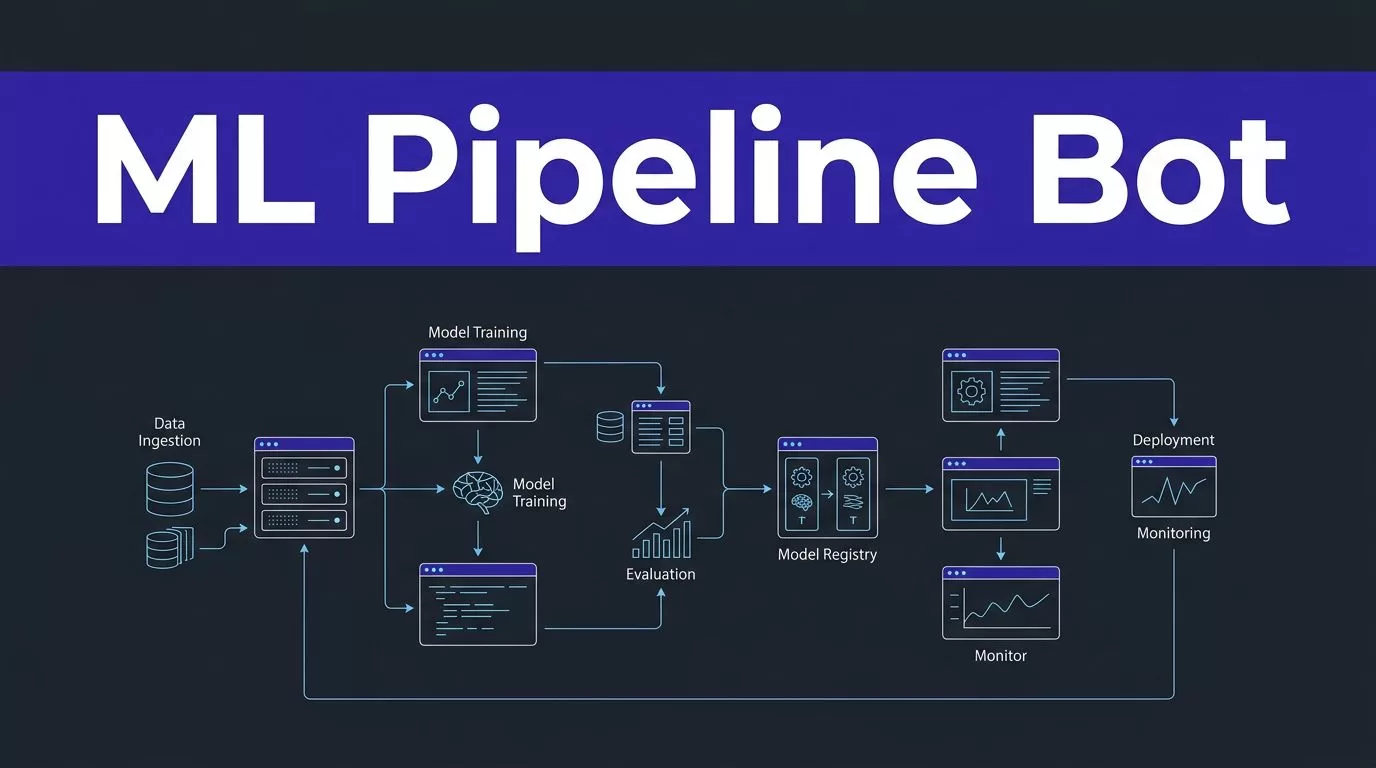
A model can pass every offline test and still fail in production because the pipeline around it is weak. A Twin.so agent adds a control layer for recurring data, training, evaluation, and reporting tasks.
Twin.so works best as the orchestration layer around your existing data pipeline, training jobs, model registry, and deployment system. It can run workflows on time triggers or webhooks, use APIs where available, and operate a browser when a system has no usable API. When relevant, Twin Talk can provide an approved connection to industrial data within that workflow.
The result is a repeatable operating process, not an autonomous AI employee with unrestricted access to production systems.
Key Takeaways
- Use Twin.so as the orchestration layer around your existing data pipeline, training jobs, model registry, deployment system, and monitoring tools.
- Define every pipeline stage with a clear input, output, owner, validation check, and failure condition before building the bot.
- Prefer APIs, separate execution from production promotion, and require human approval before deploying or changing a model.
- Protect credentials, personal data, and model artifacts with least-privilege access, environment-specific connections, allowlists, and approved secret storage.
- Version datasets, features, code, models, instructions, and reports so the team can evaluate releases, investigate failures, and roll back reliably.
What Twin.so Should Do in an ML System
Treat Twin.so as the operator for your machine learning workflow. Don’t treat it as a replacement for a feature store, training cluster, model registry, or inference service.
Your existing ML stack should handle compute-heavy and stateful work:
- Use data ingestion to collect industrial signals from Twin Talk, then store raw and processed datasets.
- Prepare data and run feature engineering.
- Run model training on approved datasets.
- Record metrics and artifacts.
- Perform model selection and approve candidate models before orchestration begins.
- Deploy models through your normal release process.
- Monitor predictions and infrastructure.
Twin.so can coordinate the data pipeline around those systems. It can start a job, collect its result, compare metrics with a release policy, prepare a report, notify a team, and request approval before promotion.
This division keeps the bot useful without giving it authority over every system. It also gives machine learning operations clear ownership when failures occur. A failed training job belongs to the model platform, while a failed Twin Talk handoff belongs to its source or integration owner. A failed notification or approval step belongs to the Twin workflow.
A Twin.so machine learning pipeline is most reliable when every stage has a clear input, output, owner, and failure condition.
Design the Pipeline Before You Build the Bot
Write the ML workflow as a sequence of contracts. Each stage should produce an artifact that the next stage can verify. Define the data pipeline before implementation, including inputs, outputs, owners, and checks.
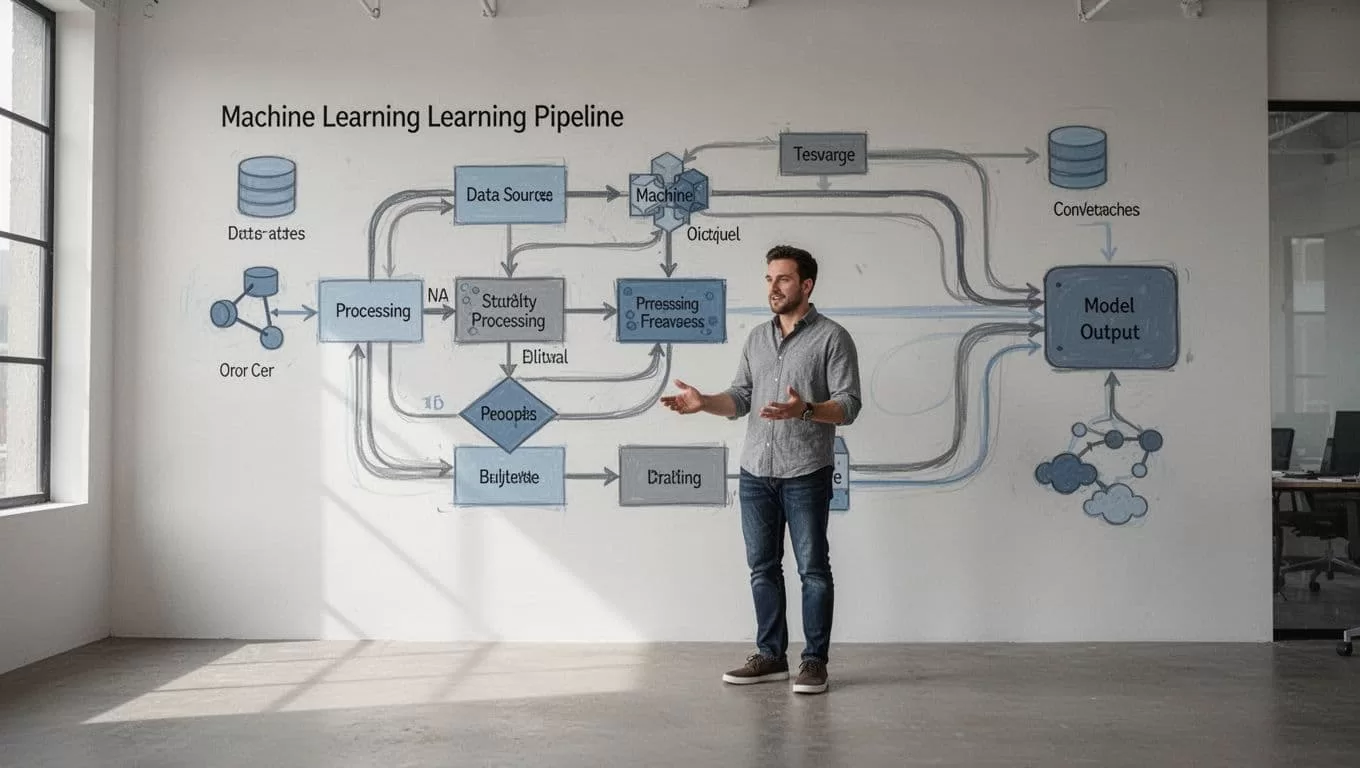
An end-to-end workflow usually includes these stages:
- Data ingestion collects records from approved databases, object storage, APIs, or event streams. For industrial data, Twin Talk can be an approved source when its records and access rules are documented.
- Data validation checks schemas, missing values, duplicates, ranges, timestamps, and row counts. Version the data exploration summary or profiling result before validation begins.
- Data preprocessing cleans and transforms data into the format required by the model.
- Feature engineering creates the variables used for training and inference.
- Model training runs a selected machine learning algorithm against a versioned training dataset. The contract records model selection, the model family, learning approach, and hyperparameter tuning settings. It can cover supervised learning, neural networks, and transfer learning. Automated machine learning can implement training or candidate generation, but it must follow the same contracts and checks.
- Model evaluation tests performance against validation and test datasets.
- Deployment publishes an approved model to a staging or production environment.
- Monitoring tracks prediction quality, latency, data quality, and changes in model behavior.
Data preprocessing and feature engineering often determine more of the final result than changing the algorithm. A strong model trained on inconsistent features will still produce unreliable predictions. Store transformation logic in code or a managed pipeline. Apply the same transformations during training and inference. Use model selection to compare candidates with consistent metrics and validation splits.
A traditional ETL data pipeline moves data from source systems to a destination. A machine learning pipeline continues past that point. It creates features, trains models, compares experiments, packages artifacts, and tracks whether the model remains useful after release.
Build a Twin.so Bot for an ML Workflow
Start with one repeatable machine learning pipeline. A nightly retraining process or weekly model report is easier to control than a bot with several unrelated responsibilities.
Use Twin’s agent builder to describe the outcome, then map each action to an approved integration, API call, or browser step. The exact tools available depend on the connections in your workspace.
A clear agent instruction might look like this:
Every weekday at 02:00 UTC, or when approved data ingestion completes, retrieve the latest approved training dataset, run data preprocessing to validate its schema and row count, start the registered model training job, collect model evaluation metrics, and prepare a release report. Never deploy a model without human approval. If any validation or training step fails, stop the workflow and notify the ML channel with the run ID and error.
This instruction defines the schedule, data source, job, output, approval gate, and failure path. It gives the bot a bounded task instead of a vague command such as “manage the ML pipeline.”
Build the workflow around five controls.
- Set a trigger and an input contract. Use a time trigger for scheduled retraining. Use a webhook when a completed data load should start the process. A Twin Talk webhook or industrial data handoff can provide that event. Pass a data-pipeline run ID, dataset location, feature version, target environment, and approval state as structured inputs.
- Use APIs before browser automation. APIs provide clearer responses, narrower permissions, and better logs. Use Twin’s browser agent only when the required system has no suitable API or when an approved browser step is necessary.
- Separate execution from promotion. Let the bot initiate the registered job and collect results. Require human approval before production deployment. The bot must not complete model deployment without approval. A passing metric should create a review request, not silently release a model.
- Define measurable release rules. Use model selection criteria for supervised learning, including precision, recall, F1 score, ROC-AUC, and class-specific results. For regression, compare MAE, RMSE, and errors across important segments. Record the hyperparameter tuning configuration for review. Reject the run when the dataset is stale, a metric threshold fails, or the evaluation report is incomplete.
- Stop on unsafe errors. Retry temporary network failures with a limit. Don’t retry a schema failure indefinitely. Return the failed stage, run ID, source, error message, and recommended owner to the team.
The bot should also write a compact run report. Include the dataset version, code or pipeline version, model training duration, and resulting model version. Also record evaluation metrics, the deployment decision, and a link or version for the data exploration summary, not raw exploratory data. Record the source, such as Twin Talk, when a handoff triggered the run. A report without versions can’t support a reliable rollback.
For production design support, Book A Call before granting an automated agent access to customer data or release systems.
Protect Credentials, Data, and Model Artifacts
An autonomous agent can move quickly through connected systems. That makes access control more important, not less.
Give the bot separate credentials for development, staging, and production. Each Twin Talk connection needs environment-specific credentials with the smallest permission set possible. A reporting workflow shouldn’t have permission to delete datasets, and a training workflow shouldn’t modify billing or identity settings.
Never place API keys, passwords, private certificates, or database credentials in the agent prompt. Store secrets in an approved secret manager or connection system. Rotate them on a schedule, and revoke them when the workflow changes ownership.
Keep sensitive data out of browser screenshots, logs, and notifications. Apply data governance controls to retention, logging, and notifications. Pass dataset references instead of copying raw records into chat or agent context, and mask personal information before a report leaves the data platform.
Set explicit allowlists for destinations and actions. For example, the bot may write a report to a controlled storage location and open an approval request, but it may not send model artifacts to an unapproved email address.
Add human approval before these actions:
- Publishing a model to production.
- Changing a feature transformation.
- Accessing personal or regulated data.
- Altering a training schedule.
- Retiring a current model.
- Sending an external notification based on model output.
Evaluate, Deploy, and Monitor the Release
Model evaluation needs separate validation and test data. Use the validation dataset to compare candidates and guide parameter tuning, while keeping the test dataset isolated until the final comparison. Before that comparison, verify the same data preprocessing checks and transformation version used during model training and serving. For supervised learning, match classification or regression metrics to the task; reused records weaken the test score.
Automated machine learning can reduce the time needed for model selection and hyperparameter tuning. It doesn’t remove the need for data checks, metric selection, or human review. The bot can start that job and collect candidates, but your team must define model selection eligibility rules for review. Set a hyperparameter tuning budget, and allow transfer learning only when approved.
Model deployment should happen through the system that already manages your runtime. That may be a managed cloud computing service, a container image, or a Kubernetes workload. Twin Talk can coordinate the handoff when your platform exposes an approved API or browser workflow. It shouldn’t become the only record of what reached production.
Google’s MLOps continuous delivery guidance covers the connection between CI, CD, automated training, and model release. Use the same discipline for the bot itself, treating it as part of machine learning operations. Version its instructions, connected tools, release rules, notification destinations, and the data pipeline from source data to serving features. Attach a versioned data exploration summary to each release report.
Track these signals after deployment:
- Prediction latency and error rates.
- Input schema and missing-value changes.
- Feature distribution changes.
- Prediction distribution changes.
- Ground-truth performance when labels arrive.
- Business outcomes tied to the model.
- Differences between training and serving features.
Model drift can happen even when infrastructure is healthy. Twin Talk should detect the threshold breach, route a monitoring review, and attach evidence. It shouldn’t retrain and deploy automatically unless that action has passed a separate risk review.
The MLOps principles include consistent feature order and automated feature transformations. Keep those rules in the pipeline contract, and have Twin Talk verify expected versions and notification state before starting a run. A model improvement versioning checklist also reinforces the need to track data, code, models, and post-deployment metrics together.
Where Twin Talk and Edge Impulse Fit
Twin.so, through Twin Talk, is useful for coordinating business and engineering actions around an ML pipeline. Industrial platforms solve a different part of the problem.
Twin Talk can orchestrate operational technology and IoT data with scheduled workflows, S3-compatible sources, enrichment, and contextualization. Edge Impulse focuses on building and deploying models for edge devices, where inference must run near sensors or machines.
A sensible architecture can support predictive maintenance across both layers. Edge Impulse may run neural networks on devices and apply transfer learning when labeled equipment data supports it. It can use supervised learning for local alerts, while the central ML platform manages lifecycle records. Twin.so starts approved workflows, checks results, prepares reports, and routes decisions to people.
Use a clear ownership checklist:
- Twin Talk acts as the source layer for industrial sensor, work-order, and alarm records.
- Twin Talk manages data ingestion and data contextualization before those records reach the central platform.
- Twin Talk sends normalized sensor records for predictive maintenance through a documented handoff to the central platform.
- Twin Talk and the central platform use an agreed authentication method and retention period.
- Twin Talk doesn’t own model selection; the central platform approves the edge or central model and reviews predictive maintenance outcomes.
Don’t assume these products share data automatically. Define the handoff format, ownership, retention period, and authentication method at every boundary.
Frequently Asked Questions
What role should Twin.so play in a machine learning pipeline?
Twin.so should coordinate recurring data, training, evaluation, reporting, and approval tasks around your existing ML systems. It should not replace your feature store, training cluster, model registry, inference service, or monitoring platform.
Can Twin.so deploy a model automatically?
Twin.so can start registered jobs, collect evaluation results, and prepare a release request. Production deployment should remain behind a human approval gate unless a separate risk review has authorized automation.
Should I use APIs or browser automation for the workflow?
Use APIs before browser automation because they provide clearer responses, narrower permissions, and better logs. Use Twin’s browser agent only when the required system has no suitable API or an approved browser step is necessary.
How should failures be handled by the bot?
The bot should retry temporary network failures with a defined limit and stop on unsafe errors such as schema failures or incomplete evaluation reports. Each failure notification should include the failed stage, run ID, source, error message, and recommended owner.
How do Twin Talk and Edge Impulse fit into the architecture?
Twin Talk can provide approved industrial sensor, work-order, and alarm data and coordinate handoffs to a central ML platform. Edge Impulse can build and deploy models for edge devices, while Twin.so coordinates approved workflows and routes results without taking ownership of model selection.
Conclusion
A Twin.so machine learning pipeline should coordinate a controlled ML system, not replace it. Keep data processing, training, model storage, deployment, and monitoring in systems built for those jobs.
Use Twin.so for scheduled execution, webhook-driven actions, and Twin Talk when coordinating approved cross-system updates or industrial handoffs. It can also produce reports and route exceptions. Restrict credentials, version every important artifact, monitor for model drift, and require human approval before production changes.
The best bot is not the one with the most access. It’s the one that completes a defined workflow, stops when evidence is missing, and leaves a complete record of what happened.
