Write Viral LinkedIn Posts Consistently with Someli
Most LinkedIn posts don’t fail because the idea is bad. They fail because the rhythm breaks, the draft sits too long, and the hook never gets sharpened. I used to treat posting like a mood. Some weeks I wrote a lot, then I disappeared...

Most LinkedIn posts don’t fail because the idea is bad. They fail because the rhythm breaks, the draft sits too long, and the hook never gets sharpened.
I used to treat posting like a mood. Some weeks I wrote a lot, then I disappeared for days. Now I use Someli to keep the process moving, so I can write viral LinkedIn posts consistently instead of waiting for a perfect burst of energy.
Key Takeaways
- Consistency beats random spikes because your audience learns when to expect you.
- I use Someli to move faster from rough notes to usable drafts.
- Strong hooks, clear points, and real proof matter more than polished fluff.
- A simple weekly system keeps my LinkedIn posting steady.
- I watch saves, comments, and profile visits, then repeat the winners.
Why Consistency Beats Random Bursts
I don’t chase one lucky post. I build a repeatable posting rhythm, because the feed rewards people who show up often enough to be remembered.
A single high-performing post can open the door. A steady stream keeps that door from closing. When I post once, then vanish for two weeks, my next post has to reintroduce me. When I stay visible, each post has a warmer start.
That matters even more for founders, marketers, creators, and personal brands. Your audience is busy. They see a flood of opinions, frameworks, and self-promo every day. If my posts arrive in fits and starts, they blur together. If I post on a dependable schedule, my ideas start to stack.
I also get better feedback when I stay consistent. One post tells me little. Five posts tell me which hook pulled attention, which topic got comments, and which angle felt flat. That is how I stop guessing. I keep what works and cut what doesn’t.
I use how to schedule LinkedIn posts when I want the cadence to hold up during a messy week. I also compare my drafts with this 6-step LinkedIn post framework when I need a cleaner structure. Both help me stay out of the blank-page trap.
How I Use Someli to Turn Ideas Into Drafts


Someli works best for me when I treat it like a writing partner, not a replacement for judgment. I bring the raw material, then let it help me shape the post faster.
My process starts with messy notes. A client call. A lesson from a launch. A short win. A frustrating mistake. I dump those fragments into Someli and ask for a few angles. One might be a contrarian take. Another might be a founder story. Another might be a short lesson with a clean takeaway.
The first draft matters because it removes resistance. Once I can see the shape of the post, I’m no longer staring at a blinking cursor. Someli’s AI-powered LinkedIn post writer helps me get to that point faster, then I cut, tighten, and rewrite until it sounds like me.
I use a few prompts again and again:
- “Write a LinkedIn post for founders about a lesson learned the hard way.”
- “Turn these notes into a short post with a strong first line.”
- “Give me three hook options, one story-driven, one data-driven, and one contrarian.”
- “Rewrite this so it sounds direct and useful, not stiff.”
That last part matters. Viral LinkedIn posts usually do one thing well. They teach, surprise, or prove a point. They don’t try to do all three in the same paragraph.
I also keep my draft limits tight. If a post tries to explain everything, I trim it. If the hook is soft, I rewrite it. If the payoff is vague, I add a real detail, a number, or a concrete outcome. Someli helps me move quickly, but the final shape still comes from my judgment.
For broader automation, I keep social media automation for LinkedIn in my toolkit when I want a fuller content workflow. That keeps the work from piling up in one tired afternoon.
Hooks and Formats That Make People Stop Scrolling
The first line does most of the work. If it sounds like every other post, people glide past it.
If the first line feels familiar, I keep scrolling too.
I start by asking what the hook promises. Does it open a loop? Does it reveal a mistake? Does it challenge a common habit? The best hooks give the reader a reason to stay for the second line.
I keep a small set of post types and rotate them. That gives me variety without forcing me to invent a brand-new shape every time.
| Post type | When I use it | Hook example |
|---|---|---|
| Founder lesson | After a mistake or rough decision | “I lost a deal because I said this too early.” |
| Mini case study | After a real win | “One change doubled my replies in a week.” |
| Contrarian take | When common advice feels tired | “Posting every day is not the goal.” |
| Process post | When I want to show my system | “My 15-minute LinkedIn workflow starts here.” |
These formats work because they promise something clear. A reader knows whether the post will teach, challenge, or show proof before the third line.
I also like to keep the body simple. One idea per post. One lesson. One example. One action. If I need more than that, I split the thought into two posts.
For extra structure, I sometimes compare my draft with this viral LinkedIn posts guide. It helps when I want a fresh angle on formats, but I still keep the final voice plain and direct.
The other detail I watch is specificity. “Work harder” is forgettable. “I rewrote the opening line three times and doubled the comments” gives the post a shape people can remember. Specificity makes the post feel lived-in, not manufactured.
My Weekly System for Shipping Posts Without Burnout
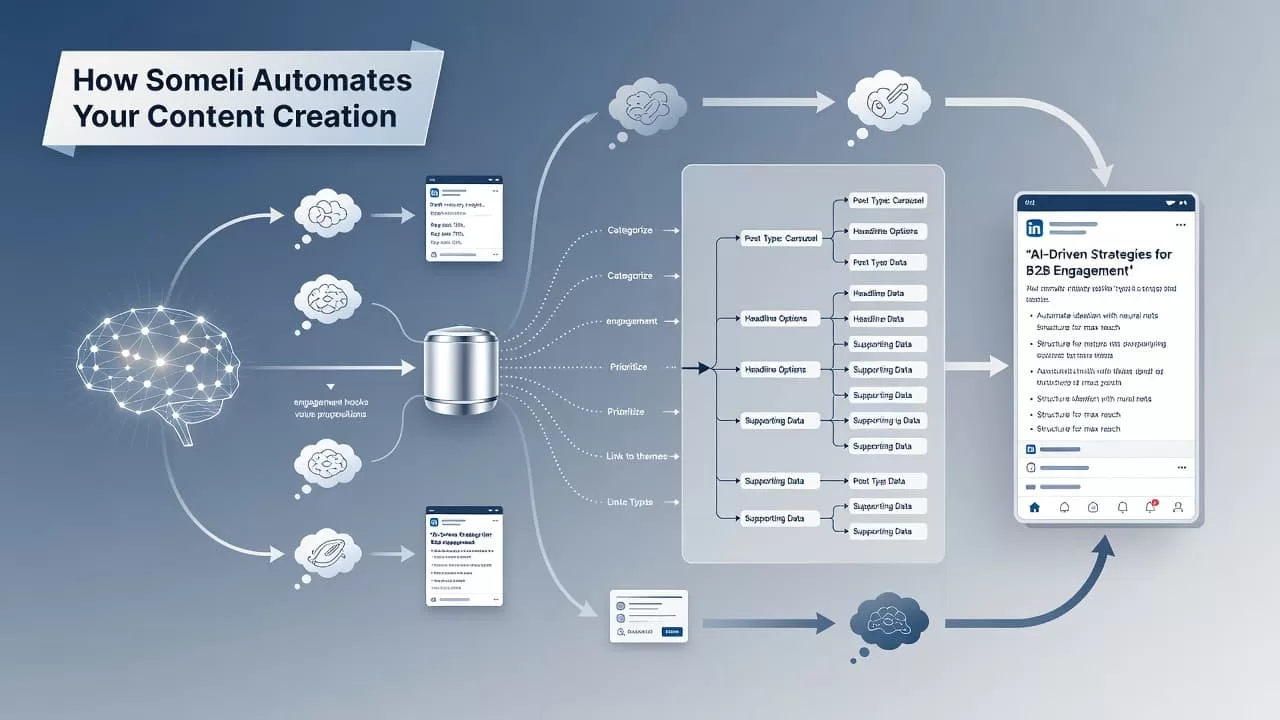
I don’t try to write from scratch every day. I batch the thinking, then spread the posting out.
My week usually looks like this:
- I collect raw ideas throughout the week.
- I ask Someli for three to five angles on each good idea.
- I pick the strongest hook and trim the post to one point.
- I schedule the posts and leave one slot open for something timely.
- I review performance after a few days and note what got saves or comments.
That simple loop keeps me from starting at zero. It also gives me enough material to test without flooding my feed. A week of posts feels easier when most of the hard thinking happens in one sitting.
I pay close attention to the response after publishing. Likes are nice, but saves and comments tell me more. Saves usually mean the idea was worth keeping. Comments often show where the post hit a nerve or sparked a useful disagreement. Profile visits matter too, because they tell me the post moved beyond empty attention.
When I want a broader posting cadence, I use how to schedule LinkedIn posts to keep the queue full. I also lean on Someli’s pattern support when I want the draft, timing, and publishing flow to stay connected instead of scattered.
The biggest shift for me was simple. I stopped treating each post like a one-off performance. I started treating LinkedIn like a weekly system. That made my work lighter and my output stronger.
Conclusion
I don’t need a new personality to get better results on LinkedIn. I need a repeatable way to find ideas, shape them fast, and keep posting when the week gets busy.
That’s where Someli fits for me. It helps me move from rough thought to clear post without losing momentum, and that makes consistency possible.
When I keep the rhythm steady, test the hook, and repeat the formats that earn saves, viral LinkedIn posts stop feeling like a lucky accident. They become part of the process.

