Management Consulting Tools Built with Twin.so
Consulting teams lose time when proven methods live in scattered documents, spreadsheets, and slide templates. The work gets repeated, but the process never becomes easier to run. Management consulting tools built with Twin.so can turn repe...
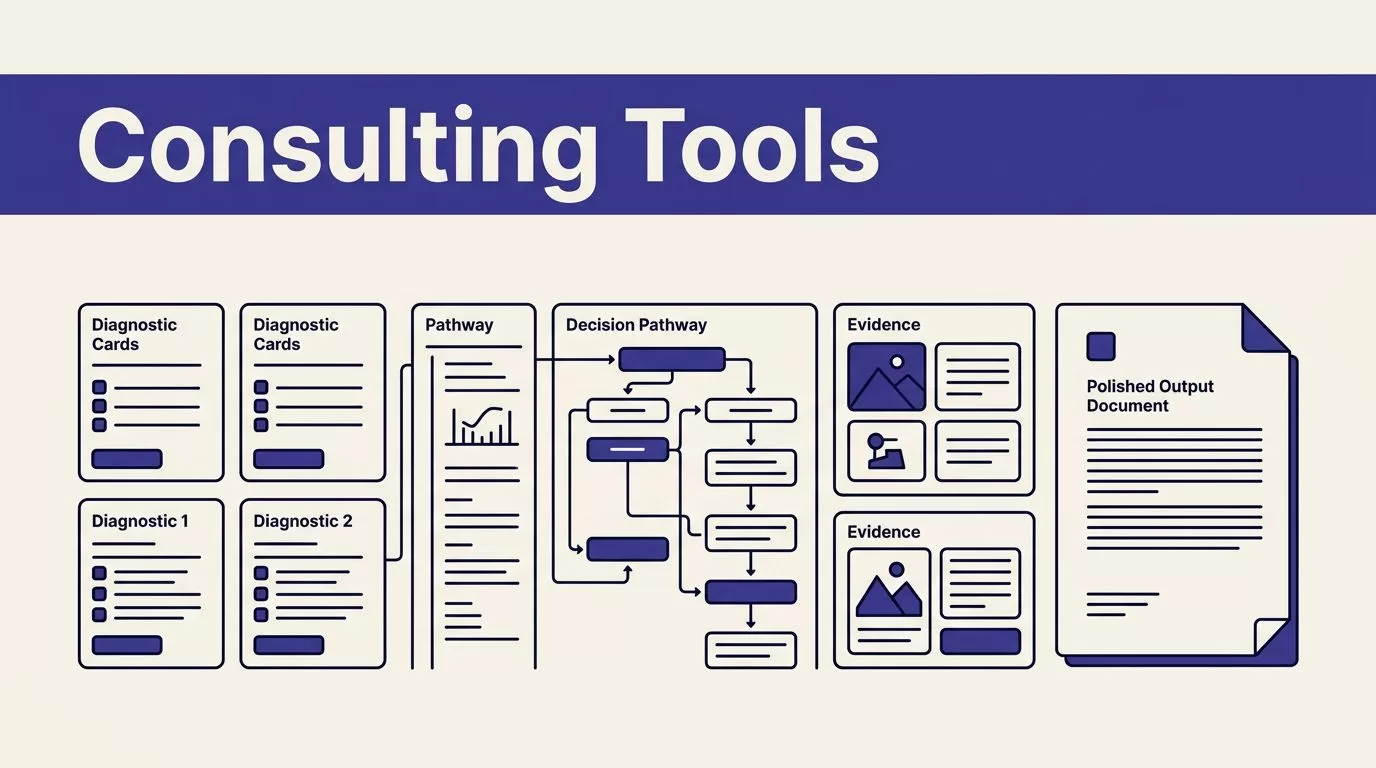
Consulting teams lose time when proven methods live in scattered documents, spreadsheets, and slide templates. The work gets repeated, but the process never becomes easier to run.
Management consulting tools built with Twin.so can turn repeatable frameworks into working systems. Consultants can guide users through a diagnostic, apply defined logic, collect evidence, and produce structured outputs without rebuilding the same workflow for every engagement.
The useful starting point is not a list of features. It is a clear consulting process that a tool can support.
Why management consulting tools need a clear operating model
A framework gives consultants a way to structure a problem. A tool makes that structure usable by other people.
A market-entry framework may contain standard questions about customer segments, competitors, regulation, pricing, and internal capabilities. A process diagnostic may score maturity across ownership, controls, systems, and performance. A PMO review may track risks, decisions, dependencies, and overdue actions.
These methods become more valuable when users can apply them consistently. Consulting frameworks and methodologies give teams a shared way to structure problems, analyze data, and communicate recommendations. A custom tool adds the operating layer around that method.
That operating layer should define:
- What information the user enters.
- Which questions appear next.
- How responses are scored or categorized.
- Which evidence supports the result.
- What output the consultant receives.
- Where a human must review the recommendation.
The distinction matters. A calculator can return a score. A consulting tool should help a team understand what the score means and what action follows.
A strong tool also protects the firm’s intellectual property. The framework stays inside a controlled workflow instead of being copied into separate client files. Updates become easier because the underlying method has one maintained version.
A framework becomes reusable when another consultant can run it without asking the original author to explain every step.
How Twin.so turns a consulting method into a working tool
Twin.so is useful when a consulting team wants to package a repeatable method into a tailored workflow. The team defines the method, the inputs, the decision rules, and the required output. Twin.so can then be used to shape that process into an internal or client-facing tool.
Start with the decision the tool must support. Avoid building a broad “strategy assistant” with unclear boundaries. Define a narrow job, such as:
- Assess the readiness of a business unit for a new operating model.
- Identify the main causes of delayed order fulfillment.
- Compare vendors against a fixed set of evaluation criteria.
- Convert stakeholder interviews into an issue register.
- Prepare a first-pass KPI review for a monthly operating meeting.
Next, map the workflow in plain language. Write what happens when a user selects an answer, uploads evidence, or leaves a field incomplete. Include exceptions. A tool that works only when the input is perfect will create more review work.
A practical build sequence looks like this:
- Write the framework as a decision tree, not a slide deck.
- Separate required inputs from optional context.
- Define the output format before building the interface.
- Add examples that show what a good response looks like.
- Test the workflow against completed past engagements.
- Add review points for judgment-heavy decisions.
- Release the smallest useful version to a limited group.
The output might be a diagnostic summary, a prioritized action list, a risk view, or a draft client discussion guide. Keep the output close to the consultant’s actual work. A polished interface has little value if the result still needs to be rebuilt manually in Excel or PowerPoint.
BCG describes digital agents and related tools as ways to handle routine work and improve business outcomes. That principle applies here, but the consulting team still owns the method and the final judgment.

Management consulting tools worth building first
The best first tool is usually a workflow your team runs often and delivers in a similar format. It should remove repeated manual work without trying to automate the entire engagement.
A diagnostic assessment is a strong starting point. Users answer structured questions about a business function, attach supporting evidence, and receive a maturity view or issue summary. Consultants can use the result to prepare interviews and focus the first workshop on the largest gaps.
A hypothesis and issue tracker can support strategy engagements. The tool records the question being tested, the available evidence, the owner, the status, and the next analysis required. It can also separate confirmed findings from assumptions. This prevents early ideas from appearing as final recommendations.
An operating model review tool can guide analysis across structure, governance, processes, technology, and capabilities. Each category can use its own questions and scoring rules. The final output can show where the operating model is misaligned and which changes require executive decisions.
A vendor evaluation tool can standardize procurement support. Set the criteria, assign weights, record evidence, and require written reasons for each score. Keep the final recommendation editable because commercial terms and stakeholder priorities can change.
A workshop preparation tool can collect participant roles, business questions, process pain points, and relevant documents before a session. The consultant starts with a better fact base and spends less time gathering basic information during the meeting.
A KPI review tool can turn recurring performance reviews into a consistent process. Users enter current results, targets, trends, and commentary. The tool can organize exceptions for discussion, while the consultant decides whether an issue needs analysis, escalation, or no action.
Avoid building a tool for a process that changes every week. If the method has no stable structure, the build will become a second project instead of a reusable asset.
Use custom tools across the consulting engagement
A consulting tool can support more than analysis. It can carry a defined workflow through several stages of an engagement.
During diagnosis, use it to collect structured information before interviews and workshops. This creates a common starting point for the team. It also makes missing evidence visible early.
During analysis, use it to organize hypotheses, score options, compare business units, or classify interview findings. The tool should show the source of an input when that source matters. A score without evidence is difficult to defend with a client.
During decision-making, use it to compare scenarios against agreed criteria. Make assumptions visible. Record who approved a change to the criteria or weighting. This creates a useful record when stakeholders challenge the recommendation later.
During implementation, use it to track actions, owners, due dates, dependencies, and unresolved decisions. A consulting firm can reuse the same structure across transformation work, operating model programs, and post-merger integration.
Client-facing use requires a tighter boundary. Give the client only the questions, information, and outputs needed for that stage. Keep internal hypotheses, pricing logic, partner notes, and review comments outside the client view.
The tool should also fit existing work habits. If the team uses Microsoft Excel for source data, PowerPoint for executive communication, and a project system for actions, define where the custom workflow fits. A new tool should remove duplication, not create another place to update the same fact.

Set controls before you share the tool
A consulting workflow may contain confidential strategy, financial, employee, or customer information. Treat data handling as part of the build, not a later task.
Before a pilot, confirm what information the tool stores, who can access it, how long it remains available, and how it can be removed. Review the rules for client documents and personal data. Do not place sensitive information into a workflow until your security and legal teams approve the setup.
Define human review points. A tool can organize evidence and apply a scoring model. It should not make a high-impact recommendation without a consultant checking the inputs and reasoning.
Use clear version control for the framework. Record the owner, release date, scoring changes, and approved use cases. If one team changes the method, other teams need to know which version they are using.
Change management also needs a simple plan. Prosci describes a digital transformation framework as a blueprint for planning and managing technology-driven change. The same principle applies to an internal consulting tool. Assign an owner, train the first users, collect failure cases, and set a review date.
A small pilot will expose problems quickly. Watch for incomplete inputs, confusing questions, unsupported recommendations, and outputs that require heavy editing. Fix those issues before broader deployment.
If the build requires a dedicated analyst, implementation lead, or workflow owner, Book A Call to discuss the staffing requirement.
How to judge whether the tool is working
Measure the workflow against the manual process. Do not rely on adoption alone.
Track the time required to complete an assessment, prepare a workshop, produce a first draft, or update an action register. Check how often consultants correct the output. Record the number of incomplete submissions and the points where users abandon the workflow.
Quality matters as much as speed. Ask whether the tool produces:
- More consistent analysis across teams.
- Better evidence for recommendations.
- Fewer repeated data requests.
- Clearer ownership of follow-up actions.
- Outputs that need less reformatting.
Also measure usefulness for the client. Can the client understand the questions? Does the output support a decision? Does the workflow make the engagement easier to run without hiding important judgment calls?
Management consulting tools should reduce repeatable work while improving consistency. They shouldn’t force every client into the same answer. Keep the framework fixed where consistency matters, and leave room for documented judgment where the situation requires it.
Conclusion
The strongest consulting tools start with a method that already works. You define the decision, map the inputs, set the rules, and design the output before building the workflow.
Twin.so can help consulting teams package that method into reusable internal or client-facing tools. The practical gain comes from fewer repeated steps, clearer evidence, and more consistent delivery.
A tool should make good consulting easier to repeat, not replace the thinking that makes the work valuable.
