
Most startup lists arrive late, when the crowd already knows the name. I use Exploding Topics to spot movement earlier, then I test whether that movement points to a real business or just a loud week online.
That matters with emerging tech startups. A few months can change entry price, content difficulty, partner access, and product timing. My rule is simple: first, find a rising topic; next, find the startup inside it; then, validate traction with outside proof.
How I spot startup trends before they look obvious
I start with Exploding Topics’ Trending Startup Topics, not company names. Categories usually move before brands do. If I search for a startup first, I can miss the bigger wave behind it.
Then I compare those themes with the current technology startup list. I want overlap. When the same pattern shows up in both places, I pay attention. In March 2026, that overlap is hard to miss: AI-driven tools, defense tech, and AR built for real jobs, not consumer novelty.
That last part matters. I don’t get excited by broad buzz alone. I want startups tied to a painful task. AI voice agents for customer service fit. So do AI research tools, forecast engines, and warehouse AR workflows. They save time, cut labor, or reduce error. That’s where budgets usually appear first.
Retell AI is a good example of why I like this process. Search growth has been strong, and the use case is plain to see: voice agents that help teams handle more customer conversations. Konnecto stands out for a similar reason. Its growth signals line up with a clear business job, better forecasting and faster decisions.

Before I go deeper, I run a fast first-pass checklist:
- Real pain: Does the startup solve a costly, annoying problem?
- Trend shape: Is growth steady for months, not one sharp spike?
- Buyer clarity: Can I name the team or budget that would buy it?
- Market fit: Does the product match a broader shift, like AI automation or defense demand?
I don’t chase a curve by itself. I chase a curve tied to a clear problem.
My framework for separating hype from sustainable traction
A rising chart is only the first breadcrumb. To judge hype versus traction, I look for six supporting signals. If at least four line up, I keep digging. If only one or two show up, I usually move on.
Here is the framework I use:
| Signal | What I want to see | Warning sign |
|---|---|---|
| Search growth | Multi-month climb, branded and non-branded | One viral spike |
| Funding activity | Fresh rounds, active investors, repeat backing | Old funding, no follow-through |
| Hiring momentum | Open roles in product, sales, and engineering | Flat team, no key hires |
| Product launches | New features, integrations, enterprise wins | Demo-heavy, little shipping |
| Social discussion | Smart discussion from users, buyers, and builders | Empty hype or founder-only posts |
| Competitive landscape | Room for several players or a clear niche | Crowded clone market |
The takeaway is simple: one signal tells me interest exists; several signals tell me a business may be forming.
I also cross-check with the latest fast-growing companies roundup. If a startup theme appears there too, I ask why. Is the market broadening, or is one winner soaking up all demand?
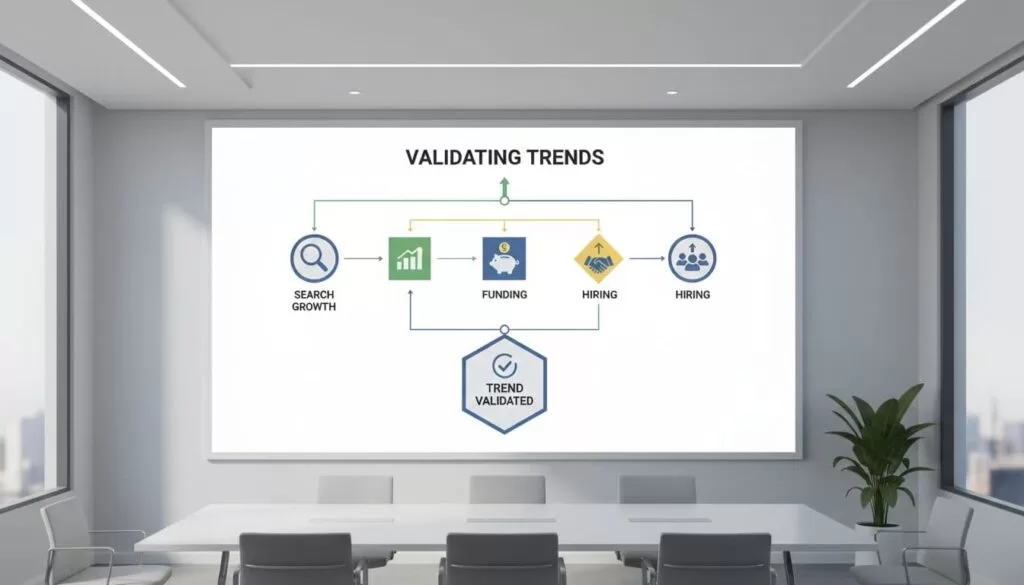
This is where hype usually cracks. A flashy AR demo may get social shares, yet have no hiring, no repeat product launches, and no sign of budget owners. On the other hand, defense tech may look less glamorous, but current market data points to funding near $50 billion last year. That tells me demand is not just chatter.
AI cybersecurity and automation tools often sit in the middle. They can spike fast, so I watch for proof that the startup is moving past a clever demo. Are teams hiring sales staff? Are they shipping product updates? Are buyers talking about them without being prompted? That’s when I start taking the signal seriously.
How I use early startup signals in real work
For investing decisions
If I’m building an investment watchlist, I don’t need perfect certainty. I need a short list with strong odds. Exploding Topics gives me the first cut. My framework gives me the second. Then I rank startups by market size, buyer urgency, and founder speed.
I also look for timing. When search is rising, hiring is active, and funding is early, outreach can happen before the round gets noisy. That’s where emerging tech startups can still feel mispriced.
For operators and product teams
When I work like an operator, I use this process to spot adjacent products and partner ideas. If AI voice agents rise, I don’t only look at the agent company. I look at QA tools, compliance layers, workflow routing, and data security around it.
That helps me avoid building in the dark. A trend map becomes a roadmap filter.
For marketers
If I’m planning content or category pages, I want topics before they harden into crowded keywords. Exploding Topics helps me see that window. Then I write around the buyer problem, not just the startup name.
For example, a marketer can create content around AI customer support quality, secure voice automation, or warehouse AR workflows before the market gets packed with lookalike articles. If social chatter is loud but product proof is thin, I wait. If the conversation is smaller but buyers sound serious, I move early.
Conclusion
Exploding Topics gives me the first signal, not the final answer. I still need to test search growth, funding, hiring, launches, discussion, and competition. When those signals line up, emerging tech startups stop looking like guesses and start looking like opportunities I can explain, defend, and act on.