Automate Rewardful Commission Calculations
Affiliate payouts become unreliable when the commission rule lives in someone’s spreadsheet. Rewardful commission calculations connect referral attribution to the Stripe invoice that was actually paid, then keep the record current as...
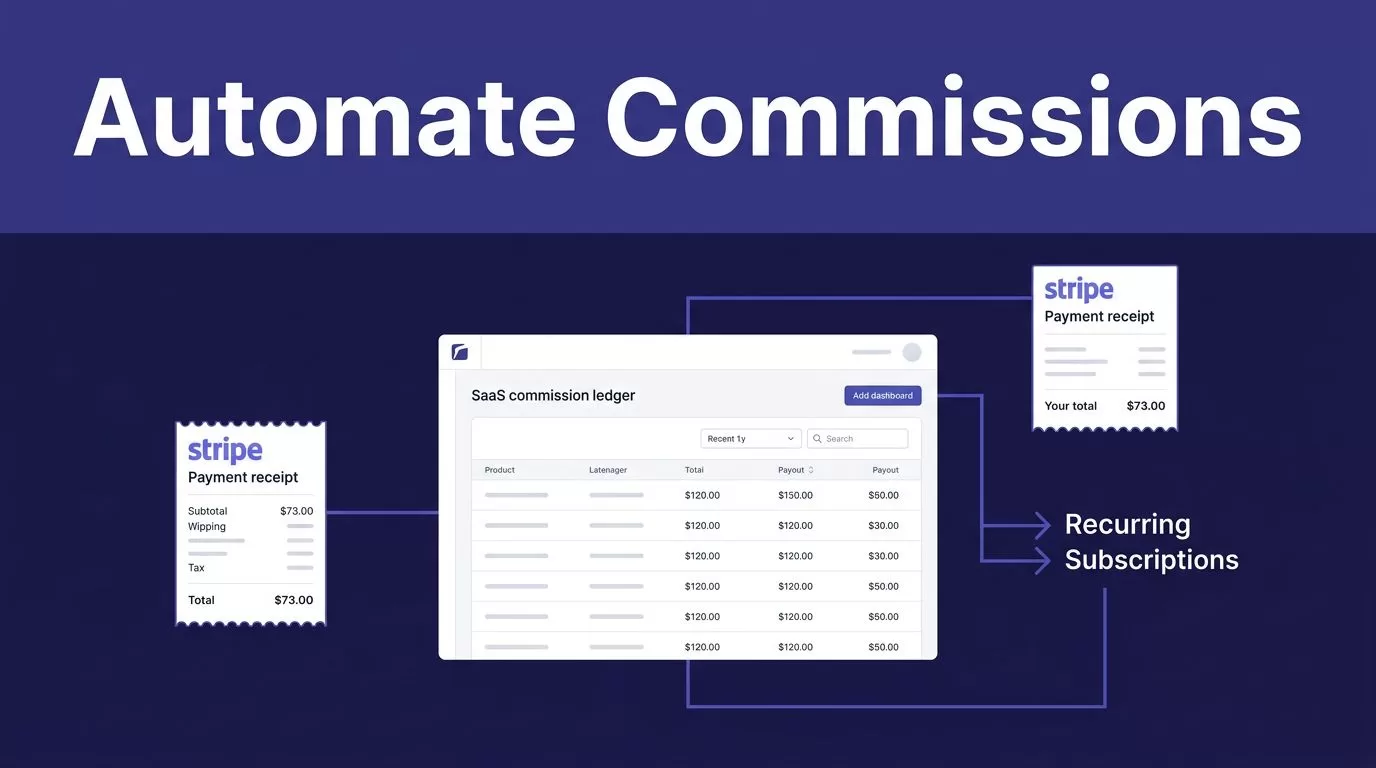
Affiliate payouts become unreliable when the commission rule lives in someone’s spreadsheet. Rewardful commission calculations connect referral attribution to the Stripe invoice that was actually paid, then keep the record current as a subscription changes.
That gives your SaaS team a usable commission ledger. It doesn’t remove finance review. Build the rules first, then test the data path before you approve a payout.
Set Up Rewardful Commission Calculations Correctly
Rewardful creates commissions when Stripe records a qualifying paid invoice for a referred customer. Its commission tracking model also adjusts records for subscription changes and refunds.
Your campaign settings are the policy. Treat them like finance rules, not marketing preferences.
Pay on collected revenue, not list price
For a percentage campaign, the basic rule is simple:
Commission = amount actually paid x commission rate
If a customer uses a coupon and pays $80, a 20% commission is $16. It isn’t $20 because the list price was $100.
Use a fixed commission only when the payout should stay the same regardless of plan price. A $50 fixed commission can work for a qualified annual plan. It can create losses if it also applies to discounted monthly plans.
Test each billing path before launch:
- A standard monthly subscription
- A coupon-discounted subscription
- A free trial that converts
- An annual plan
- A partially paid invoice
Define recurring limits and pending days
Choose whether affiliates earn on the first invoice, every invoice, or a limited number of invoices. Rewardful supports recurring commissions and campaign caps by payment count or time period.
Set the pending period to match your refund policy. If customers can request a refund for 30 days, don’t make commissions due after seven days.
Also set a minimum payout amount. Small balances stay pending until the affiliate reaches the threshold. This reduces payment fees and avoids paying a $3 commission every month.
Connect Stripe and Test the Referral Record
Connect the Stripe account that collects subscription revenue. Rewardful reads Stripe billing activity and uses paid invoice data to create the commission record.
A browser referral proves acquisition intent. It doesn’t prove revenue. The Stripe payment event is the financial proof.
Run a controlled test before inviting affiliates
Create one internal test affiliate. Click the referral link, complete checkout, and inspect the customer and invoice inside Rewardful.
Check the affiliate name, customer email, Stripe invoice ID, currency, amount paid, and commission amount. Then repeat the test with a coupon and a subscription update.
If a legitimate customer was missed, Rewardful allows manual affiliate attribution. Restrict this permission. Record the reason, old attribution, new attribution, reviewer, and date.
Don’t let a support request become an undocumented commission override.
Handle Refunds, Failed Payments, and Plan Changes
Subscription revenue changes after the first sale. Your commission process must follow the same changes.
Let paid invoices drive the commission
A failed payment should not create a commission. Rewardful creates the record when the invoice is successfully paid.
For upgrades and downgrades, check the final prorated invoice amount. A mid-cycle upgrade may create a smaller invoice than the new monthly list price. Rewardful calculates against the paid invoice, not a sales rep’s quote.
Refunds need the same attention. Stripe notifies Rewardful when an invoice is refunded. A full refund removes the related commission. A partial refund recalculates it, as described in Rewardful’s Stripe integration details.
If you already paid the affiliate, finance needs a documented offset or recovery decision. Don’t hide the adjustment in a future payout.
Control attribution and currency exceptions
Don’t change attribution after a sale without a clear rule. Define whether your program uses first-touch, last-touch, coupon-based attribution, or a manual exception process.
Store the Stripe invoice currency and amount alongside the Rewardful commission. Rewardful supports multiple currencies, but don’t assume a universal rounding rule for every payout case. Reconcile in the smallest currency unit available, then record any one-cent difference as an exception.
Reconcile Due Commissions Before Approval
A due commission is ready for review. It isn’t proof that money reached an affiliate.
A commission total can look correct while containing a refunded invoice, duplicate customer, or wrong affiliate assignment.
Use a monthly approval sheet
Start with commissions marked pending, due, paid, or voided. Rewardful’s payout guidance notes that merchants receive a reminder when commissions are due.
Use this control sheet before releasing a payout batch:
| Check | Compare | Action |
|---|---|---|
| Invoice validity | Rewardful invoice ID against Stripe | Remove missing or unpaid invoices |
| Refund status | Stripe refunds against commission status | Void or adjust affected commissions |
| Attribution | Affiliate, customer, coupon, and campaign | Route unclear records for review |
| Amount and currency | Paid amount, rate, and rounded commission | Log any rounding exception |
| Payout status | Payment confirmation against payout list | Mark paid only after confirmation |
Keep the last approved export unchanged. Store the new export, approval date, reviewer, payout reference, and exceptions separately. This gives finance a usable audit trail when an affiliate disputes a payment three months later.
Pilot this process with 25 to 100 known commissions. Measure approved records, exception volume, review minutes, and correction time. A workflow that removes ten minutes of data entry but adds thirty minutes of cleanup has failed.
If your program spans multiple Stripe accounts, currencies, or payout owners, Book A Call to map the approval rules before volume grows.
Final Approval Comes From Reconciliation
Accurate Rewardful commission calculations depend on paid invoice data, defined campaign rules, and a review step before money moves.
Let Rewardful handle recurring tracking and invoice-based adjustments. Keep people responsible for exceptions, approvals, and payout confirmation.
