Churn rarely shows up with a warning label. It starts as a small dip in MRR, a weak cohort, or a few failed payments that look harmless on their own.
I use Baremetrics customer success metrics to catch those signals early. When I read the numbers the right way, I can see which accounts are growing, which ones are drifting, and where retention is starting to bend.
The metrics I keep on one screen
I start with a small set of numbers that tell me whether customer success is working or just staying busy. For a deeper look at the revenue side, I keep a reference for using Baremetrics to monitor MRR and churn.
| Metric | What I read | What it helps me decide |
|---|---|---|
| MRR | How monthly recurring revenue changes | Whether growth is clean or held up by new sales alone |
| Customer churn | How many accounts leave | Whether onboarding, support, or fit needs attention |
| Revenue churn | Dollars lost from cancellations and downgrades | Whether large accounts are slipping away |
| Net revenue retention | How much existing revenue stays and expands | Whether the base is healthy enough to grow on its own |
| Active customers | How many paying customers remain | Whether revenue growth has real depth |
| LTV | How much value a customer brings over time | How much effort a segment deserves |
I do not read those numbers one by one. I read the pattern between them. MRR tells me pace. Churn tells me pressure. NRR tells me whether the customer base can still carry the business forward.
When revenue rises but customer count stays flat, I pay attention. That can mean the company is depending on a few larger accounts, which is fine for a month and risky over time. On the other hand, when active customers rise and churn stays low, I know the product and success motion are working together.
The dashboard view I check every day
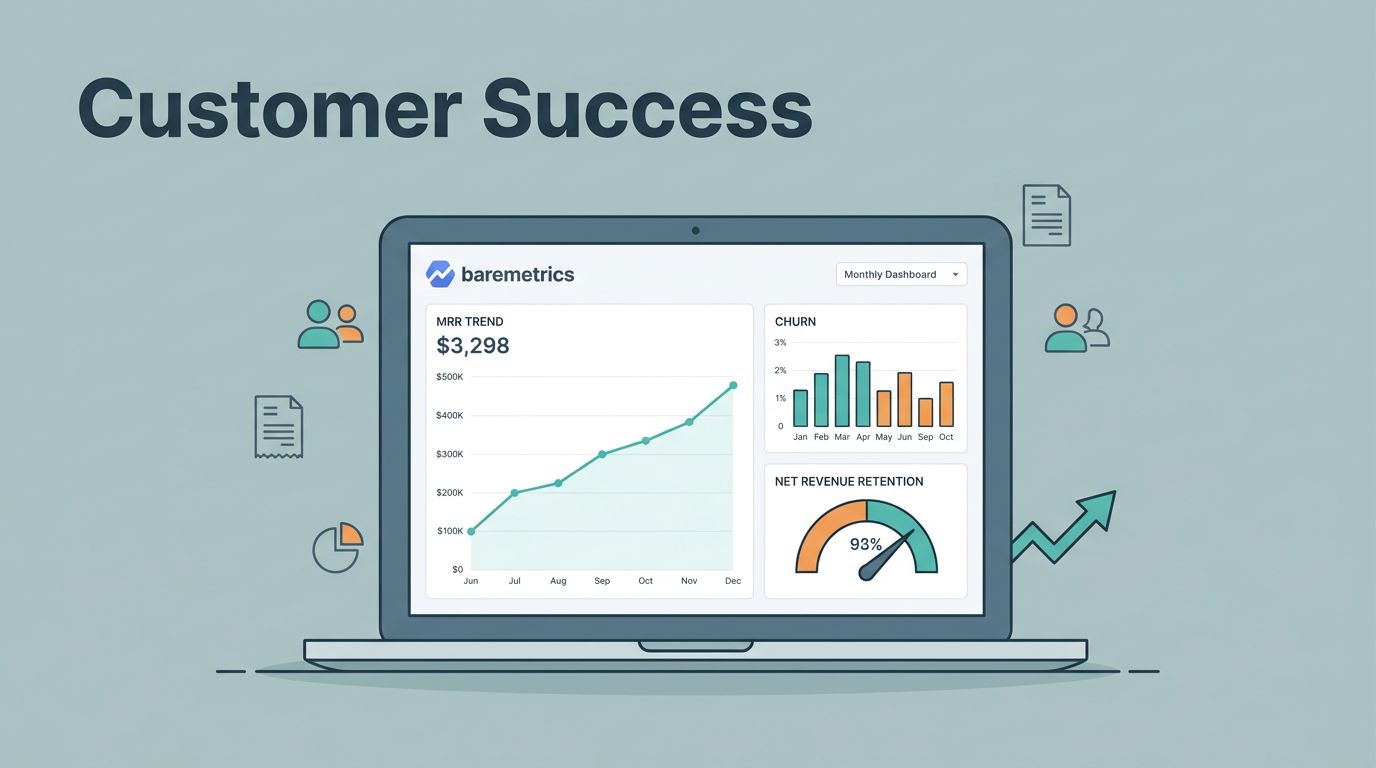
I want the first screen to answer one thing, are existing customers getting healthier or not? Baremetrics helps with that because it shows live changes in signups, payments, upgrades, downgrades, and cancellations, which means I do not wait for a week-old export to tell me what happened.

I like keeping the top row tight. MRR, net new MRR, churn, and active customers are enough to give me a fast read. If I need a model for layout, I use building a smarter SaaS metrics dashboard as a guide.
Baremetrics also makes it easier to organize the view by audience. When I look at the dashboard for leadership, I keep it simple. When I look at it for customer success, I care more about signals that show where intervention is needed.
I also like the way dashboard examples can sharpen my setup. Baremetrics’ SaaS metrics dashboard examples and templates are useful when I want to compare my own layout with a cleaner model.
The real payoff is speed. If I see a churn spike or a downgrade cluster in the morning, I can check the accounts before the day gets away from me. That is a better rhythm than waiting for a month-end report that arrives after the damage is already done.
Cohorts and segments show where churn starts
A single churn rate can hide a lot. One plan can be healthy while another is bleeding. That is why I use segmentation and cohorts together instead of trusting the average.
Baremetrics’ customer retention metrics guide matches the way I think about this. I want to know which customer groups stay, which ones shrink, and which ones grow after signup.
My weekly cohort check usually has three steps:
- I split customers by cohort, plan, or location.
- I compare early behavior with later months.
- I look for changes in expansion, downgrade, and churn patterns inside each group.
That review tells me where the problem lives. If a new plan has strong signups but weak month-three retention, I look at onboarding and expectation setting. If one region has steady signups but weak expansion, I look at usage, support response time, and follow-up cadence.
I also use LTV to decide where to focus my time. A segment with strong retention and healthy expansion deserves more attention than a low-value group that keeps burning support hours. For that, I keep predicting customer value with Baremetrics data close by.
Averages are comfortable, but they can hide the account group that is quietly slipping.
That is why I trust segments more than broad summaries. When I can see the pattern by customer type, I can act before churn spreads across the whole base.
Recovery tools turn failed payments into saved revenue
Failed payments are easy to ignore because they look small on their own. A few misses do not feel like a crisis. Then the cancellations stack up, and the month ends with a hole in revenue.
That is where Baremetrics Recover helps. I use it to handle dunning, catch failed cards, and reduce the number of accounts that disappear for payment reasons instead of product reasons. If a customer meant to stay, I want the system to give me a second chance.
When revenue drops, I do not stop at the number. I want the reason attached to it. Baremetrics’ feedback tools help me learn why revenue was lost, which is better than a vague note in a spreadsheet.
If failed charges spike in one segment, I check the billing path, the reminder timing, and the follow-up message. If downgrades rise after a renewal wave, I look at product fit and account handoff. If cancellations cluster around one plan, I ask whether pricing, usage limits, or support response is pushing people out.
I like this part of the workflow because it connects data to action. Customer success is not only about saving accounts with a friendly email. It is about spotting the reason behind the loss and fixing the process that caused it.
Forecasting that helps me plan the next quarter
Forecasting matters because it lets me act before the month ends. If I wait until the close, I am already looking backward.

I use Baremetrics forecasting to test whether current retention trends can support the plan I have in mind. If churn rises, the forecast softens. If expansion revenue improves, the path looks better. That gives me a cleaner basis for hiring, spending, and customer success priorities.
I also use goals and benchmarks to keep my judgment honest. A metric feels different when I know the target. A 4 percent churn rate can look acceptable until I compare it with my own goal, or with the kind of retention I need for the next funding round.
That wider view is helpful too. Baremetrics’ 10 reporting metrics every subscription SaaS company must track gives me a broader checklist when I want to make sure nothing important is missing.
My rule is simple. If the forecast moves, I move something with it. That might mean a sharper onboarding flow, a different renewal touchpoint, or a change in how I route high-value accounts. Numbers matter most when they lead to a decision.
Conclusion
When I track SaaS customer success metrics in Baremetrics this way, I see more than revenue. I see where customers are settling in, where they are stretching, and where money is slipping out.
The value is in the pattern. Dashboards show the current state, cohorts show where the trouble starts, recovery tools catch avoidable loss, and forecasting gives me a reason to act now instead of later.
That is what makes Baremetrics customer success metrics useful to me. They turn retention into something I can see, read, and improve before the next month closes.