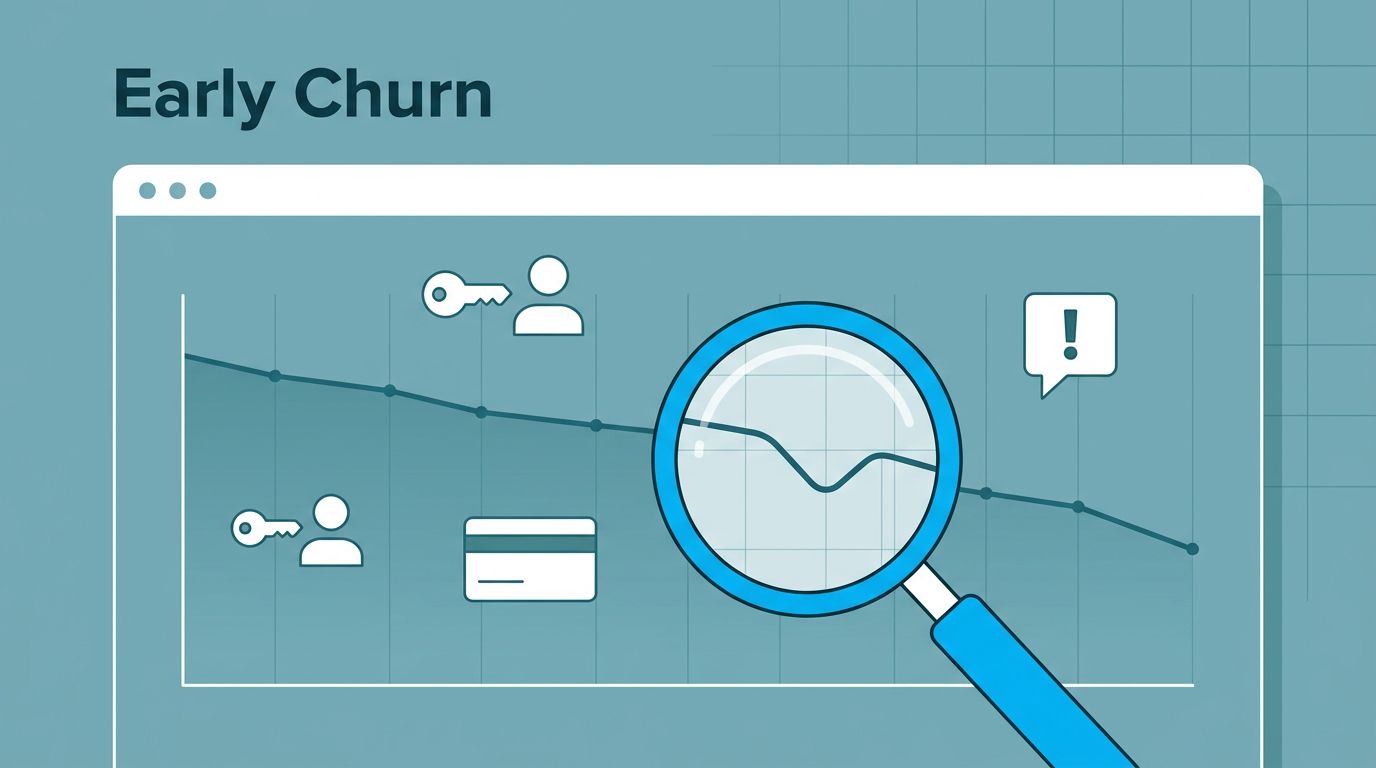
Churn rarely begins with a clean cancellation. It starts with a dropped login, a failed card, or a customer who stops using the product they once pushed hard to buy.
When I look at Baremetrics churn data, I am not hunting for a dramatic red alert. I am looking for small shifts that tell me a subscription is loosening before it breaks.
That matters because once an account goes quiet, the fix takes more time and more trust. Baremetrics helps me see the slip while there is still room to act.
The warning signs I watch first
I start with behavior, then billing, then support. Those three usually tell me more than a single survey response ever will.
A customer who used to log in every week and now shows up once a month is sending a message. So is the account that keeps downgrading, or the one that opens support tickets every time a new admin joins. If the product feels hard to use, or the plan no longer fits the team, churn risk rises fast.
I keep a simple map of the signals I trust most.
| Early signal | What it can mean | What I check next |
|---|---|---|
| Failed payments | Card issue, billing friction, or abandoned use | Retry rate, payment history, recent account activity |
| Lower logins | Stalled onboarding or fading value | Active seats, feature use, account age |
| Downgrades | Budget pressure or poor plan fit | Plan history, renewal timing, seat count |
| More support tickets | Confusion, bugs, or service strain | Ticket themes, time to resolution, owner notes |
| Shrinking team activity | Champion risk or weak adoption | Invited users, admin actions, shared usage |
Those signals line up with the logic behind behavioral churn scoring, where billing events, usage, and support patterns often matter more than a late-stage complaint.

The takeaway is simple. I do not wait for one signal to prove the case. I watch for a cluster, then I move.
What Baremetrics shows before a customer cancels
Baremetrics is useful because it brings subscription movement into one place. I can look at revenue, customer records, and billing patterns without piecing together half a dozen exports.
When I want a clearer read on risk, I segment the data. Plan type matters. Billing interval matters. Customer age matters. So does the difference between a healthy annual account and a monthly account that never really settled in.
My tracking key MRR metrics guide goes deeper into the numbers I use when I want to separate noise from real churn pressure.
A billing problem can look like churn, but it may only be a failed card or a payment method that expired.
That is where Baremetrics can save me from the wrong response. If a customer is still using the product but a payment failed, I do not treat it like a lost account. I treat it like a recovery problem.
Baremetrics Recover matters here because failed payments need a fast, clear path back to good standing. If I can fix the money flow, I do not have to start a retention fight that never needed to happen.
I also pay attention to plan mismatch. A customer can stay subscribed and still be on the edge of churn. If they pay for a larger package but only one person uses it, the plan may be too big. If everyone keeps asking for features that the current tier does not cover, the account is already under pressure.
That matches what I see in most churn reviews, the average account is rarely the one that leaves. The account in trouble is usually hiding inside a segment.
How I turn a risk score into action
A warning sign is only useful if I know what to do with it. Otherwise, I am just collecting anxious facts.
When I see a risk pattern, I move in this order:
- Confirm the signal. I check whether the drop is real or just a short dip after a holiday, a rollout, or a pricing change.
- Segment the account. I look at plan, tenure, and value. A small self-serve user needs a different response than a large team account.
- Assign the owner. Finance, customer success, and product should not all assume someone else is handling it.
- Choose the fix. Billing issues get billing help. Usage issues get onboarding or training. Fit issues need a real conversation about the plan.

I try to keep the response matched to the signal. If logins drop, I ask where the product got confusing. If support tickets spike, I ask whether the issue is product quality or process friction. If a high-value account starts downgrading, I check whether budget pressure or weak adoption is driving the change.
That is also where timing matters. A lot of teams wait until renewal is close. I prefer to act earlier, especially on larger accounts. If a customer matters, 90 days can pass quickly. By then, the story may already be set.
I also want one owner for each at-risk account. A shared inbox is not a plan. A named person with a clear next step is.
Why cancellation reasons sharpen the picture
Baremetrics tells me what changed. Cancellation reasons help me understand why.
I use Baremetrics Cancellation Insights when I want to collect reasons in the cancel flow or follow up after a customer leaves. That matters because a single churn reason can be misleading. A customer may pick “too expensive” when the real issue is low usage, weak adoption, or a bad plan fit.
Once those reasons pile up, patterns appear. If the same cohort keeps naming missing features, I have a product gap. If newer accounts keep saying setup was harder than expected, I have an onboarding problem. If billing complaints show up next to failed payments, I have a process problem.
Baremetrics is strong on the numbers side, but it does not replace real conversations. For the human layer, I like the framing in a modern churn playbook, where structured interviews help surface the strategic reasons people leave. I do not need that every day, but I do need it when the numbers alone stop making sense.
A weekly churn review that keeps me honest
My best retention work comes from a short, repeated review. I do not need a giant dashboard session every week. I need a calm pass through the accounts that matter.
I usually check:
- accounts with failed payments in the last few days
- plans where usage fell faster than revenue
- customers who downgraded and then stopped engaging
- support-heavy accounts with weak adoption
- renewals that are close enough to need early contact
I also start renewal conversations early for important accounts, often around 90 days out. That gives me time to fix a billing issue, reshape a plan, or bring in the right stakeholder before the customer starts shopping around.
When I want to remind myself where Baremetrics fits in the stack, I look back at my Baremetrics analytics platform review. It helps me keep the tool in the right role. I use it for subscription truth, not as a replacement for product analytics, support systems, or customer interviews.
That boundary matters. Baremetrics gives me the revenue pattern. Other tools fill in the behavior and the conversation. Together, they tell a cleaner story than any one dashboard can.
Conclusion
Churn usually leaves a trail before it leaves a cancellation. The trail shows up in billing hiccups, weak adoption, downgrades, and support noise.
Baremetrics helps me spot those shifts early, which gives me time to act while the account still has momentum. When I combine that view with cancellation reasons and a steady review process, I get a much clearer read on risk.
That is the part I care about most. Early churn signals are not a warning to panic. They are a chance to fix the right problem before the customer is gone.