A/B testing gets harder when your website receives only a few thousand visitors each month. Random variation can make a weak change look like a winner, while a useful improvement may need weeks to show a clear pattern.
Small traffic A/B testing works when you reduce the number of decisions inside each test. Use one primary goal, collect clean data, and treat statistical significance as evidence rather than proof. Mida.so helps teams run this process with one place to configure experiments, track conversions, and review visitor behavior.
The tool can improve your testing workflow. It can’t create traffic or remove uncertainty. Your process still determines the quality of the result.
Key Takeaways
- Test one meaningful change and one primary conversion goal at a time.
- Use Mida.so to centralize experiment setup, tracking, and result review.
- Small samples produce wide uncertainty ranges and require longer test periods.
- Don’t stop a test because one variant leads early.
- Combine A/B results with qualitative evidence before making a permanent change.
Why Small-Traffic Tests Need Tighter Controls
A high-traffic website can collect thousands of conversions quickly. A small SaaS website may need several weeks to collect the same evidence. A few sales, trial starts, or demo requests can shift the reported conversion rate by several percentage points.
That movement doesn’t always come from your change. It can come from traffic sources, weekdays, campaigns, device types, or ordinary chance.
Imagine a landing page that receives 2,000 visitors in a month. The original page gets 20 signups. A new version gets 24. The conversion rates are 2% and 2.4%. The new page leads, but four extra signups aren’t enough to establish a reliable result by themselves.
This is the first operating rule:
A leading variant is not automatically a winning variant.
Statistical significance asks whether the observed difference is unlikely under a stated model of random variation. It doesn’t confirm that the change caused the result. It also doesn’t tell you whether the improvement is large enough to matter financially.
Small traffic increases the risk of two errors:
- False positive: You ship a change that looked successful but doesn’t improve performance after launch.
- False negative: You reject a useful change because the test didn’t collect enough data.
You can reduce both risks by choosing larger, more meaningful changes and setting a realistic minimum detectable effect. If your current conversion rate is 2%, don’t design a test around detecting a tiny change from 2% to 2.05%. Your traffic may never support that decision.
Use a sample size calculator for A/B tests before you launch. Enter your baseline conversion rate, expected improvement, confidence level, and statistical power. The result gives you a planning estimate, not a guarantee.
Set Up a Clean Experiment in Mida.so
Mida.so is useful when your testing process needs fewer disconnected tools. Start with the site or product area you want to measure. Then define the decision before creating the variant.
A test should answer one clear question. Examples include:
- Does a shorter signup form increase completed registrations?
- Does a clearer pricing comparison increase demo requests?
- Does moving the primary call to action above the fold improve trial starts?
Avoid combining several unrelated changes in one experiment. If you change the headline, form length, button copy, pricing layout, and page speed at once, you may see an outcome but won’t know what caused it.
1. Record the baseline
Review the current page before you touch it. Record the primary conversion rate and the number of visitors, conversions, and traffic sources for a defined period.
Also record important secondary metrics. These can include form errors, activation, paid conversion, refund requests, or support contacts. Secondary metrics won’t replace the primary goal, but they can expose a bad trade-off.
For example, a shorter form may increase signups while reducing the percentage of users who complete onboarding. A test that measures signups alone can hide that problem.
2. Create the test and define the goal
In Mida.so, configure the original page and the variation. Select a primary conversion event that matches the business decision. For a pricing page test, that might be a completed demo request rather than a button click.
A click is useful when it leads directly to value. It is weaker when users click through and abandon the next step.
Set the audience before launch. Decide whether the test applies to all eligible visitors or a specific segment, such as new visitors, mobile users, or visitors from paid search. Don’t change the audience halfway through the test unless you document the change and treat the result as exploratory.
If your site uses several domains or a separate checkout, confirm that the conversion event can be tracked across the full journey. A test report is only as useful as the event data behind it.
3. QA every path
Run the original and variation yourself on desktop and mobile. Test the form. Test validation messages. Test the thank-you page. Check that the conversion fires once, not twice.
Review the experiment in a clean browser session. Cached pages, ad blockers, consent settings, and logged-in states can change what you see.
Before publishing, confirm these points:
- The correct page receives the experiment.
- Visitors stay in the same variant during their session.
- The primary event records once per intended conversion.
- Existing analytics and payment flows still work.
- Internal traffic and test users are excluded when appropriate.
Mida’s official website and product information can help you confirm the current setup options. Interfaces and plan limits can change, so check the current documentation before assigning a test to a production page.
Read Small-Sample Results Without False Certainty
Mida.so can show which variant has more conversions. Your job is to decide how much confidence that difference deserves.
Start with the sample, not the percentage. A variant with a 50% higher conversion rate may have produced only three additional conversions. That result can be useful as an early signal, but it is not a reason to rewrite your website immediately.
Look at these four values together:
- Visitors assigned to each variant
- Number of conversions
- Conversion rate
- Estimated uncertainty around the difference
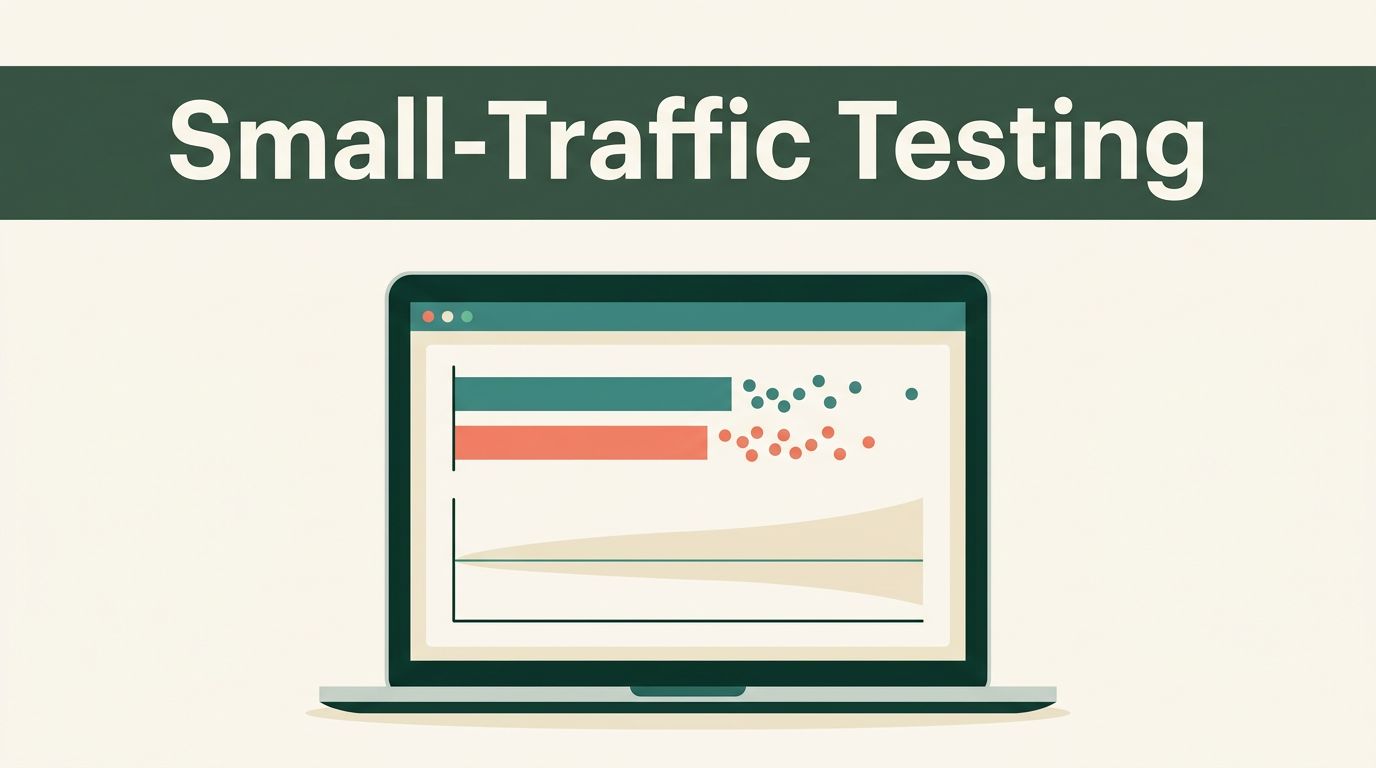
A confidence interval gives a range of plausible values around an estimate. Wide intervals are common with low traffic. They mean the true effect could be much smaller, much larger, or close to zero.
Statistical significance also needs careful handling. A result below a chosen p-value threshold doesn’t mean there is a 95% chance your variant is correct. It means the observed result would be less likely under the test’s assumptions. Those assumptions include independent observations, correct tracking, stable allocation, and a properly defined analysis.
Read Optimizely’s explanation of statistical significance if your team needs a shared definition.
Don’t check the dashboard every hour and stop when the result turns positive. Repeatedly checking and stopping early increases the chance of declaring a false winner. Pick a stopping rule before launch. That rule might use a planned number of visitors, conversions, or a fixed period that covers normal weekly patterns.
A fixed period doesn’t repair an undersized test. It only prevents a decision based on the first unusual traffic spike.
Separate statistical and business significance
A small improvement can be statistically credible but commercially irrelevant. A large reported improvement can be commercially valuable but too uncertain to trust.
Use a simple decision frame:
| Question | What to check |
|---|---|
| Is the result stable? | Does the direction hold across several time periods? |
| Is the effect large enough? | Does it exceed your minimum useful improvement? |
| Is the data clean? | Did tracking, allocation, and traffic sources remain consistent? |
| Is there a downside? | Did activation, revenue, or quality metrics decline? |
The result is stronger when the variant leads on the primary metric, avoids harm to guardrail metrics, and shows a meaningful effect after enough exposure.
Make Limited Traffic More Useful
You can’t force a small audience to produce large-sample certainty. You can make each test answer a better question.
Prioritize changes with a clear reason behind them. Use user research, support tickets, sales objections, session recordings, and funnel data to identify friction. Mida’s behavioral data can help you see where visitors drop, hesitate, or repeat actions, depending on the tracking features enabled for your account.
Don’t test random button colors because they are easy to change. Test a page element tied to a known problem. A pricing page that receives few visitors may produce more useful evidence from a simplified plan comparison than from five minor visual experiments.
Run fewer tests with stronger hypotheses. Each experiment should state:
- The observed problem
- The proposed change
- The expected user behavior
- The primary metric
- The minimum useful improvement
- The guardrail metrics
- The planned stopping rule
Small traffic also changes how you choose the conversion event. If paid conversions are rare, use a closer but meaningful event such as completed signup or activated account. Track the later business outcome as a guardrail or follow-up metric.
Don’t treat micro-conversions as equal to revenue. A button click is not a customer. A signup is not an activated account. Use the closest reliable event your traffic can support, then check whether the result carries into the next stage.
Segment results only when the segment was planned or has a strong business reason. If you inspect ten device, source, and geography segments after the test, one may look positive by chance. Treat unplanned segment findings as hypotheses for a later test.
For low-volume sites, qualitative evidence matters more. Interview users who saw the page. Review recordings. Ask sales and support teams whether the new message addresses a real objection. This evidence can’t replace an experiment, but it can help you decide whether an uncertain result deserves another test.
A Practical Mida.so Testing Checklist
Use this checklist before you publish a small-traffic experiment:
- Define one decision in one sentence.
- Record the current conversion rate and recent traffic volume.
- Choose a change large enough to produce a meaningful effect.
- Select one primary metric and two or three guardrails.
- Estimate the required sample with a sample size calculator.
- Configure the original and variation in Mida.so.
- Confirm audience rules and traffic allocation.
- Test every conversion path on desktop and mobile.
- Set a stopping rule before the test begins.
- Review the result by sample size, uncertainty, business impact, and data quality.
Keep a test log. Store the hypothesis, launch date, allocation, changes, anomalies, and final decision. This prevents your team from repeating weak ideas and helps explain why an uncertain result was retained, rejected, or tested again.
Mida.so is a practical starting point when you need experiment setup and performance data in one workflow. Try Mida.so with a narrow test first. Use the first experiment to validate tracking and decision-making before expanding to higher-value pages.
Conclusion
Small traffic A/B testing isn’t about forcing certainty from limited data. It’s about reducing avoidable error, testing meaningful changes, and making decisions that match the evidence.
Mida.so can organize the operational work, but it can’t turn 20 conversions into a definitive answer. Use clean tracking, realistic sample expectations, fixed stopping rules, and business guardrails. When a result leads without enough evidence, call it a signal, not a verdict. That discipline keeps experimentation useful when traffic is limited.