Baremetrics Coupon Tracking for Profitable Subscription Growth
When I run a discount campaign, I want more than a redemption count. I want to know whether the coupon pulled in durable revenue or just shaved money off the top. That is where Baremetrics coupon tracking matters, because it helps me read t...

When I run a discount campaign, I want more than a redemption count. I want to know whether the coupon pulled in durable revenue or just shaved money off the top. That is where Baremetrics coupon tracking matters, because it helps me read the real cost of a discount, not just the fact that someone used one.
For SaaS founders and finance teams, a coupon can look healthy on day one and ugly by month three. A spike in signups means little if churn rises, LTV falls, or expansion slows. I use Baremetrics to spot that tradeoff before a promotion becomes a habit.
Why coupon count is the wrong number to watch
Redemption totals are easy to celebrate and easy to misread. If 200 prospects use a coupon, the campaign may look strong, yet the business could still lose more revenue than it gains.
I treat Baremetrics as a finance lens inside a wider subscription analytics stack, not a place to admire charts. My Baremetrics analytics platform review goes deeper on that mindset, but the short version is simple, I care about revenue quality, not vanity lift.
Baremetrics helps because it connects coupon use to the subscription itself. I can see the discount on active subscribers, then compare that against MRR growth and retention. That matters when a coupon changes plan choice, pulls forward a purchase, or attracts a lower-value customer.
Timing matters too. A launch-week spike and a long-tail promo tell different stories. A coupon that pulls in annual subscribers can look weak in month one while still winning over 12 months.
For teams that need a second layer of billing detail, coupon code visibility shows why line-level coupon context matters for finance and revenue checks. The more clearly I can trace a discount, the easier it is to judge whether it paid off.
The Baremetrics metrics that tell the real story
I do not judge a coupon on one metric. I look at a small set that shows both growth and drag. My own tracking subscription performance metrics guide keeps me focused on the numbers that change decisions.
| Metric | What I look for | What worries me |
|---|---|---|
| MRR | Discounted plans add net new recurring revenue | MRR rises briefly, then stalls after the promotion |
| Churn | Coupon users stay at least as long as normal customers | Coupon cohorts leave faster than baseline |
| LTV | Lifetime value still clears the discount cost | LTV drops below my payback window |
| Conversion rate | The coupon improves trial-to-paid or checkout completion | Conversion lifts, but retention weakens later |
| Discount impact | Revenue lost to the coupon stays controlled | The discount cost grows faster than new revenue |
This table gives me a fast read, but the real answer comes from the relationship between the columns. A coupon can lift conversion rate and still be a bad trade if churn climbs with it. Likewise, a lower MRR month can still be fine if the cohort sticks longer and expands later.
I also watch plan mix. If a coupon pushes buyers into a cheaper plan, the campaign may look efficient on the surface while shrinking future MRR. That is where Baremetrics helps me separate short-term demand from long-term value.
How I decide if a coupon is profitable
I start with cohorts. Coupon users need a comparison group, or the numbers lie. When I compare discounted customers with non-discounted customers who entered around the same time, I can see whether the coupon changed behavior or just timing.
I want to know three things first. Did conversion rate improve? Did churn hold steady? Did LTV stay healthy after the first billing cycle?
Baremetrics makes this easier because I can line up the revenue effect with the customer’s billing life. That gives me a real read on whether the discount changed buying intent or just delayed payment.
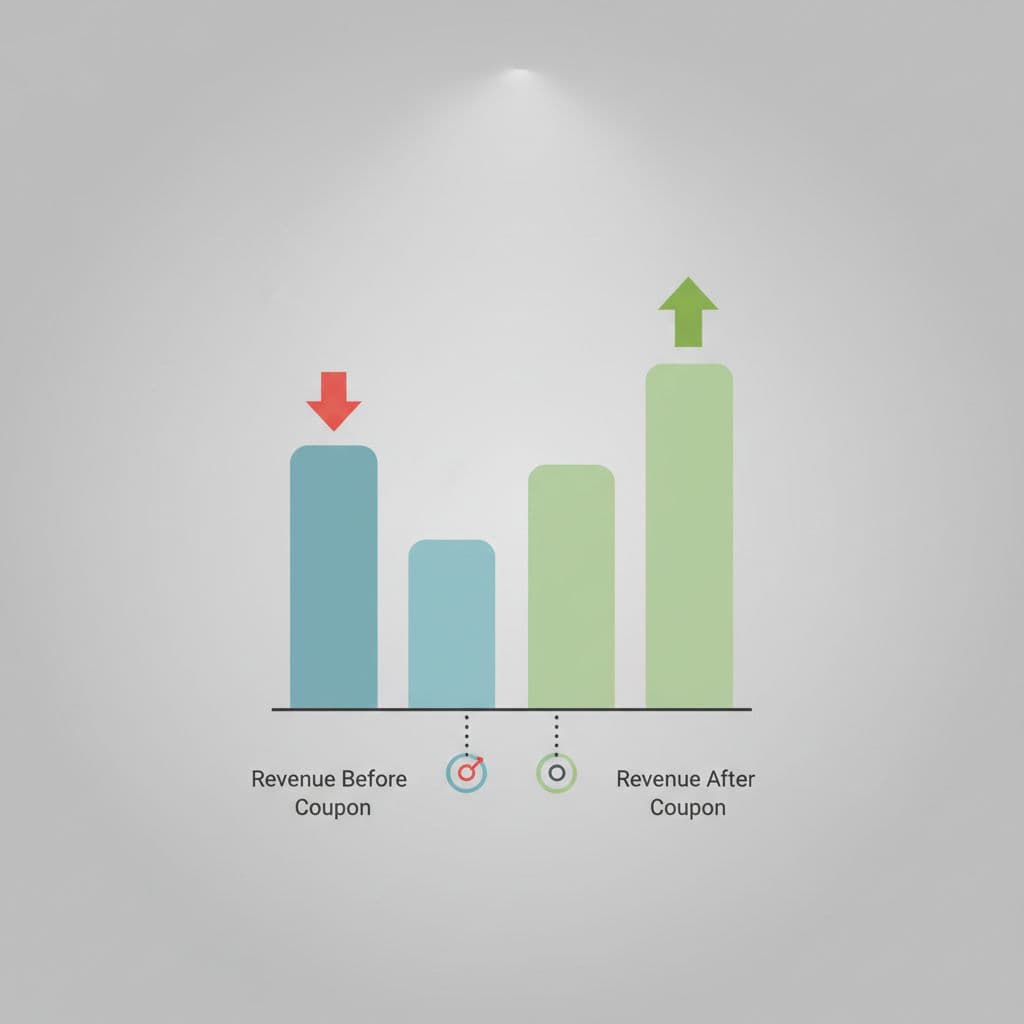
When I want a second view on coupon effectiveness, I like Count’s Stripe coupon performance analysis because it frames the same problem in terms of revenue impact and customer behavior. That is useful when I need to compare percentage discounts, fixed discounts, or different campaign windows.
A discount that improves conversion but hurts LTV is a delayed expense, not a growth win.
I use that rule constantly. If the coupon buys customers who leave quickly, the campaign is a tax on revenue. If it brings in customers who stay, upgrade, and renew, then the discount may be a smart acquisition cost.
My monthly review workflow in Baremetrics
I keep the review simple so it happens every month. The process works best when it stays close to the numbers and far from guesswork.
- I isolate customers who used a coupon in the last 30 to 90 days.
- I compare their MRR, churn, and LTV against a no-coupon group.
- I check whether the coupon changed plan mix, billing cadence, or upgrade behavior.
- I look at the size of the discount next to the revenue it brought in.
- I decide whether to keep the coupon, narrow it, or retire it.
That review is easier when the dashboard is already clean. I keep my own Baremetrics dashboard setup guide style view centered on recurring revenue, churn, and retention, so coupon analysis never gets buried under noise.
If the answer is unclear, I do not extend the promotion. Instead, I tighten the offer, shorten the window, or restrict it to a segment that converts well. A broad coupon often feels safe, but a targeted one gives me cleaner data and less revenue leakage.
Conclusion
Coupon campaigns can help growth, but only when the math holds up. Baremetrics gives me the mix of MRR, churn, LTV, conversion rate, and discount impact that I need to judge the trade, not just the traffic spike.
When I review coupon usage this way, the question changes. I stop asking whether the offer was popular and start asking whether it was profitable. That is the test that matters for every subscription business.
