Automating Donor Contact Information Discovery With Twin.so
Development teams waste hours hunting down valid phone numbers and missing email addresses across public business registries. Manually verifying details for major gift prospects slows down active fundraising campaigns and leaves database re...
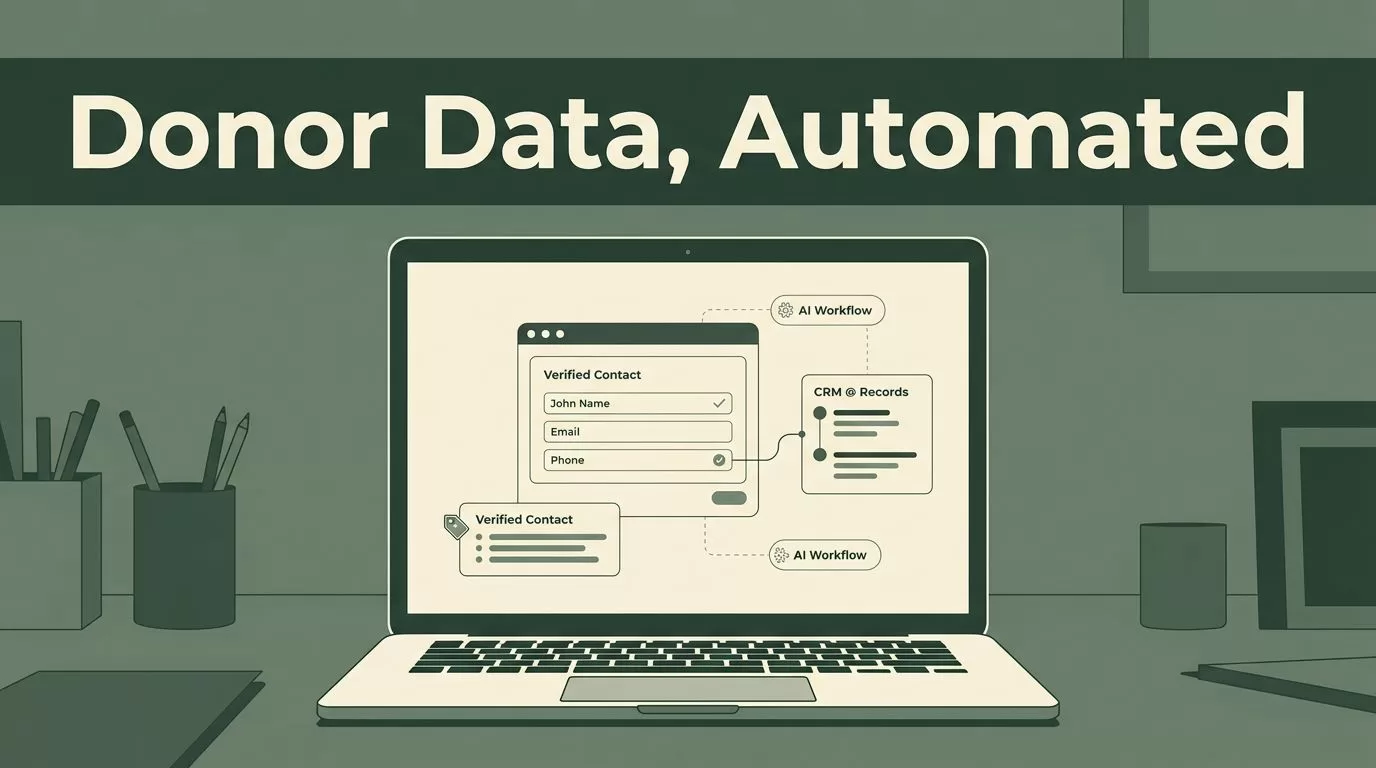
Development teams waste hours hunting down valid phone numbers and missing email addresses across public business registries. Manually verifying details for major gift prospects slows down active fundraising campaigns and leaves database records hopelessly outdated.
Finding accurate donor contact information remains the single biggest operational bottleneck in modern capital campaigns. When your researchers spend half their day on manual data entry, high-value outreach stalls completely.
You can eliminate this manual bottleneck by deploying AI agents to handle prospecting and verification. Twin.so automates this entire discovery process, letting you enrich records and sync them directly into your CRM.
Understanding How Twin.so Handles Data Enrichment
Twin.so operates as an AI agent automation platform built to handle multi-step tasks without requiring custom code. Instead of forcing you to write complex automation scripts, the platform accepts plain-English workflow instructions.
You describe what data you need, and the system deploys autonomous agents to execute the search. These agents pull missing emails, direct phone numbers, and physical addresses from multiple public web sources simultaneously.
The platform uses a credit-based pricing model that scales according to your team’s volume. Self-serve Pro plans start at around twenty euros per month, giving you enough monthly credits to run standard prospect lists.
When standard APIs fail to return results, Twin.so relies on a browser-based automation fallback. This proprietary agent logs into gated portals, navigates complex user interfaces, and extracts structured data from pages that lack public endpoints.
Traditional data apps often break when target websites change their HTML structure. Agentic automation solves this fragility by using visual comprehension to adapt to layout changes dynamically.
Setting Up Your First Automated Workflow for Donor Contact Information
Configuring an automated search pipeline requires a structured approach to keep your operational data clean. You start by defining your target parameters inside the Twin.so dashboard.
Upload a basic spreadsheet containing your target company names, foundation names, or known executive names. Select the specific data points you want to append to each record.
Instruct the agent to search for verified professional email addresses and direct phone lines associated with each entry. Run a small test batch of twenty records to verify that the output matches your expected format before processing thousands of rows.
Check the returned records for accuracy and formatting consistency. Once the test batch clears your internal standards, schedule your agents to run automatically on a weekly basis.
Building reliable prompts is the core requirement for successful agent execution. Write instructions that specify exact output formats, required field names, and acceptable confidence thresholds for phone numbers and email domains.
Integrating Enriched Records Directly Into Your CRM
Raw data sitting in an isolated spreadsheet does nothing to accelerate your fundraising pipeline. You need your freshly discovered donor contact information pushed directly into your central database where development officers can access it immediately.
Twin.so connects natively with major sales and fundraising systems like HubSpot and Salesforce. You map your CRM fields to the corresponding output columns inside your Twin workflow configuration.
The automation pipeline automatically logs activity records, updates prospect stages, and appends new contact fields without manual intervention. If your team operates out of simpler environments, you can route clean lists directly into Google Sheets.
This direct synchronization prevents duplicate entries and eliminates manual copy pasting errors. Your development officers always see up-to-date phone numbers and active email addresses when preparing for donor meetings.
Data hygiene protocols should dictate how incoming records overwrite existing profiles. Configure your CRM mapping rules to flag conflicting phone numbers for human review rather than letting automated scripts overwrite verified donor records blindly.
Maintaining Compliance and Data Privacy Standards
Automated web scraping requires strict adherence to privacy regulations and anti-spam protocols. Nonprofits must respect communication preferences and regional data protection laws when conducting outreach.
Configure your workflows to cross-reference opt-out lists before launching any email campaigns. Never store unverified or outdated contact records that violate local privacy standards in your primary donor database.
For a broader overview of how modern organizations handle append workflows, review this Donor Data Enrichment and Employer Appends FAQ. Keeping your compliance checks strict protects your organization’s reputation and maintains donor trust over time.
Regularly audit your database to prune bounced emails and disconnected phone lines. Clean data keeps your sender reputation high and prevents your outreach messages from landing in spam filters.
Nonprofit compliance teams also need clear documentation on where scraped data originates. Keep a log of your Twin.so workflow parameters so you can answer donor inquiries about data sourcing transparently.
Comparing Twin.so With Traditional Prospecting Tools
Traditional donor research software relies entirely on static, pre-compiled databases that update on quarterly cycles. These legacy databases often contain stale contact details because people change jobs and organizations frequently.
Twin.so takes a dynamic approach by performing live web searches and executing browser actions in real time. When an executive changes roles, the autonomous agent crawls current sources to return fresh contact data instantly.
To explore how specialized predictive platforms evaluate prospect wealth and giving capacity, examine the DonorSearch Ai Predictive Modeling Solution. Combining predictive wealth scores with automated contact discovery gives your development team a complete prospecting toolkit.
For broader institutional research on grantmakers and philanthropic trends, consult the data resources available on the Candid Research Platform. Pairing institutional research with automated contact extraction covers every angle of your development pipeline.
Static databases charge high annual licensing fees regardless of your actual usage volume. Twin.so uses consumption-based credits, making it a flexible option for mid-sized development departments with fluctuating research demands.
Best Practices for Scaling Prospect Research Operations
Scaling your prospect research requires clear operational guidelines to prevent data corruption across your systems. Establish naming conventions for your input lists and workflow templates before launching large batches.
Assign a single team member to manage agent configurations and monitor credit consumption metrics. Review your failed runs weekly to identify broken web scrapers or outdated source URLs that need manual updates.
Pair your automated enrichment pipeline with structured research protocols so your development staff knows how to use the newly acquired data responsibly. When your team follows a repeatable playbook, prospect research shifts from a tedious chore into a predictable growth engine.
Training your development officers on how to review automated outputs prevents bad data from entering active gift discussions. Maintain a feedback loop where fundraisers report invalid emails directly to the research operator so workflow prompts can be refined.
Conclusion
Automating your prospect research transforms how your development team manages pipeline growth. By deploying autonomous agents to handle repetitive data lookups, you eliminate hours of manual searching and keep your CRM records current.
Audit your current prospect lists, set up a small test workflow on Twin.so today, and reclaim valuable hours for direct donor engagement. Clean data and efficient workflows lay the foundation for successful fundraising campaigns.
