Most websites suffer from a quiet leak. Visitors arrive from search engines, paid ads, and social channels, scan your layout, and leave without handing over an email address or creating an account. Bumping up those conversion numbers doesn’t require guessing what color button works today. It requires a disciplined, structured approach to user behavior and rapid experimentation. Mida.so provides the testing infrastructure you need, but tools only work when you pair them with an operational process.
Key Takeaways
- Establish baseline conversion rates and traffic stability before launching any new experiment on your pages.
- Formulate clear hypotheses based on user friction points rather than random design tweaks.
- Monitor segment performance across mobile devices and paid traffic sources instead of relying solely on aggregate totals.
- Define strict decision rules and statistical confidence thresholds before checking live test results to prevent false positives.
- Document every completed test outcome to build an institutional memory that informs your next growth cycle.
Formulating Testable Hypotheses Around User Friction
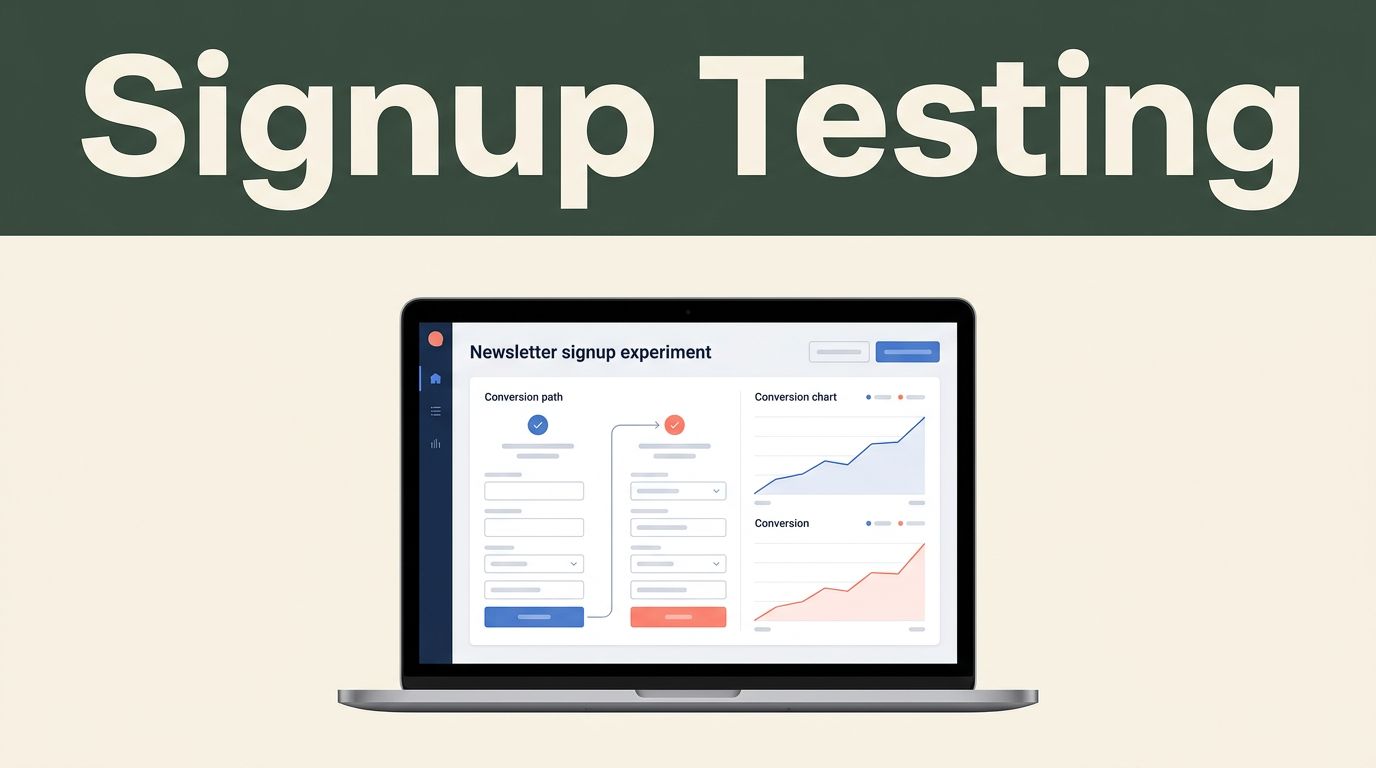
A strong test starts with a specific problem. A vague goal like “improve our newsletter signup form” is not a test brief. A proper hypothesis connects an observed user problem to a measurable change. Write your hypothesis in one clear sentence: changing the email input from a single column to a two-step prompt will increase completed submissions because visitors experience less initial friction. This gives your growth team, designer, and analyst one shared reference point.
Build your control version first. The control is the live page that receives standard traffic. Then build one meaningful variant using Mida.so. Testing five unrelated changes at once can produce a winning percentage, but it won’t tell you which specific change caused the result. Isolate your variables so your data points to an unambiguous winner.


Setting Up Your Newsletter Signup Testing Environment
Before you push any variant live, you need clean baseline data. Pull your current metrics directly from Google Analytics 4. Industry research shows that average performance varies widely by traffic source, device type, and industry vertical. Mobile visitors rarely convert at the same rate as desktop users, and paid search traffic behaves differently than organic social clicks.
Keep your traffic distribution steady and avoid changing audience rules while the test is active. Altering targeting parameters mid-stream creates a new test condition, corrupting sample purity and forcing you to restart your measurement window. Configure your targeting rules in Mida.so to exclude internal company traffic, automated bots, and visitors already enrolled in conflicting experiments. For a deeper look at how leading experimentation platforms handle these workflows, review what is A/B testing and what can you test.
Protecting Core Web Vitals and Page Performance
Speed is necessary for a functional site, but it is not a strategy for persuasion. Most experimentation tools rely on heavy client-side scripts that block the main thread and slow down rendering. When a browser downloads a massive testing bundle before rendering your layout, page load speed drops immediately. Visitors on mobile devices feel this delay the most, resulting in higher bounce rates and abandoned form fields.
Mida.so is engineered for performance with a lightweight script size, but your implementation strategy still matters. Keep your tracking scope limited to the specific pages and audiences that require testing. Treat Largest Contentful Paint and Cumulative Layout Shift as hard test guardrails. If a high-converting variant introduces an annoying layout shift or delays your main hero image, reject the update. A modest conversion gain is never worth a slower mobile experience that frustrates your best prospects.
Reading Mida.so Results Without Chasing Short-Term Noise
A test can collect thousands of visits and still produce the wrong decision if you read the data too early. Real-time monitoring gives you visibility while an experiment runs, but live numbers require statistical discipline. Open your report after launch and inspect the data in a fixed order. First, check the traffic split. If your plan is a fifty-fifty test, visitor counts should remain reasonably close over time. Small differences are normal, but a large gap points to targeting rules or an implementation issue.
Next, check total visitors and conversions. A test with twelve visitors and three conversions has a twenty-five percent conversion rate, but that rate has little decision value. Your interpretation must account for the small sample size. Then review the primary conversion rate for every variation. Keep the raw counts visible because rates based on very few conversions can move sharply. For more details on defining these success metrics correctly, read about what is conversion rate in A/B testing.
| Metric Type | What It Measures | Common Pitfall |
|---|---|---|
| Exposures | Number of users entering each variation | Uneven traffic splits skewing confidence |
| Conversion Rate | Percentage of visitors completing the primary goal | Relying on tiny sample sizes |
| Guardrail Metrics | Page load speed, error rates, and bounce rates | Ignoring negative side effects on mobile |
When evaluating your findings, you must look beyond top-line numbers. A variant that wins overall may underperform for mobile users or specific traffic sources that matter most to your bottom line. Check whether your results remain consistent across important audience segments. You should also review absolute numbers alongside rates. A small percentage difference based on a handful of conversions should never drive a site-wide redesign.
Guardrail metrics protect your bottom line from shallow wins that sacrifice long-term user retention for short-term form submissions.
Documenting and Scaling Your Winning Variations
When your test reaches statistical significance and satisfies your pre-planned sample size requirements, record the outcome inside your experiment log. Classify the result as won, lost, inconclusive, or technically invalid based on your data guardrails. If the variant wins, define the permanent implementation steps for your development team. If the test loses, document what the outcome rules out so you don’t repeat the same mistake next quarter.
To compare how different software options handle these structured workflows, explore this overview of Mida software pricing, alternatives, and more. Keep your stakeholders informed with clear reports that outline what you changed, what the experiment measured, and what the financial impact was.
Conclusion
Systematic newsletter signup testing removes guesswork from user experience design and replaces it with verifiable data. By defining precise hypotheses, establishing robust traffic baselines, and monitoring Mida.so dashboards without reacting to every short-term fluctuation, you protect your conversion pathways from costly mistakes. Focus on one meaningful change at a time, respect your sample size requirements, and let evidence guide your structural updates. Set up your next split test in your workspace today to start validating your user journeys with confidence.