Adopt Rewardful for a B2B SaaS Affiliate Program
Affiliate revenue becomes unreliable when marketing sees clicks, finance sees invoices, and partners see unpaid commissions. You need one controlled system that connects the referral link to the billing record. B2B SaaS affiliate software s...

Affiliate revenue becomes unreliable when marketing sees clicks, finance sees invoices, and partners see unpaid commissions. You need one controlled system that connects the referral link to the billing record.
B2B SaaS affiliate software should track more than signups. It needs to handle paid subscriptions, upgrades, cancellations, refunds, commissions, and payout records without creating a spreadsheet cleanup project.
Rewardful can fit that job when your billing flow, attribution rules, and finance review process are ready before you invite partners.
When B2B SaaS affiliate software fits your plan
Rewardful is built for SaaS referral and affiliate programs that depend on subscription revenue. Its SaaS affiliate platform connects with Stripe so teams can track recurring commissions and subscription changes such as upgrades, downgrades, and cancellations.
This is a fit when affiliates send qualified buyers to a product with a clear paid conversion event. It is less useful when your team cannot define who owns a deal, when a customer becomes commissionable, or how long a referral should receive credit.
Check the commercial fit first
As of August 2026, Rewardful’s published plans start at $49 per month for affiliate-driven revenue up to $7,500 per month. The $99 Growth plan covers up to $15,000 in monthly affiliate revenue. Enterprise pricing starts at $149 per month for higher volumes.
Rewardful states that standard plans have no transaction fees. Its optional Managed Payouts service carries a 3% fee. Your software subscription is separate from the commissions you promise partners.
Model the full program cost before launch:
- The Rewardful plan that matches expected affiliate-driven revenue.
- Commission expense after refunds, credits, and failed payments.
- Partner recruitment and content production time.
- Finance review, payout administration, and dispute handling.
A $49 tool can still support an expensive program if your commission terms are loose.
Ask the questions that expose problems
Start with your billing system. Stripe is the clearest confirmed billing connection in Rewardful’s public product material. If you use Paddle, Chargebee, a custom checkout, or multiple billing accounts, confirm the live integration path and data behavior before you sign a partner.
Also ask these questions:
- Does last-touch attribution match your commercial policy?
- What is the attribution window for your selected setup?
- Can you exclude existing leads, internal purchases, and self-referrals?
- How will finance match a commission to a paid invoice?
- Who owns disputed attribution and payout exceptions?
Public product information does not fully confirm the exact cookie period, cross-device rules, tax document collection, or payout availability in every country. Get written answers for those points if they affect your program.
Build the billing and tracking foundation
Do not recruit affiliates into an untested setup. The system must return the same answer for marketing, customer success, billing, and finance.
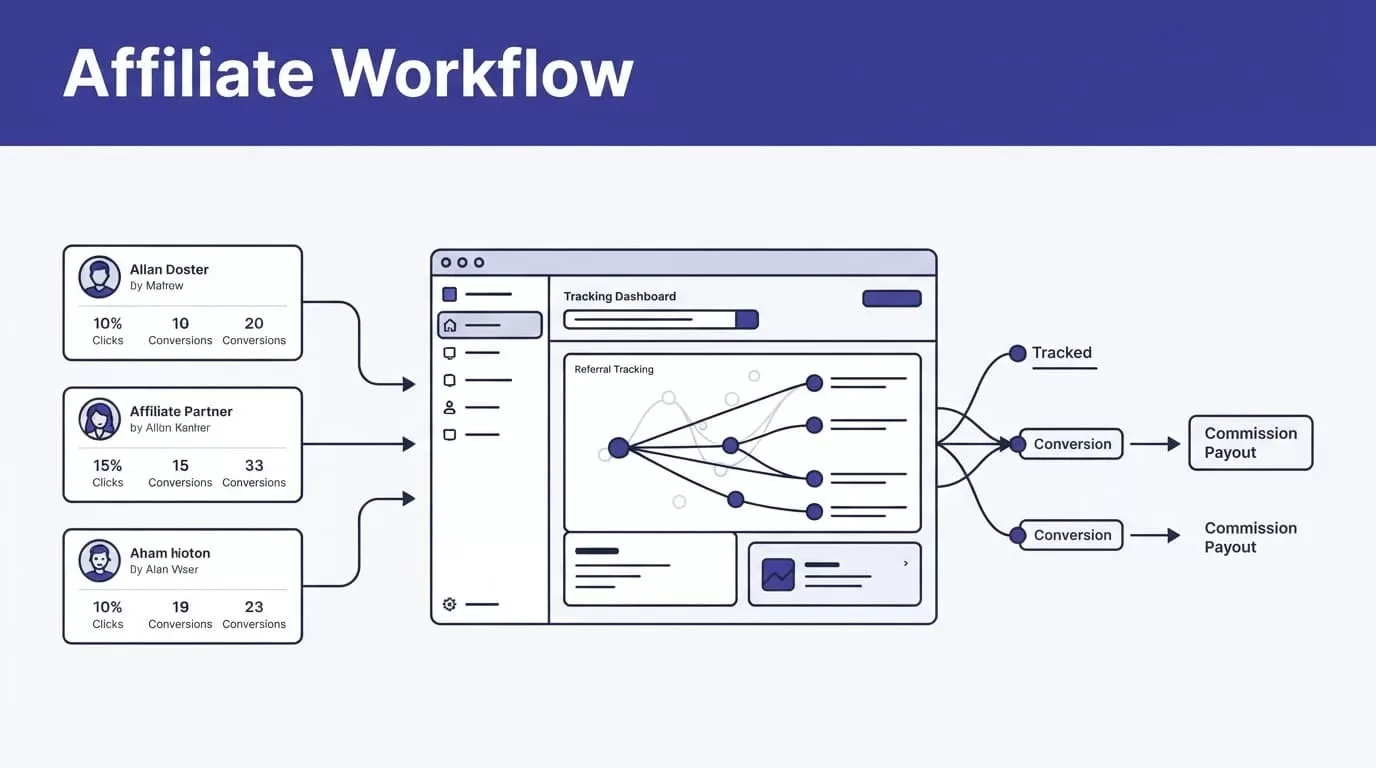
Rewardful’s affiliate tracking features focus on tracking referrals and settling earned commissions. That solves the calculation layer. Your team still needs a defined commercial policy.
Map one pilot campaign
Start with one product, one target buyer, and one commission structure. A pilot makes failures visible before they reach 100 partners.
Complete this implementation checklist before launch:
- Connect the billing account that contains the subscription events you want to track.
- Create one campaign with a documented commission rate and payment rule.
- Define eligible customers, excluded customers, and the point when a commission becomes payable.
- Install the required tracking code on the marketing site and signup path.
- Run a test referral through signup, payment, upgrade, refund, and cancellation.
- Store the partner ID, customer ID, invoice ID, commission status, and payout reference in a fixed record.
- Assign one owner for technical tracking and one owner for commission approval.
Do not assume a connected account is a correct account. A test customer is the fastest way to find a missing script, wrong domain, duplicate claim, or failed billing sync.
Keep your source records intact
Keep a pre-launch export of active customers, subscription status, and current revenue. This is your last trusted dataset if a checkout update breaks tracking.
Do not overwrite a commission record when someone makes a correction. Store the original amount, the changed amount, the reason, the reviewer, and the date. Finance teams need an audit trail, not a dashboard number with no explanation.
If product, finance, and partnerships cannot agree on the records required for launch, Book A Call before you add more software or more affiliates.
Recruit partners who can reach real buyers
A B2B affiliate program is not a public coupon page. Start with people who already have access to your ideal customer profile.
Build a short, qualified partner list
Begin with existing customers who recommend your product, implementation consultants, agencies, integration partners, niche newsletters, community operators, and credible product educators. Each group needs a different offer and message.
An agency may want a recurring revenue share. A consultant may prefer a referral fee tied to a paid customer. A customer advocate may need simple talking points and a link they can share with their network.
Invite 10 to 20 partners for the first cohort. Give them one clear offer. Avoid several campaigns, several rates, and several landing pages at launch. Complexity creates support work before you know whether the partner type converts.
Give partners rules, not vague promises
Your onboarding packet should state the commission rate, attribution rule, payout timing, prohibited traffic sources, trademark rules, disclosure expectations, and refund treatment.
Include approved copy blocks, product screenshots, use cases, and a direct contact for deal questions. Partners should know when to send a prospect to sales instead of pushing a referral link.
Do not allow employees, contractors, or existing customers to create self-referral claims. Flag internal email domains and company payment cards before the first payout run.
Set attribution rules before the first click
Rewardful is commonly described as using last-touch attribution. That means the most recent eligible referral interaction receives credit. This can work well for SaaS, but only if your team defines what “eligible” means.
Write the policy in plain language
State whether a referral must be a new customer, whether an open sales opportunity is excluded, and whether a partner earns commission on expansion revenue. Define what happens when a buyer uses an affiliate link after a sales call.
Your policy should also cover:
- Referral link and coupon-code conflicts.
- Free trials that convert after the attribution window.
- Upgrades, downgrades, pauses, and reactivations.
- Refunds, chargebacks, account credits, and failed invoices.
- Partner-owned leads that enter through a demo form.
Use your privacy notice and consent process to explain tracking where required. Do not treat attribution data as separate from your normal customer-data controls.
Test the full customer path
Run controlled tests through the full sequence: affiliate click, signup, paid invoice, upgrade, refund, and cancellation. Compare the tracked result with the underlying billing record after each event.
A click report does not prove correct attribution. The paid customer, invoice, commission amount, and refund status must match the billing data.
Review a small sample every week during launch. Check for missing attribution, duplicate claims, self-referrals, and commission reversals. A system that creates hours of correction work is not saving your team time.
Manage commissions as a finance process
Commission rules should be simple enough for partners to understand and strict enough for finance to reconcile. Start with one model, such as a percentage of eligible recurring revenue or a fixed amount after a customer reaches a paid milestone.
Define the commission math
Write down the exact calculation. For a recurring share, decide whether the rate applies to gross invoice value, net revenue after credits, or another defined amount. Exclude sales tax and payment-processing costs only if your agreement says so.
Set a payment hold period that accounts for refunds and payment failure. Do not promise “lifetime” commissions unless you have defined the end date, eligible plans, account transfers, and cancellation rules.
Rewardful’s public materials describe commission configuration options, but your agreement is the source of truth. If a feature or rule matters to your program, test it in the account before announcing it.
Reconcile before payout
Rewardful’s commission payment guide explains how Stripe subscription data, refunds, and payouts connect in the workflow. Use that connection, but keep an approval step outside automated status changes.
For every payout cycle, reconcile:
- The affiliate and campaign that earned the commission.
- The customer and paid invoice behind the reward.
- Any refund, credit, chargeback, or cancellation adjustment.
- The approved amount, payout date, method, and payment reference.
Track reconciled payouts, not exported payouts. A payout file is not proof that a partner received the correct amount.
Confirm payment-provider availability, payout thresholds, tax reporting, contractor classification, withholding, and record-retention requirements with qualified legal and tax advisers. These obligations depend on where your company and affiliates operate.
Measure affiliate performance after revenue clears
Clicks can be useful for diagnosing content. They are not the KPI that funds a B2B SaaS affiliate program. Measure paid customers and retained revenue.

Use a revenue-first KPI set
Review these measures by partner, campaign, and acquisition period.
| KPI | Calculation | Decision it supports |
|---|---|---|
| Confirmed affiliate customers | Paid customers with validated attribution | Shows which partners drive real buyers |
| Referral-to-paid conversion | Confirmed paid customers divided by referred signups | Exposes weak traffic quality |
| Net affiliate revenue | Attributed subscription revenue less refunds and credits | Shows economic value after reversals |
| Commission rate | Approved commissions divided by net affiliate revenue | Controls program margin |
| Payout exception rate | Disputed, missing, or corrected payouts divided by total payouts | Shows operating risk |
Review activation and retention alongside these numbers. A partner that sends many low-fit trials can look successful until the first renewal period.
Launch small, then expand
Run the first cohort for 30 days before broad recruitment. Hold a weekly review with partnerships, finance, and the product owner.
Expand only after your team can match affiliate records to billing records without manual guessing. Keep an alert for sudden drops in attributed paid customers, failed tracking, duplicate claims, and unexpected commission spikes.
A B2B SaaS affiliate software rollout works when the accepted records are accurate, the rules are visible, and payouts can be explained line by line.
Final decision
Rewardful is a practical option for SaaS teams that want affiliate tracking connected to subscription billing and recurring commission logic. Its value depends on the operating controls around it.
Start with one campaign, a small partner group, tested attribution, and a weekly billing reconciliation. Reliable affiliate revenue is paid, retained, and traceable revenue.
