How I Spot New DeFi Tools With Exploding Topics
The fastest DeFi tools usually look small before they look famous. I use Exploding Topics as an early radar because it shows me which ideas are heating up before the crowd piles in. That matters in April 2026, because a lot of DeFi growth i...

The fastest DeFi tools usually look small before they look famous. I use Exploding Topics as an early radar because it shows me which ideas are heating up before the crowd piles in.
That matters in April 2026, because a lot of DeFi growth is hiding inside tooling, not headlines. I keep seeing AI agents, vaults, RWAs, and institutional lending surface again and again.
I don’t treat that as proof. I treat it as a lead, then I check whether the tool has real users, real security, and a reason to exist.
What Exploding Topics tells me first
I never trust one spike. I want a steady slope, related terms, and a story that makes sense.
The Exploding Topics DeFi trends page gives me the first pass. Then I compare what I see with my early-stage consumer trends guide and my uncrowded markets playbook. The same pattern shows up in all three places, rising interest means more when it grows in a narrow lane.


I also ask a simple question, what is rising here? Sometimes it’s a token. Sometimes it’s a tool. Sometimes it’s only a naming trend. That distinction saves me from chasing noise.
A rising topic is only a lead. The real test is whether wallets and liquidity follow.
How I decide whether a DeFi tool is more than hype
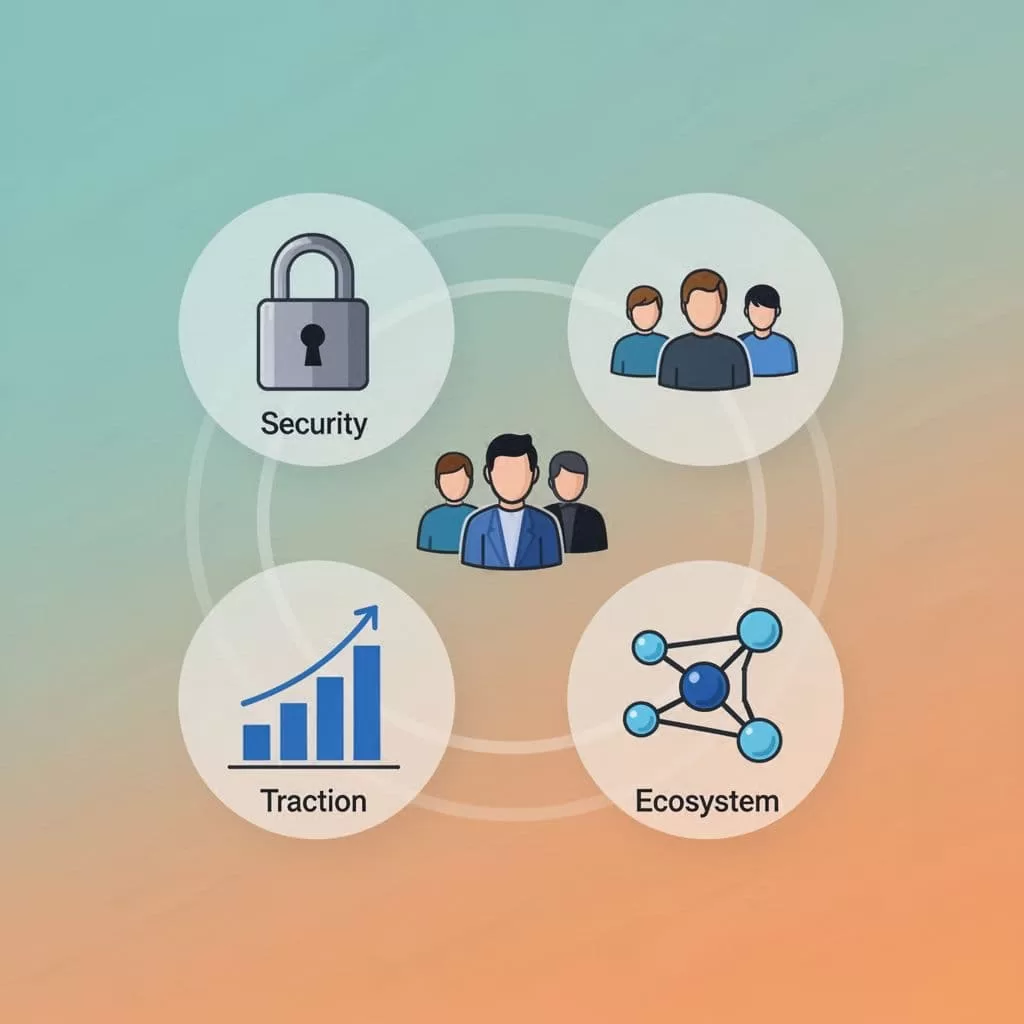
Once a topic looks hot, I run it through a basic filter. I want proof that people use it, not just talk about it.
| Signal | What I check | Why it matters |
|---|---|---|
| Traction | active wallets, TVL, repeat users | Shows real demand |
| Utility | the job the tool actually does | Stops me from chasing novelty |
| Token risk | unlocks, emissions, fee share | Cuts surprise dilution |
| Security | audits, permissions, bug bounties | Bad code breaks trust fast |
| Team credibility | public history, docs, prior launches | Good teams ship faster |
| On-chain activity | tx count, retention, liquidity depth | Reveals use beyond hype |
| Ecosystem fit | chain, wallet, and bridge support | Tools fail when they don’t fit the network |
That table is my shortcut. If a project looks good in one column but weak in three others, I slow down.
I also cross-check bigger shifts with current research. An April 2026 analysis on AI agents in new DeFi protocols says AI agents are becoming part of protocol design, not a side feature. That matters because automation changes how a DeFi tool works day to day.

The DeFi tools I keep seeing rise in 2026
Some categories keep showing up because they solve real problems.
AI agents are the loudest signal right now. They matter because they can handle trading, routing, and risk checks without constant hand-holding. A project like Almanak matters here because it treats automation as core plumbing. That’s a different shape than a flashy dashboard with no depth.
Vaults are another strong signal. Jupiter’s vault products and Sui-based yield vaults matter because they wrap a complex strategy into something easier to use. That kind of packaging usually helps adoption, especially for users who want exposure without managing every move themselves.
RWAs also deserve attention. They connect DeFi to assets people already understand, like funds, bills, and debt instruments. That gives the category a real-world anchor, which helps it feel less like pure speculation.
Institutional lending is the last bucket I watch closely. Aave keeps coming up because deep lending markets attract serious liquidity and conservative users. DEXTools’ DeFi trends in 2026 coverage points to the same shift, more tokenization, more privacy, and more infrastructure that can handle larger flows.
When I see the same category showing up in trend tools, on-chain data, and product launches, I pay attention. That is when a topic starts to feel like a market, not a mood.
How I turn a trend into a shortlist
At this stage, I stop reading broadly and start researching tightly.
- I open the protocol docs and audit pages.
- I check tokenomics, unlocks, and who earns fees.
- I look at on-chain activity in tools like Dune, DefiLlama, and chain explorers.
- I ask whether the tool fits the chain and the user it claims to serve.
That last step matters more than people think. A good tool on the wrong chain can still stall. A strong team with weak docs can also lose users fast.
I use the same filtering habit I describe in my early-stage consumer trends guide and my uncrowded markets playbook. The category changes, but the logic stays the same.
This is for research and education only, not financial advice. I still verify code quality, liquidity, security, and local rules before I touch any protocol.
The pattern I trust most
Exploding Topics helps me spot the first spark. It does not tell me what will last.
I look for DeFi tools with real traction, clear utility, sane token design, and a team that can ship. In April 2026, that filter keeps me focused on what matters, not what shouts the loudest.
If a tool survives that test, it stays on my watchlist.

