How I Spot Early Consumer Trends With Exploding Topics
Every month, a few consumer ideas start climbing before most people notice. In April 2026, I see that in things like cold plunge tubs, AI air fryers, red light masks, and probiotic soda on Top Trending Topics (April 2026). That matters beca...

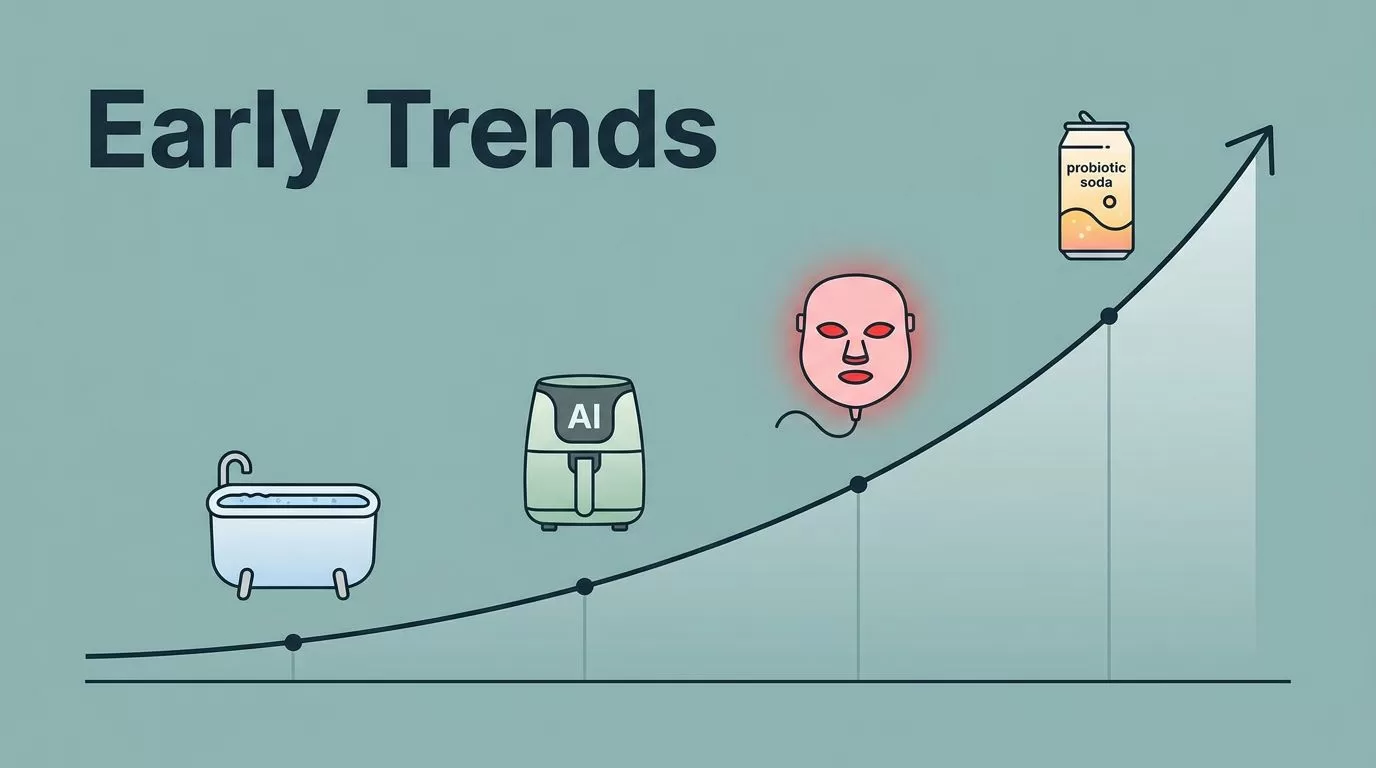
Every month, a few consumer ideas start climbing before most people notice. In April 2026, I see that in things like cold plunge tubs, AI air fryers, red light masks, and probiotic soda on Top Trending Topics (April 2026).
That matters because I don’t want to build content, products, or campaigns around late signals. I want the first useful clue, then I want proof. That is why I use Exploding Topics consumer trends as an early read, then I test the idea against demand, intent, and fit. The next step is simple, I start with the shape of the trend.
I Start With the Shape of the Curve
I care more about the slope than the spike. A sharp jump can come from one viral post, but a steady climb tells me people keep coming back. When I scan Exploding Topics, I look for that repeat motion across weeks or months.
That is also why I keep my early consumer trends guide close, along with my Exploding Topics trend spotting method. Both help me sort a rising signal from a passing burst.


I also check whether the topic expands into clear use cases. A trend around fitness recovery can turn into products, content, or services. A trend around kitchen AI can turn into reviews, demos, or comparison pages.
I also compare categories, because a wellness spike and a gadget spike behave differently. One may drive repeat buyers. The other may drive clicks and short tests. If I can map the path from attention to use, I pay close attention.
The Signals I Score Before I Trust a Trend
I use a simple scorecard because excitement can blur judgment. For every topic, I ask whether the growth is steady, whether search demand is rising, and whether people are talking about the problem in useful ways. I also compare what I see with 11 Important Consumer Trends (2024-2027) when I want a broader read.
| Signal | What I want | Why it matters |
|---|---|---|
| Growth trajectory | A steady rise over weeks or months | It shows momentum, not a quick flash |
| Search demand | More people searching the same idea in different words | It proves curiosity is turning into interest |
| Social discussion | Real conversations on Reddit, TikTok, YouTube, and forums | It shows how buyers describe the pain |
| Product-market fit | A clear buyer and a clear job to be done | It tells me the idea can become a real offer |
| Commercial intent | Words like buy, best, pricing, review, or bundle | It tells me money is close |
A trend with no buying path is just entertainment.
If a topic scores well on all five, I do not need perfect certainty. I need enough signal to test. If it misses two or three, I leave it on the shelf. I cross-check that score with Exploding Topics real demand data when I need a clearer read on whether interest is turning into buyer pressure.
How I Filter Out Noise Before I Spend
Noise usually shows up as speed without depth. A trend jumps, gets shared, then disappears before anyone buys. I watch for three warning signs.
- The curve rises fast, then falls just as fast.
- Social chatter is loud, but the comments stay shallow.
- The product gets attention, but there is no repeat use or refill path.

When I see that pattern, I keep the topic on a watchlist. I do not force a product idea onto weak data. I also compare it with rising ecommerce products early if I think it could become an offer.
Crowded markets do not scare me when the demand is real. Thin markets do. If the search trail looks small, the comments feel generic, and the product has no clear repeat use, I move on. That saves me from building around a flash of attention.
The Validation Stack I Use Before I Invest
Before I put money behind a trend, I cross-check it outside Exploding Topics. I look at Google Trends for shape, Reddit for real complaints, TikTok and YouTube comments for language, and marketplace listings for competition. I also read product pages and reviews to see what buyers praise and what they hate.
That mix matters because consumer trends are rarely clear in one place. A topic can look hot in search, but weak in shopping intent. It can also look small on the surface and still have strong product-market fit.


When the signal stays strong, I map the business angle. My fast-growing industries watchlist helps me decide whether a trend belongs in content, products, or a service offer. If it fits ecommerce, I use the same lens I apply in my Exploding Topics ecommerce niches process.
I also watch for commercial intent in plain sight. If people search for pricing, comparisons, reviews, or starter kits, I know the topic is moving closer to spend. If they only want definitions, I slow down and keep testing. That difference saves me from chasing curiosity that never turns into revenue.
What I Do Once a Trend Looks Real
Once a trend clears my filter, I still start small. I might publish one landing page, build one product test, or write one tight content cluster. I do not need a huge launch to learn something useful.
That is where trend spotting becomes useful for marketers, founders, ecommerce operators, and content strategists. I can shape the offer around the problem, not around a guess. I can also match the channel to the behavior, so a trend with strong social talk gets different treatment than one with strong search demand.
If the signal is strong, I move fast enough to stay early. If the signal weakens, I pause without guilt. That keeps me focused on real demand, not on the thrill of being first.
The best trends feel obvious only after the test
Exploding Topics helps me spot movement early, but the real work comes after that. I still check growth trajectory, search demand, social talk, product-market fit, and commercial intent before I spend.
When those signals line up, I stop guessing. I start building around real consumer demand.

