How I Track Fast Growing App Categories on Exploding Topics
Fast growing app categories can fool you. A category can look hot for one month and then disappear. I use Exploding Topics because it helps me see when demand is building, not when the crowd has already arrived. If I’m a founder, mark...


Fast growing app categories can fool you. A category can look hot for one month and then disappear. I use Exploding Topics because it helps me see when demand is building, not when the crowd has already arrived.
If I’m a founder, marketer, product lead, or investor, I need more than a shiny chart. I need to know whether a category is a passing spike or a real shift in behavior. I look for that answer before I spend time or money.
How I read the first signals
I start with trend movement, but I never stop there. I keep a wider watchlist in my fast-growing industries in 2026 notes, then I compare it with Exploding Topics’ startup topics page and top trending topics for April 2026. That gives me a cleaner view of the market.
A single spike doesn’t mean much to me. However, a steady climb over months often tells a different story. I look for related searches, buyer language, and category clusters. If those pieces line up, I pay attention.


The filters I use before I trust a category
I don’t buy the spike. I buy the pattern behind it.
A category gets interesting when people return, pay, and talk about it again.
Before I treat a category like a real opportunity, I run it through the same filter every time.
| Filter | What I want to see | What it tells me |
|---|---|---|
| Growth consistency | Months of steady climb | The category may have real momentum |
| Commercial intent | Pricing, reviews, comparisons | Buyers are closer to purchase |
| Market size | Room for repeat use or spend | Revenue can scale beyond a niche |
| Competition | Few sharp products, not just clones | There may still be room to enter |
| Timing | Early growth, not peak hype | I can still move before the market gets noisy |
I don’t need every box checked. Still, I want at least three strong signals. That usually tells me I’m not looking at noise.
I also watch how people talk about the problem. Curiosity sounds different from intent. A search for “what is this app” is weak. A search for “best app for [job]” or “app pricing” is stronger.
The app categories I would watch in 2026
In 2026, I see AI-powered wellness and mental health apps leading the pack. The AI companion market is now estimated at $48.63 billion, with a 31% CAGR. That’s not a tiny experiment. It looks like a real category shift.
Here’s the shortlist I keep in front of me.
| App category | Why I care | My caution |
|---|---|---|
| AI-powered wellness and mental health apps | Strong habit loops and subscription fit | Weak safety and shallow chatbots fail fast |
| Personal finance apps | Clear money-saving promise and repeat use | Trust is hard to earn |
| Niche community platforms | Tight audience, strong identity, low churn | Empty rooms die quickly |
| Health and fitness apps | Recurring goals and wearable tie-ins | Users drop off after novelty fades |
| AR/VR experience apps | Useful for gaming, training, and retail demos | Hardware friction still matters |
| On-demand service apps | Obvious convenience and local demand | Operations can get messy |
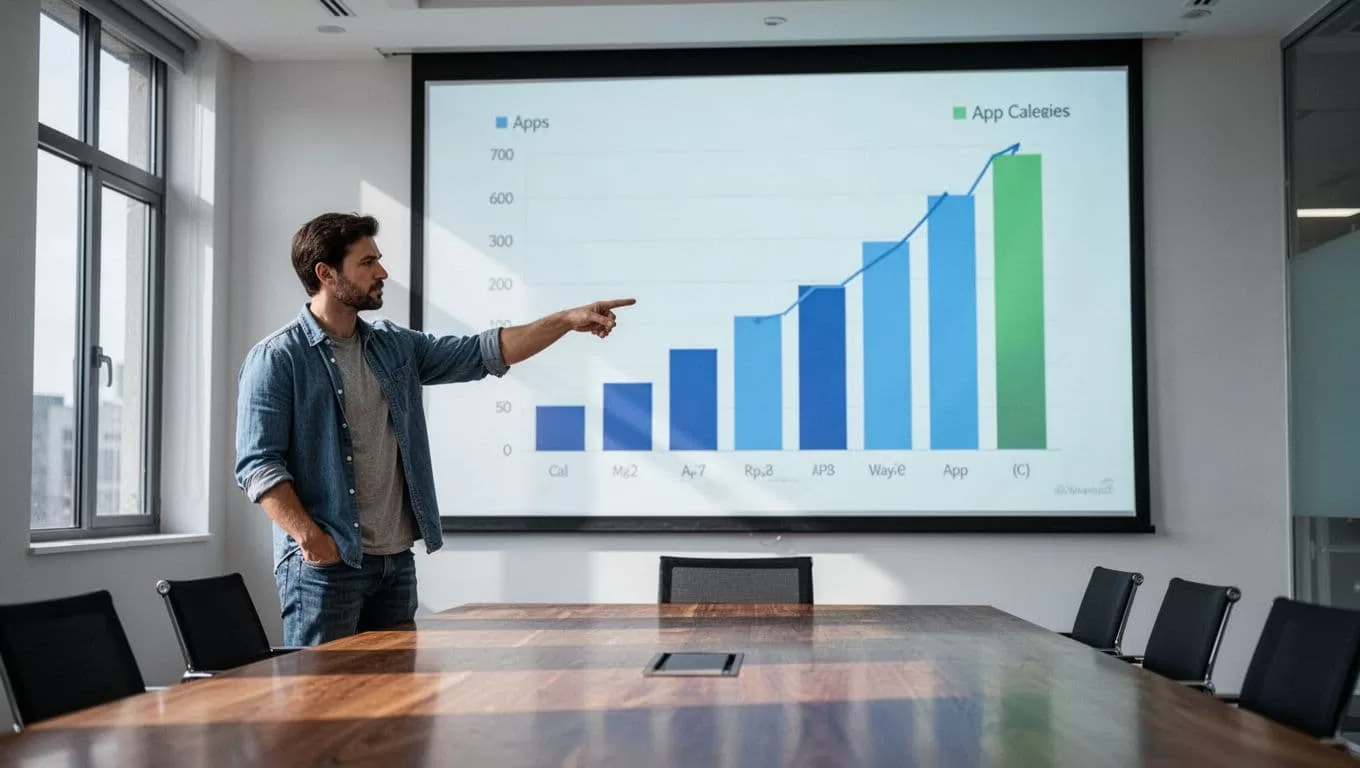
The pattern is simple. Categories with recurring pain and repeat use beat flashy one-off downloads. That’s why I care more about retention than launch buzz.
I also keep an eye on niche marketplaces and ecommerce-style app layers. They often grow when they solve one clear job better than broad tools. If you want a wider view of how categories turn into business moves, I pair this with my my Exploding Topics business-idea process.
How I turn a trend into action
I treat trend spotting like a short loop, not a one-time read. For founders, marketers, product teams, and investors, I split the next move this way:
- Founders: I look for one painful job to be done, then I test a narrow app promise.
- Marketers: I match the category to search language people already use.
- Product teams: I check whether the app needs integrations, trust, or compliance work.
- Investors: I compare early growth with competition, retention risk, and market depth.
That keeps me from mistaking attention for demand. It also keeps me from building too wide, too early.
I use a simple rule here. If the category needs me to explain the value too much, I slow down. If I can describe the benefit in one sentence, I move faster.
In practice, that might mean a landing page, a content test, a prototype, or a small pilot. I don’t need full certainty. I need enough proof to see whether the category has legs.
Hype feels loud, sustainable growth feels steady
Short-lived hype usually has a sharp rise and a fast fade. It gets attention, but it doesn’t build habits. Sustainable growth looks calmer. It keeps rising because the app solves a real problem again and again.
That’s why I don’t chase the loudest category. I watch for the one that keeps climbing after the posts slow down. I want apps that people use on Monday, then again on Thursday, then again next month.
Exploding Topics helps me spot the first faint line of that growth. The real edge comes from reading the signal well and acting before the market feels obvious. When I do that, I stop guessing and start choosing better.

