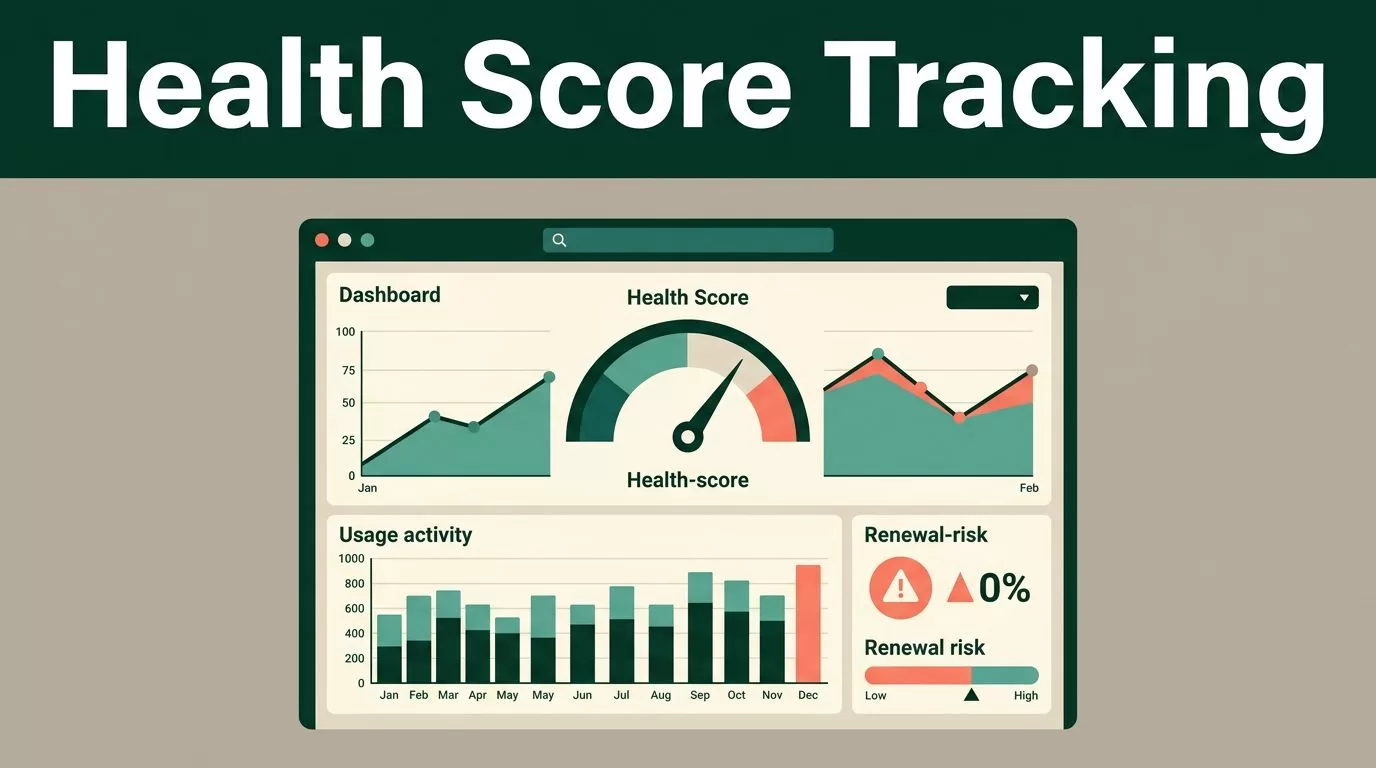
A health score is only useful when it changes what your team does. Health score tracking in Twin.so helps customer success teams connect account activity with renewal risk, adoption gaps, and expansion signals.
The mistake is treating one number as the full customer story. A score can rise while usage stays shallow, or remain stable while support issues increase. You need a repeatable model, clear ownership, and a review process that turns movement into action.
Key Takeaways
- Separate leading indicators, such as product usage, from lagging indicators, such as churn.
- Build scores from a small set of reliable signals.
- Review score movement and account history, not only the current value.
- Assign a specific action when a score improves, declines, or stays flat.
- Use Twin.so as part of an operating process, not as a passive reporting screen.
What Health Score Tracking Should Measure
Customer health scoring estimates the strength of an account relationship. It combines multiple signals into a score that helps your team prioritize attention.
A strong model answers three questions:
- Is the customer using the product?
- Is the customer getting value from that usage?
- Is the account likely to renew or grow?
Usage data usually provides the first answer. Business outcomes, stakeholder engagement, support activity, and renewal information help answer the other two.
This distinction matters because not every metric predicts the future equally well. Leading indicators show what may happen next. Product logins, feature adoption, workflow completion, active users, and time between sessions are common examples.
Lagging indicators show the result after problems have already developed. Churn, non-renewal, reduced contract value, missed renewal dates, and formal cancellation requests fall into this group.
A lagging indicator is still important. It tells you whether the account outcome matched your earlier assessment. But it usually arrives too late for a customer success manager to change the result.
A practical health score model might include:
| Signal | Indicator type | What to check |
|---|---|---|
| Product usage | Leading | Are core users active? |
| Feature adoption | Leading | Are customers using the features tied to value? |
| Stakeholder engagement | Leading | Are meetings, replies, and reviews happening? |
| Support activity | Leading or warning | Are issues resolved, repeated, or escalating? |
| Customer feedback | Leading | Are survey responses and comments improving? |
| Renewal status | Lagging | Is the commercial outcome at risk? |
| Churn or contraction | Lagging | Did the account reduce or end its agreement? |
The model should stay small. A score built from twenty weak signals creates false precision. Start with the measures your team can collect consistently and explain to account owners.

Build a Health Score Model That Teams Can Use
Health scoring fails when the rules are difficult to understand. Your customer success team should know which inputs affect the score and what each change means.
Start by defining the customer outcome. For example, the score may help your team identify accounts that need adoption support before renewal. It may also help account managers find customers with enough usage and engagement to discuss additional products.
Next, group signals by category. Product behavior, relationship strength, support experience, customer feedback, and commercial status are useful categories for many SaaS teams.
Assign more weight to signals that have a clear connection to customer value. If a customer gets results only after using a specific workflow, that workflow should matter more than a general login count.
Avoid treating every login as positive. A high number of sessions can indicate healthy adoption, but it can also show that users are struggling to complete a task. Combine activity data with completion, retention, and support context.
Set a review period for each input. Daily usage data may need frequent updates. Executive engagement may change less often. Renewal status may require manual review by the account owner.
The score also needs a change policy. Define what happens when information is missing, delayed, or contradictory. For example, a stale usage value shouldn’t automatically make an account look healthy. A missing survey response shouldn’t automatically make it unhealthy.
[!IMPORTANT] A score is a prioritization tool. It isn’t a replacement for account judgment, customer conversations, or renewal planning.
Use Paddle’s customer health score guidance to compare scoring inputs and impact models before finalizing your own structure. The model should reflect how your customers receive value, not how another company labels its metrics.
How to Track Health Scores on Twin.so
Twin.so should support a consistent view of account condition and account change. The exact fields and views available depend on your workspace setup, so build the process around the information your team can verify.
Begin by identifying the customer records your team reviews. Use the same account naming, ownership, segment, and renewal details across the relevant records. Inconsistent account data makes score comparisons unreliable.
Then define how the score is stored or displayed in your Twin.so workspace. Use the available customer health fields, score views, notes, or reporting options that match your setup. Don’t create multiple versions of the same score unless each version has a separate purpose.
Use this workflow:
- Set the scoring rules. Document each input, its source, its review period, and its effect on the score.
- Load or update account signals. Add verified usage, engagement, support, feedback, and commercial information through the methods available in your workspace.
- Review the current score with its history. A score of 72 means less when you don’t know whether it moved from 45 or 90.
- Check the account context. Read recent notes, open issues, meeting outcomes, and renewal details before taking action.
- Assign an owner and next step. Each meaningful score change needs a person responsible for follow-up.
- Record the result. Note the action taken and the next review date.
This process keeps health score tracking tied to account management. A score update without an owner is only a data change. It doesn’t reduce risk.
Review account segments separately. Enterprise customers may need stakeholder and renewal signals. Self-serve accounts may rely more heavily on product usage and support behavior. One model can cover both groups only when the buying process and value path are similar.
For additional model ideas, Gainsight’s customer health score guide covers common inputs such as usage, support activity, survey scores, and account growth.
Act on Score Movement, Not Only Score Levels
A current score tells you where an account is. Score movement tells you what may be happening.
A declining score requires a cause review. Check which inputs changed first. A drop in product usage may require an adoption call. Repeated support issues may require escalation. Lower executive engagement may point to weak business value or a change in internal priorities.
Don’t send the same message to every declining account. Match the response to the signal.
- If core feature usage falls, schedule a focused workflow review.
- If active users fall, identify whether the customer reduced usage or lost team members.
- If support issues increase, confirm the owner, severity, and resolution plan.
- If renewal risk rises, update the commercial plan and involve the right internal stakeholder.
An improving score also needs review. Find the input responsible for the change. If usage increased after training, capture that tactic for similar accounts. If stakeholder engagement improved after an executive review, schedule the next business-value conversation.
Don’t treat improvement as a reason to stop contact. Confirm that the new behavior lasts and that customers are reaching the outcome connected to the product.
A stagnant score is not automatically healthy. It may mean the customer is stable. It may also mean the data is stale or the model isn’t sensitive to the customer’s situation.
Check the age of each input. Confirm that usage is current, support data is complete, and the account owner has reviewed recent customer conversations. If all signals remain flat, create a targeted experiment, such as a workflow session, training plan, or value review.
Health score tracking works when every score state has a defined response. Vitally’s four-metric scoring framework also emphasizes using health scores to decide where teams should focus their time.
Create a Review Cadence for Customer Teams
A health score should have a place in your team’s normal operating rhythm. Otherwise, updates happen only before renewal meetings.
Customer success managers can review major score changes during weekly account planning. Operations leaders can inspect data quality and segment trends on a regular schedule. Account managers can use the score alongside renewal dates, open opportunities, and stakeholder coverage.
Set rules for review without turning them into platform assumptions. Your team might review high-risk accounts weekly and stable accounts less often. The exact cadence should match contract size, renewal complexity, and customer volume.
Use a simple review record for each account:
- Current score and prior score
- Date of the last meaningful change
- Main driver of the change
- Customer impact
- Assigned owner
- Next action and review date
Track false positives and false negatives. A false positive occurs when the score shows risk but the account renews without difficulty. A false negative occurs when the score looks healthy but the account churns or contracts.
These outcomes help you improve the model. If support volume predicts risk better than survey scores, adjust the weighting. If login counts create noise, reduce their influence or pair them with workflow completion.
The goal isn’t to make the score perfect. The goal is to make it useful, explainable, and connected to decisions.
Common Health Score Tracking Mistakes
The first mistake is using activity as a substitute for value. Customers can log in often without completing the work that matters. Pair usage with adoption depth and customer outcomes.
The second mistake is mixing leading and lagging indicators without labeling them. Churn should help validate the model. It shouldn’t be the main signal used to predict churn.
The third mistake is changing the model without preserving history. If the scoring rules change, document the date and reason. Otherwise, teams may compare scores that were calculated under different conditions.
The fourth mistake is allowing manual updates to replace evidence. Account notes add context, but they shouldn’t hide missing usage or support data. Require a reason when a team member overrides a score.
The fifth mistake is creating alerts without action capacity. If every small change triggers a task, the team will ignore the system. Focus on meaningful movement, repeated warnings, and high-value accounts.
Twin.so can support the process only when your operating rules are clear. Keep the score visible, keep its inputs explainable, and connect every material change to an owner.
Conclusion
Health score tracking in Twin.so should help your team decide where to spend time. Build the score around reliable leading indicators, use lagging indicators to test its accuracy, and review changes with account context.
When a score improves, confirm the behavior that caused it. When it declines, address the earliest useful warning. When it stays flat, check the data before calling the account healthy.
A useful health score doesn’t predict every renewal outcome. It gives your team enough evidence to act before the outcome is already decided.