How I Check Email Address Format Standards with Hunter.io
If an email looks wrong, I don’t trust it, even before I send a single message. A small typo or a guessed pattern can wreck a campaign faster than a bad subject line. That’s why I use Hunter.io to spot the email address format s...


If an email looks wrong, I don’t trust it, even before I send a single message. A small typo or a guessed pattern can wreck a campaign faster than a bad subject line.
That’s why I use Hunter.io to spot the email address format standard a company seems to follow, then I verify before I reach out. The key word is “seems,” because a detected format is a pattern, not a promise.
That difference matters for marketers, recruiters, sales teams, and founders. I want the fastest path to a likely business address, plus enough proof to send with care.
The email address format standard I look for first
At the simplest level, an email address has three parts, the local part, the @ symbol, and the domain. The real question is how a company shapes the local part.
Some teams use full names. Others shorten names to initials or first name only. For a plain-language refresher on structure, I like this email address formatting guide.
When I scan a domain, these are the patterns I expect first:
| Common pattern | Example | What it usually tells me |
|---|---|---|
first.last@company.com | jane.doe@acme.com | A formal, easy-to-read format |
first@company.com | jane@acme.com | A simple setup, often smaller teams |
flast@company.com | jdoe@acme.com | A shortened internal rule |
firstl@company.com | janed@acme.com | A tighter naming system |
Hunter often finds one of these patterns from public sources, then assigns a confidence score. I read that score as a clue, not a verdict.
How I use Hunter.io to spot the pattern


I start with Hunter’s domain search when I need a quick read on a company. It scans public data, then suggests the most likely pattern. If I want the wider process, I keep my Hunter.io email finder workflow open beside me.
- I enter the company domain.
- I look for named contacts and repeated shapes in the results.
- I compare the suggested pattern with any known contact, because one real match beats a guess.
- I save the pattern, then verify each address before I send.
That workflow helps me move fast without pretending the guess is guaranteed.
A format match is a map, not a mailbox key.
Hunter’s pattern detection is strongest when the company leaves public traces. If a team hides its data well, I treat the result with more caution.
What Hunter.io’s match does, and doesn’t, prove
Hunter gives me probability, not certainty. If the score is high, I treat the format as strong. If the score is lower, I slow down.
Hunter’s own email verification guide makes the same point in a different way, syntax alone doesn’t tell the whole story. An address can look perfect and still bounce later.
Here’s how I read the result:
- Valid means I’m comfortable moving ahead, but I still keep the message relevant.
- Accept-all means the domain may accept almost anything, so I expect more risk.
- Unknown means I pause and check another source before I send.
Accept-all domains need special care. If I see that signal often, I lean on Hunter.io catch-all detection for sales outreach before I load the list into a sequence.
What’s the point of finding a pattern if I still might bounce? The point is to reduce waste before I spend credits, time, and sender trust. A likely format saves me from blind guessing. Verification saves me from bad assumptions.
My verification and outreach rules
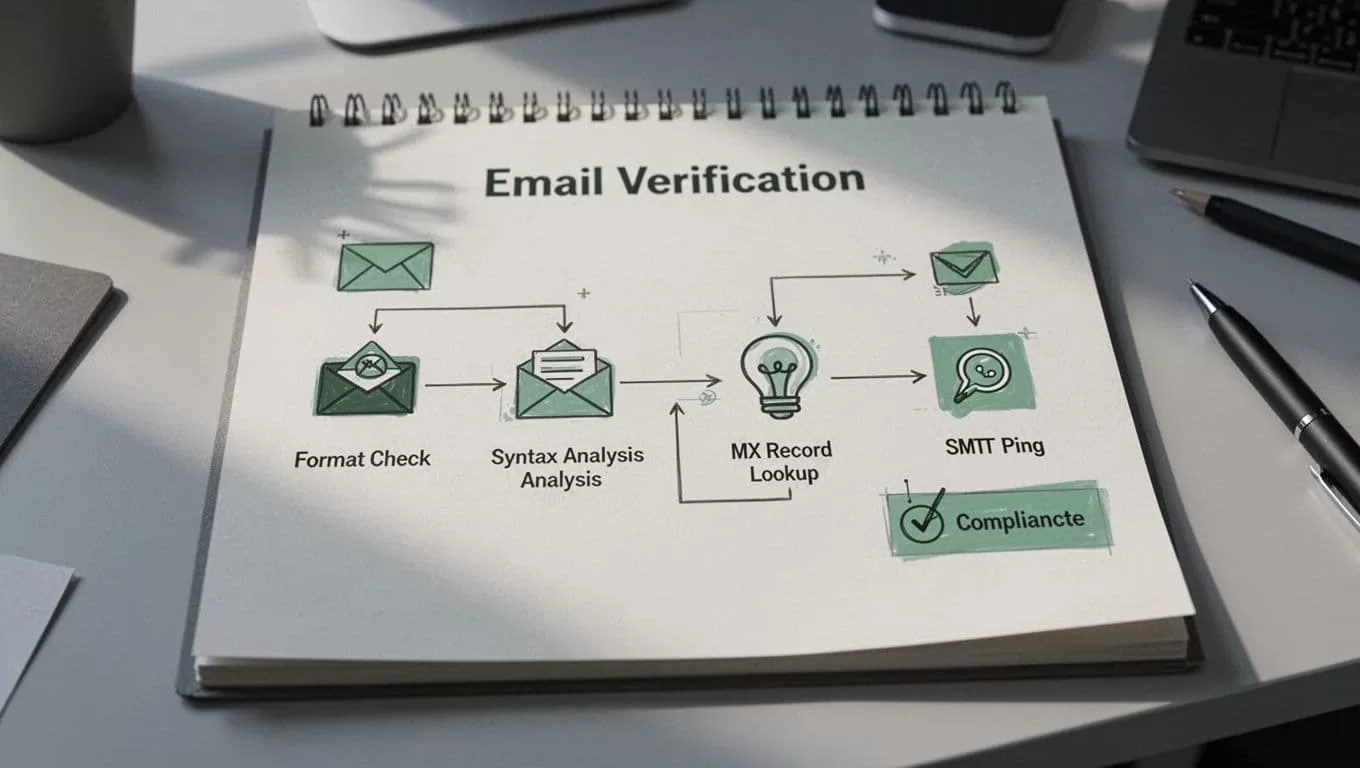
Once I have a likely format, I still verify every address before it enters a campaign. If I’m cleaning a batch, I use my bulk Hunter.io email verification workflow so the list gets checked before it hits my CRM or email tool.
I follow a few rules every time:
- I verify before the first send.
- I keep personal data minimal and use business context only.
- I suppress bounced, invalid, and opt-out addresses.
- I follow CAN-SPAM, GDPR, and the rules that apply to the region.
I also log where each lead came from. That note helps me answer complaints quickly and clean bad sources later. If a contact asks how I found them, I can explain the path without guessing.
For me, that’s the real value of Hunter. It helps me find the pattern, but it also reminds me to respect the limit of the pattern. A guessed address can still be the wrong move for outreach.
The standard matters, but verification matters more
I use Hunter.io to identify the most likely email address format standard, then I test that pattern before I trust it. That gives me speed without turning guesswork into a campaign plan.
The best outreach doesn’t start with volume. It starts with a clean pattern, a verified address, and a message that belongs in the inbox.

