Paddle Affiliate Software: Set Up Rewardful Correctly
An affiliate program can look busy and still pay the wrong people. Clicks, coupon use, and completed checkouts mean little when the referral record doesn’t match paid subscription revenue. For a SaaS company on Paddle Classic, Paddle...
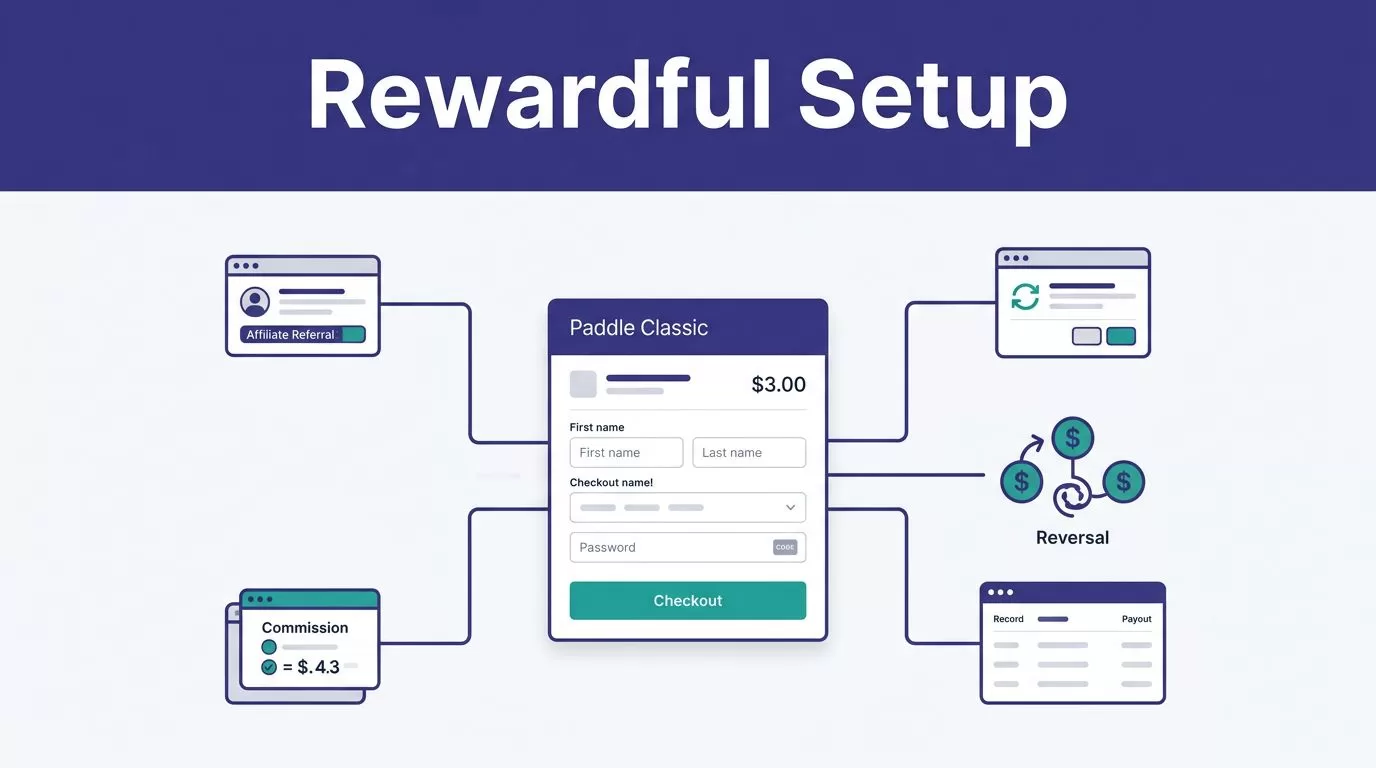
An affiliate program can look busy and still pay the wrong people. Clicks, coupon use, and completed checkouts mean little when the referral record doesn’t match paid subscription revenue.
For a SaaS company on Paddle Classic, Paddle affiliate software should connect affiliate traffic to customer payments, calculate commissions, reverse bad records, and leave a usable payout trail. Rewardful can do that through its documented Paddle Classic connection. It is not a fit for Paddle Billing.
Start by checking your payment setup. That decision controls everything that follows.
START WITH YOUR PADDLE VERSION
Rewardful documents a connection for Paddle Classic. It does not document support for Paddle Billing. Review Rewardful’s Paddle integration status before you create a campaign, recruit affiliates, or announce commission terms.
Paddle Classic and Paddle Billing are different products
Don’t treat the names as interchangeable. Rewardful’s setup uses Paddle Classic checkout, Paddle webhooks, and referral data passed into Paddle.Checkout.open().
If your SaaS uses Paddle Billing, don’t build an affiliate workflow around an unsupported connection. A custom tracking system or a different affiliate platform may be the better option.

Make the decision before changing billing
Don’t move an existing payment stack backward only to add affiliate tracking. First compare the cost of a custom integration, a supported alternative, and the commercial value of the program.
Record the answer in one place:
- Your current Paddle product and checkout type.
- Whether marketing pages and checkout can carry referral data.
- Which team owns webhooks, billing changes, and payout approval.
- The date you will run your first controlled attribution test.
This prevents a common failure. Marketing launches links while engineering discovers that the billing path cannot store the referral.
WHEN REWARDFUL IS THE RIGHT PADDLE AFFILIATE SOFTWARE
Rewardful fits SaaS companies that already use Paddle Classic and need recurring or one-time affiliate commissions. It is built for subscription programs, not one-off campaign reporting.
The public plans currently begin at $49 per month for Starter, $99 for Growth, and $149 or more for Enterprise. Rewardful lists a 14-day trial, annual billing savings, and no transaction fee. Check the live plan details before buying because plan limits and prices can change.
Match the software to your commission model
Your Paddle affiliate software should match how you sell. A monthly product, annual plan, free trial, and usage-based product can all need different rules.
Rewardful supports percentage-based commissions, fixed rewards, one-time commissions, and recurring commissions. Start with one campaign and one commission rule. Add exceptions only when you can explain and reconcile them.
A practical first rule is a percentage of eligible paid subscription revenue. Keep annual plans separate if they use a different rate or payout period.
Avoid a complicated launch structure with ten partner tiers, special coupons, and lifetime promises. Each exception creates more work when a customer changes plans or receives a refund.
CONNECT REWARDFUL TO PADDLE CLASSIC
The connection has three parts: account credentials, webhook delivery, and checkout attribution. Rewardful’s Paddle Classic setup instructions cover the required fields.

Connect credentials and payment events
In Rewardful, select Paddle as the payment processor. Then copy your Paddle Classic public key from Paddle’s Developer Tools area and add it to Rewardful. Include the BEGIN and END markers if Paddle shows them.
Next, copy the unique Rewardful webhook endpoint. Add it in Paddle under Developer Tools, Events, and the URLs for receiving webhooks.
Webhook delivery matters because Rewardful uses those events to record sales and update commissions. A checkout page alone cannot tell the system whether a charge later succeeded, failed, or was refunded.
Install Rewardful’s tracking script on the pages where affiliate visitors land and enter your purchase flow. Do not place it only on a blog or a page that visitors never use before checkout.
Pass the referral ID into checkout
A referral click creates a Rewardful referral identifier. Your checkout flow must pass that value into Paddle Classic as a passthrough custom parameter when it opens checkout.
This is the link between the affiliate visit and the Paddle transaction. UTM parameters are useful for reporting, but they do not replace the referral value required by the integration.
Have your developer document where the referral value is captured, stored, and passed into checkout. Treat this as a production billing dependency, not a marketing-page detail.
TEST ATTRIBUTION BEFORE RECRUITING AFFILIATES
Run a controlled test before you publish an affiliate signup page. Use a new private browser window so old cookies and staff sessions do not hide a broken setup.
Test one complete customer path
Create a test affiliate. Open that affiliate’s link in a private window. Visit the pricing page, complete a controlled checkout, and confirm the purchase result in both Paddle and Rewardful.
Check these five records:
- The affiliate is attached to the referral.
- The customer appears under the correct referral.
- Paddle order and checkout identifiers match the transaction.
- The payment creates the expected sale and commission.
- The commission amount follows the campaign rule.
Don’t test only the signup form. The payment event is the business event that matters.
Keep an attribution record
Store the affiliate name, Rewardful referral ID, Paddle customer details, order ID, checkout ID, payment amount, campaign, and commission outcome. Keep the original values unchanged.
If something does not match, create an exception record. Add an owner and a follow-up date. Don’t overwrite the first result or guess which system is right.
A paid checkout should not be repeated because attribution appears missing. Review the original order and event history first. A duplicate test purchase creates a second accounting problem.
SET COMMISSION RULES THAT MATCH PAID REVENUE
Commission policy needs to match what your company actually collects. The subscription price shown on a pricing page is not always the amount paid after discounts, credits, upgrades, or refunds.
Define eligibility before the first sale
Write down the commission basis in your affiliate terms. State whether commissions apply to the first payment, renewals, annual plans, upgrades, and reactivated subscriptions.
Also state which sales are excluded. Common exclusions include self-referrals, internal purchases, fraud, refunded payments, chargebacks, and accounts that violate your terms.
Pay commissions on accepted paid revenue, not on checkout activity or a dashboard export.
Set the cookie window to fit your sales cycle. A product with a same-day self-serve purchase can use a shorter window than a SaaS product with a long evaluation period.
Plan for refunds and subscription changes
Rewardful records a referred customer as a lead when the subscription is created. When payment succeeds, it records a sale and commission. Its Paddle event workflow also accounts for full and partial refunds.
A refund can reduce both the sale and the affiliate commission. Decide what happens if you already paid that commission. Most teams carry the negative balance into the next payout or hold the payout until the refund period has passed.
Use the same policy for cancellations, downgrades, disputed referrals, and failed renewals. A recurring commission program needs rules for the full customer lifecycle.
CONTROL PAYOUTS AND COMPLIANCE
Payouts are where a useful affiliate program becomes a finance process. Rewardful supports payout methods that include Managed Payouts, PayPal, and Wise options. Pick the method that fits your affiliate locations, finance controls, and payment volume.
Publish rules affiliates can follow
Your affiliate agreement should state the commission rate, eligible revenue, cookie duration, payout schedule, refund treatment, and restricted promotional methods.
Require affiliates to use clear promotional disclosures when their market requires them. Prohibit misleading claims about your product, fake coupons, trademark misuse, and self-referrals.
Limit access to customer data. Affiliate managers need enough information to investigate referrals, but they do not need broad access to billing records. Keep payout and tax documents in the systems approved by your finance team.
Reconcile before you mark a payout as paid
Exporting commissions is not the final control. Compare every due amount with the Paddle payment record and the payout confirmation.
| Record | Values to retain |
|---|---|
| Commission | Referral ID, Paddle order ID, paid amount, campaign, status |
| Payout | Affiliate, method, date, amount, payment reference |
| Exception | Issue type, owner, decision, follow-up date |
Record approvals, holds, and completed payments separately. A commission can be exported, then reversed by a refund or blocked by missing payout details.
Tax reporting, contractor status, withholding, and record retention depend on your country and affiliate arrangement. Get qualified tax and legal advice for those decisions.
RUN A WEEKLY OPERATING REVIEW
Affiliate programs drift when nobody checks the records after launch. The most useful metric is reconciled commission value, not clicks or new affiliate signups.
Pilot with a small approved batch
Start with 25 recent referred customers. Include normal renewals, a canceled subscription, a partial or full refund, a discounted purchase, and an unsuccessful payment.
For each record, compare the affiliate, referred customer, Paddle payment, Rewardful commission, and refund status. Track missing referrals, duplicate commissions, self-referral exceptions, and time spent on corrections.
A workflow that removes ten minutes of data entry but creates thirty minutes of payout fixes has failed.
Keep alerts and a recovery file
Set alerts for missing tracking scripts, sudden drops in attributed customers, failed webhook activity, and duplicate referral claims. Review changes after checkout updates, pricing experiments, or billing migrations.
Keep the last trusted commission report. If a configuration change breaks attribution, your team still has a verified payout record to work from.
Use Rewardful’s Paddle integration reference when you change checkout behavior or troubleshoot an event mismatch. Retest the complete path after every significant billing release.
KNOW THE LIMITS BEFORE YOU SCALE
Rewardful’s Paddle connection depends on Paddle Classic. That is its main operational limit. It is not an official route for Paddle Billing.
A custom Paddle Billing solution needs its own attribution design. It must capture the affiliate referral, bind it to the customer, process payment events, reverse refunded revenue, and preserve an audit trail. That work belongs in a scoped engineering project.
Don’t assume a coupon code is enough. Codes can be shared, removed, or used without a tracked referral. Don’t assume a successful payment proves the right affiliate earned a commission either.
The right system is the one your team can verify every week.
BUILD A PROGRAM YOUR FINANCE TEAM CAN TRUST
Rewardful can be effective Paddle affiliate software when your SaaS runs on Paddle Classic and your checkout passes the referral value correctly. The software records the events, but your team still owns the commission rules, payout controls, and exception decisions.
Start with one campaign, one tested checkout path, and a small batch of verified records. Accurate payouts are worth more than a large affiliate dashboard full of activity.
