Someli vs AuthoredUp in 2026 for LinkedIn Creators
If I had to choose between Someli vs AuthoredUp in 2026, I would split the decision by job, not by brand. AuthoredUp is the cleaner pick when I want control over every line, stronger formatting, and deeper post analysis. The Someli side, wh...

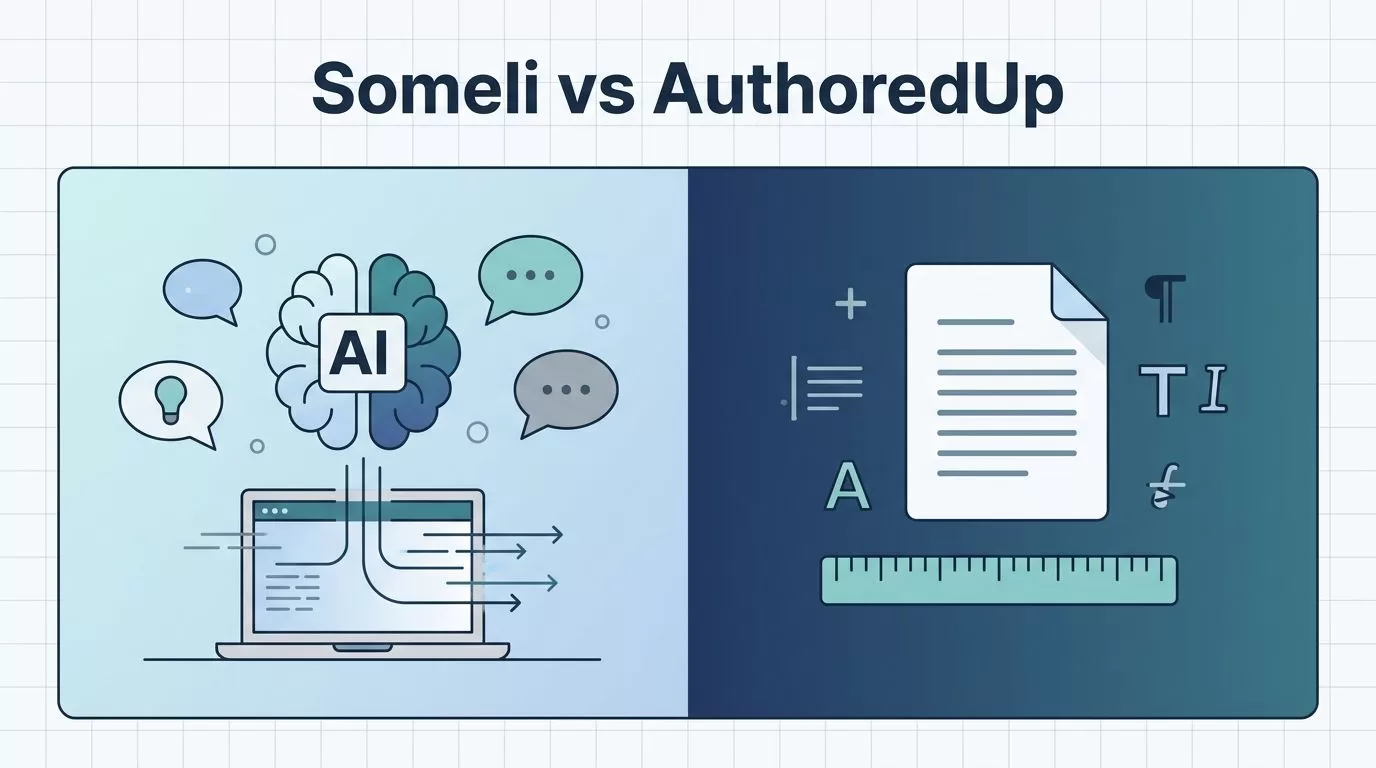
If I had to choose between Someli vs AuthoredUp in 2026, I would split the decision by job, not by brand. AuthoredUp is the cleaner pick when I want control over every line, stronger formatting, and deeper post analysis. The Someli side, which people usually mean as Taplio, is better when I want AI help, more ideas, and a wider growth stack.
I could not verify a live LinkedIn tool actually named Someli in the 2026 market, so I treat that side as the Taplio-style option. That matters, because the two tools solve different problems, and choosing the wrong one wastes time fast. The right choice depends on how I write, how often I post, and how much automation I can live with.
Key Takeaways
- I would pick AuthoredUp if I write my own posts and care about precision.
- I would pick the Someli side if I want AI drafts, ideas, images, and broader reach.
- AuthoredUp wins on formatting control, exact “See More” preview, and historical post analysis.
- The Someli side wins on AI generation, content inspiration, carousels, and lead support.
- If compliance matters most, AuthoredUp feels safer because it avoids automation.
Table of Contents
- What I mean by Someli in 2026
- Someli vs AuthoredUp at a glance
- Where AuthoredUp wins
- Where the Someli side wins
- Who I would choose each tool for
- Pricing, compliance, and day-to-day workflow
- FAQs
What I mean by Someli in 2026
I need to clear up the name first. I could not verify a live LinkedIn creator product called Someli in the 2026 U.S. market. In practice, people usually mean Taplio, so I treat Someli as the Taplio-style side of the comparison.
That framing helps because the differences are real. AuthoredUp is a writing and analytics tool built around the LinkedIn editor. The other side is AI-driven, with idea generation, drafting, images, carousels, scheduling, and lead tools. I broke that split down more fully in my Someli vs Taplio comparison, and the same logic applies here.
If I want help with the writing step itself, I also keep my LinkedIn post writer guide close. It is the part of the stack I use when the blank page feels heavier than the calendar.
Someli vs AuthoredUp at a glance
For a wider market scan, I like ConnectSafely’s 2026 LinkedIn creator tools roundup. But the real choice narrows fast when I compare these two side by side.
| Area | AuthoredUp | Someli side |
|---|---|---|
| Core job | Tight LinkedIn writing, formatting, and analytics | AI drafting, inspiration, and growth support |
| AI writing | No AI writing, I write every post | AI suggestions and drafts on paid plans |
| Formatting | Rich text editor, exact “See More” preview | Basic editor, less control over line breaks |
| Analytics | Deep LinkedIn profile analytics and archive import | More basic engagement views and hook testing |
| Content library | My own drafts and historical posts | Large searchable post library and topic feeds |
| Media tools | No image generation or carousel builder | AI images and carousel creation |
| Scope | LinkedIn only | LinkedIn plus X, Threads, and Bluesky |
| Trial and price | 14-day trial, no card, $19.95 per profile | 7-day trial, $39 to $79 per month depending on plan |
| Best for | Manual writers and operators | AI-assisted creators and lead-driven teams |
That is the whole split in plain English. AuthoredUp tightens the post. The Someli side widens the funnel.
Where AuthoredUp wins
AuthoredUp feels like a workbench built for writers who care about every line. The editor gives me bold, italics, bullets, code blocks, and a readability score, so I can shape the post before it leaves my hands. Its exact “See More” preview matters, because hooks live or die on the first screen.
Three reasons I keep it on my shortlist:
- I can analyze years of past posts through LinkedIn archive import.
- I get deeper profile analytics, including post comparisons and reaction breakdowns.
- I stay inside LinkedIn’s publishing flow instead of bouncing across extra channels.
The trade-offs are real. I do not get AI drafting, image generation, or a carousel builder. If I want a tool to think with me, AuthoredUp is not that tool. It is the editor I use when I already know what I want to say.
Where the Someli side wins
The Someli side feels broader and louder. It helps me get unstuck, because it starts with AI suggestions and a large library of posts I can search by niche. If I need a draft in minutes, it gives me one. If I want a carousel from a blog link, it can do that too. It also adds images, scheduling, audience research, and lead support, which makes it closer to an operating system than a plain editor.


What I reach for there is speed and range:
- I get AI-generated post ideas and drafts.
- I can pull from a large viral library.
- I can create visuals and carousels without leaving the tool.
- I can move across LinkedIn, X, Threads, and Bluesky.
The cost is less control. I do not get AuthoredUp’s exact preview or its deeper formatting surface. For a creator who cares about polish, that gap matters. If scheduling is the part I want to tighten, I pair this kind of workflow with my LinkedIn post scheduling workflow.
Who I would choose each tool for
I sort creators into two buckets. One group already has strong opinions and needs a better publishing desk. The other group wants help finding the next post, the next hook, or the next angle.
My rule is simple: if I edit first, AuthoredUp fits. If I draft first, the Someli side fits.
I would choose AuthoredUp if I care about exact line breaks, post previews, and historical analysis. I would also choose it if I publish fewer posts and review them carefully before they go live. That is the setup I trust when I want my writing to feel precise.
I would choose the Someli side if I want AI to generate first drafts and content ideas. I would also choose it if I need carousels, visuals, or multi-platform posting. That path makes more sense when volume, speed, and lead capture matter as much as the post itself.
Pricing, compliance, and day-to-day workflow
Price matters, but the workflow matters more. AuthoredUp starts at $19.95 per profile, or $14.95 per seat on the team plan with a three-seat minimum. It also offers a 14-day trial with no credit card. The Someli side starts at $39, then jumps to $65 for AI and $79 for Pro, with a seven-day trial.
Compliance pushes me toward AuthoredUp when I want a low-risk setup. It doesn’t rely on LinkedIn cookies or automation, while the Someli side moves closer to automation on higher plans. If I need a wider creator stack outside LinkedIn, I also like RedactAI’s 2026 creator tools roundup.
For my own use, the choice is simple. If I want to write better posts, I pick AuthoredUp. If I want the tool to help me find, draft, and distribute more ideas, I pick the Someli side.
Conclusion
I would pick AuthoredUp if my posts depend on clean formatting, exact previews, and richer history. I would pick the Someli side if I want AI to give me the first draft and help me move faster.
That is the cleanest way I know to separate them. One is the sharper editor. The other is the broader assistant.
I would not choose by brand names alone. I would choose by whether my bottleneck is writing precision or writing speed.
FAQs
Is Someli a real LinkedIn tool in 2026?
I could not verify a live tool with that name. I treat it as the Taplio-style side of the comparison because that is the product family people usually mean.
Which tool is better for writing LinkedIn posts?
If I write every post myself, AuthoredUp is better because the editor and preview are stronger. If I want AI to give me a first draft, the Someli side wins.
Which tool is better for analytics?
AuthoredUp. I get deeper profile analytics, history import, and more detailed post comparisons.
Which tool is safer for compliance?
AuthoredUp, because it does not depend on automation or a LinkedIn cookie. I still review everything manually before I publish.
Which one is better for teams?
The Someli side is stronger if the team wants AI drafts and broader collaboration. AuthoredUp is better if the team wants cleaner publishing and deeper analytics on LinkedIn itself.

