How I Spot Trending Real Estate Markets Early with Exploding Topics
The best real estate markets rarely announce themselves with a banner. They usually show up as small search bumps, tighter inventory, and a few more people asking the same local questions. I use trending real estate markets data to catch th...

The best real estate markets rarely announce themselves with a banner. They usually show up as small search bumps, tighter inventory, and a few more people asking the same local questions.
I use trending real estate markets data to catch those early ripples. Then I test them against supply, jobs, affordability, migration, and new construction, because search interest alone can fool me.
That mix keeps me from buying the headline instead of the market.
How I catch early movement before it hits listings
I start with my Exploding Topics trend spotting process, because I want motion before the crowd sees it. A city can look quiet on the surface while search interest climbs under it.
I also compare what I see with Exploding Topics’ April 2026 trending topics. If a place, suburb, or housing type keeps appearing in related searches, I pay attention. One spike can be noise. A cluster can be a clue.

When I look at search patterns, I ask a few simple things. Are people searching for a city name, a suburb, or a home type? Are they adding words like “best,” “cheapest,” or “near jobs”? Those details matter because they show intent, not just curiosity.
I also watch for migration language. Terms around “moving to,” “relocating to,” and “best places to live” often rise before listings tighten. For agents and buyers, that can hint at where attention is forming. For investors, it can point to rental demand before rents fully catch up.
My checklist for separating signal from noise
Once a market starts to look interesting, I cross-check it with Exploding Topics data for real demand. That helps me avoid a common mistake, which is mistaking attention for proof.
A simple checklist keeps me grounded.
| Signal | What I want to see | Why it matters |
|---|---|---|
| Search interest | A steady climb, not one loud spike | It shows repeated attention |
| Housing supply | More listings, but not a flood | Buyers need choice without panic |
| Jobs | Hiring in health care, logistics, tech, or trades | People move where paychecks grow |
| Affordability | Prices that still fit local wages | Demand lasts longer when homes feel reachable |
| Migration | More inbound moves than outflow | New residents create fresh demand |
| Infrastructure | New transit, schools, permits, or plant builds | Those projects pull demand forward |
That table is the core of my filter. If a market has search heat but weak jobs and thin rental math, I slow down. If prices rise while income growth stays flat, I slow down again.
A rising search trend is smoke, not proof of fire.
I also care about rent-to-price ratio and days on market. A market can look hot and still fail the numbers. For investors, that means I want rent growth, not just headlines. For agents, it means I want a real buyer pool, not only online buzz.

Photo by Jakub Zerdzicki
What April 2026 is telling me about real markets
The current picture is pretty clear. Smaller cities in the Northeast and Midwest are drawing a lot of attention right now, and the heat is not limited to one coast.
Realtor.com’s top housing markets for 2026 and Inman’s ranked hottest and coldest markets both point to the same pattern. Buyers keep chasing value, space, and lower pressure.
I keep watching places like Hartford, Rochester, Worcester, and Toledo because they show that shift in a clean way. Hartford is showing up as one of the hottest markets overall, while Indianapolis stands out as a buyer-friendly market with a median price around $283,040. Atlanta and Charlotte are still attractive, but their higher medians make the value case more mixed.
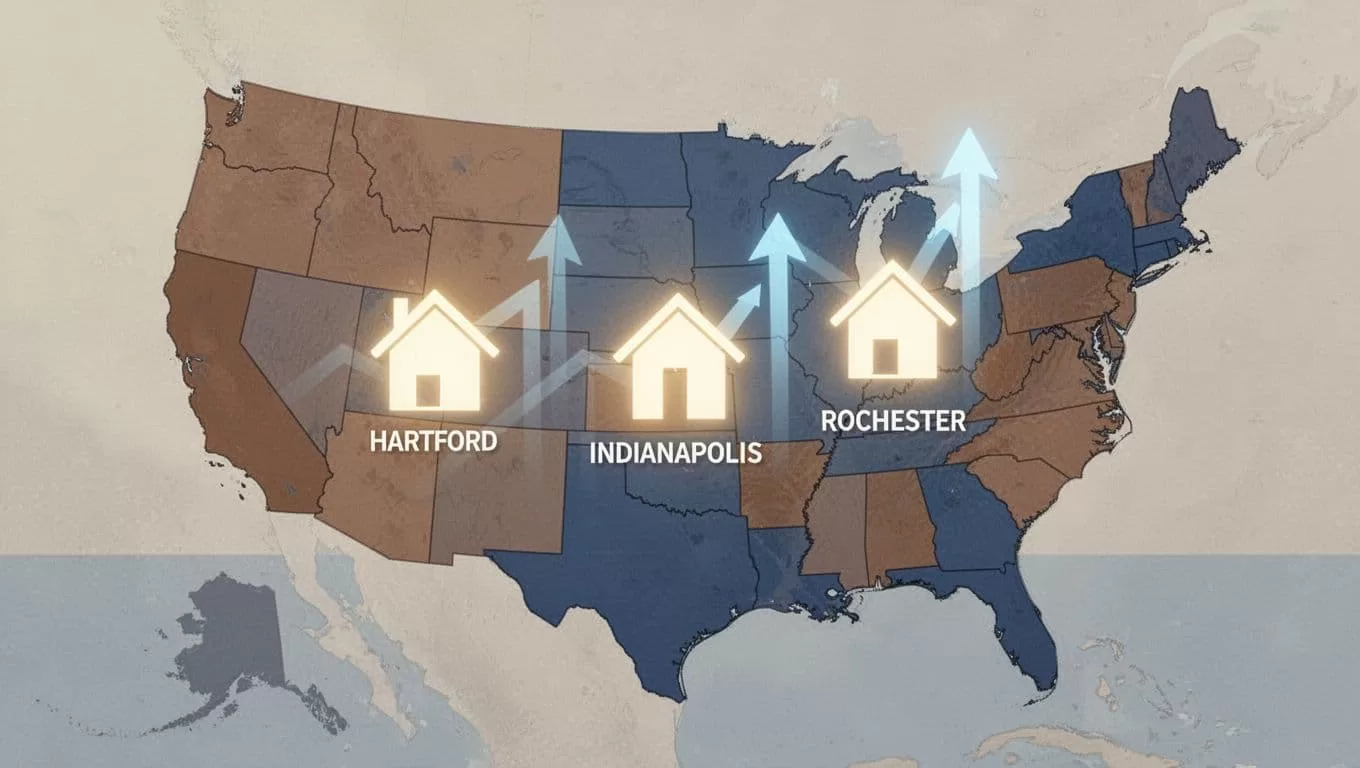
I look for a few patterns in these markets. First, inbound migration needs to be real, not just a social media story. Next, local employers need to keep hiring. Then, housing supply has to stay tight enough to support prices without choking demand.
That mix is why I pay attention to suburbs too. A big city may be too expensive, but a nearby suburb can catch the spillover. When I want narrower place-based phrases, I use my keyword discovery method to see how people name the same area in different ways.
Where I trust the trend, and where I wait
The hardest part is timing. A trend can be real and still arrive late for a buyer. By the time everyone is talking about a city, prices may already reflect the move.
I also watch for false positives. A market can spike because of a viral article, a single employer rumor, or a temporary rate dip. If the trend fades fast, I move on.
I trust a market more when the signal lasts past the first wave. I trust it even more when search interest matches job growth, supply pressure, and local development. If those pieces line up, I know I’m looking at something with legs.
The takeaway I trust most
Exploding Topics helps me spot the first flicker of interest. That matters because the earliest signals often appear before most charts, headlines, and local feeds catch up.
Still, I never treat a trend as a verdict. I want the search line, the job line, and the supply line to point in the same direction.
That’s how I separate a hot chart from a market I’d actually touch.
