Why Cloud Engineers Are Ditching AWS Automation Replacement Scripts
Your team runs hundreds of lines of shell script to handle provisioning, scheduled database snapshots, and log rotations. It works until an API rate limit hits, a credential expires, or someone alters an IAM policy without telling you. Sudd...
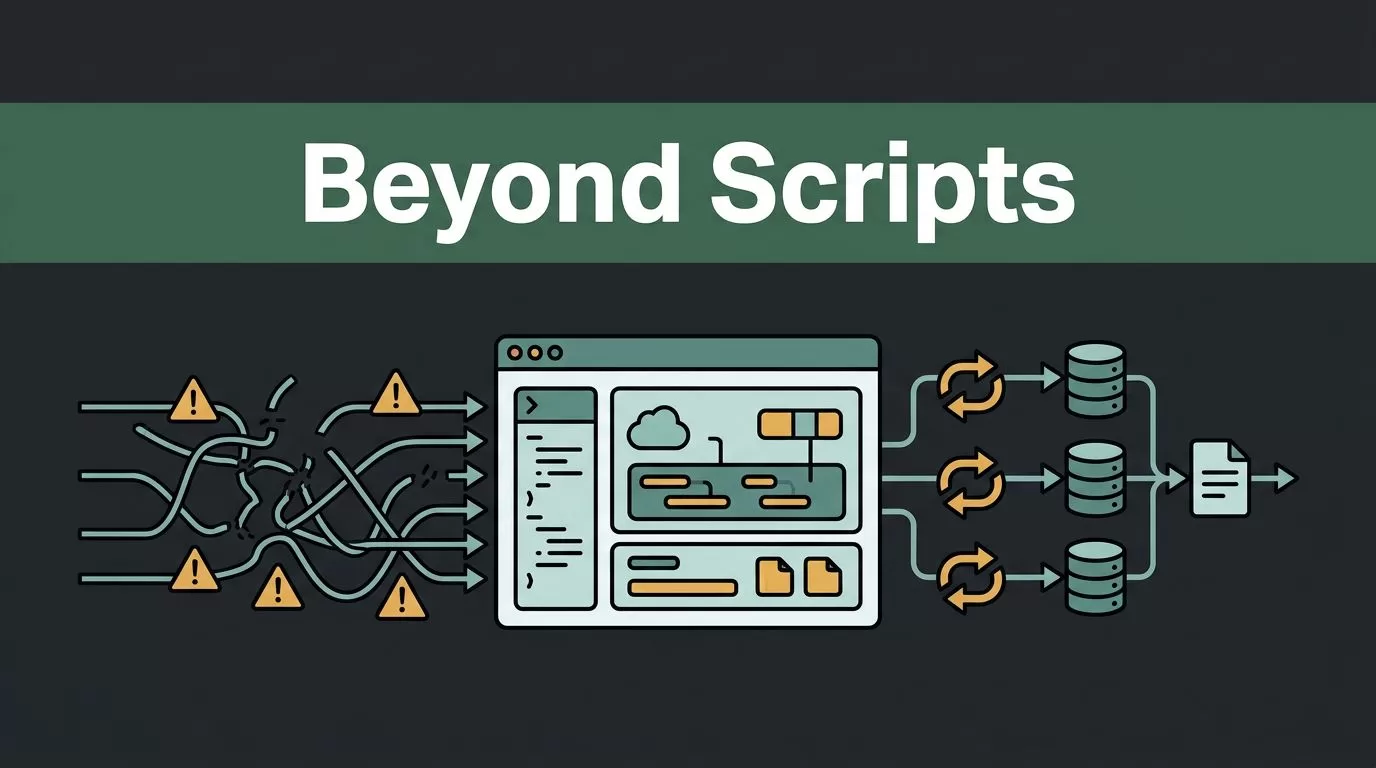
Your team runs hundreds of lines of shell script to handle provisioning, scheduled database snapshots, and log rotations. It works until an API rate limit hits, a credential expires, or someone alters an IAM policy without telling you. Suddenly, the script fails mid-run, leaving half-configured cloud resources behind. You spend hours tracing log files instead of building product features.
Moving away from fragile shell scripts toward structured execution platforms solves this headache. If you want sustainable AWS automation replacement workflows that handle retries and error reporting natively, you need to transition your cloud operations away from local terminal scripts.
Key Takeaways
- Custom shell scripts fail silently during edge cases, leaving cloud infrastructure in inconsistent states.
- Managed orchestration tools provide native error handling, retries, and audit trails without extra code.
- Declarative provisioning frameworks replace imperative scripts with version-controlled state management.
- Standardizing operational runbooks reduces troubleshooting time and eliminates single-engineer dependencies.
Moving Beyond Custom Scripts
Writing a bash script that calls the AWS command-line interface feels fast at first. You wire up an endpoint, parse a JSON response with grep or jq, and push the result to Slack. Maintenance debt builds quietly over time. When parameters change or permissions shift, the script breaks. It lacks state awareness, retry logic, and built-in parallelism.
You need an environment that treats cloud automation as a first-class engineering discipline. Instead of writing custom loops to check if an EC2 instance is running, modern platforms manage dependencies declaratively. They verify the target state before executing actions, preventing duplicate resource creation and incomplete provisioning sequences. If you manage webhooks or data payloads as part of your deployment cycle, using structured platforms like this content automation tool helps keep event handoffs reliable.
Traditional Script Approach:
[Bash Script] -> [AWS CLI Call] -> [Manual Grep Check] -> [Silent Failure Point]


Modern Platform Approach:
[State Engine] -> [API Validation] -> [Managed Retry] -> [Guaranteed State]
Standardizing Common AWS Workflows
Every engineering team repeats the same set of operational tasks across different environments. Provisioning infrastructure, scheduling routine backups, responding to cloud monitoring alerts, and generating billing reports make up the bulk of daily toil. When these tasks live in disjointed Python scripts stored on individual laptops, visibility drops to zero.
An effective AWS automation replacement centralizes these operational playbooks into a single control plane. When provisioning new microservices, you define parameters once and let the engine handle resource sequencing. For scheduled operations, event-driven triggers replace cron jobs running on lonely EC2 instances. If a scheduled database cleanup fails, the system triggers alerts based on exit codes rather than failing silently in the background.
When Custom Scripts Still Make Sense
Managed orchestration tools solve many operational problems, but they aren’t the answer for every single task. You don’t need a heavy workflow engine for a one-off data migration script you will run exactly once. If you need to parse a local log file, filter specific error strings, and output a quick CSV for a manager, a local Python script gets the job done faster.
Keep custom scripts for transient tasks, local testing, and rapid prototyping where setting up a managed pipeline introduces unnecessary friction. The moment an automation task runs on a schedule, touches production infrastructure, or requires sign-off from other team members, graduate it from a raw script to a managed platform.
| Automation Type | Best Approach | Primary Benefit |
|---|---|---|
| One-off data parsing | Local script | Zero configuration overhead |
| Scheduled infrastructure backups | Managed platform | Built-in retries and failure alerts |
| Production resource provisioning | Declarative IaC tool | State tracking and drift detection |
| Multi-step deployment pipelines | Orchestration tool | End-to-end audit logging |
Evaluating Platform Alternatives
Evaluating options for your AWS automation replacement means looking closely at how your team collaborates. Declarative infrastructure-as-code tools manage resource provisioning by defining the desired end state, while workflow orchestrators handle event-driven tasks and multi-service sequencing.
If your primary pain point is managing complex deployments across multiple services, explore options like deployment automation tools to see how modern pipelines manage releases. By replacing brittle scripts with purpose-built orchestration tools, your team spends less time fixing broken bash code and more time shipping reliable software.
Final Thoughts
Relying on custom shell scripts for core infrastructure tasks creates hidden operational risks that slow down engineering teams. Moving to a structured automation platform provides the visibility, security, and error handling required for scalable cloud environments.
Audit your existing automation scripts this week to identify which ones fail most often. Plan your migration to managed workflows for those high-friction tasks first.
