Simplify SaaS Revenue Recognition With Baremetrics
Cash and revenue rarely arrive together. A customer can pay for a full year today, and the business still earns the money month by month. SaaS revenue recognition is the set of rules for deciding when subscription cash counts as earned reve...

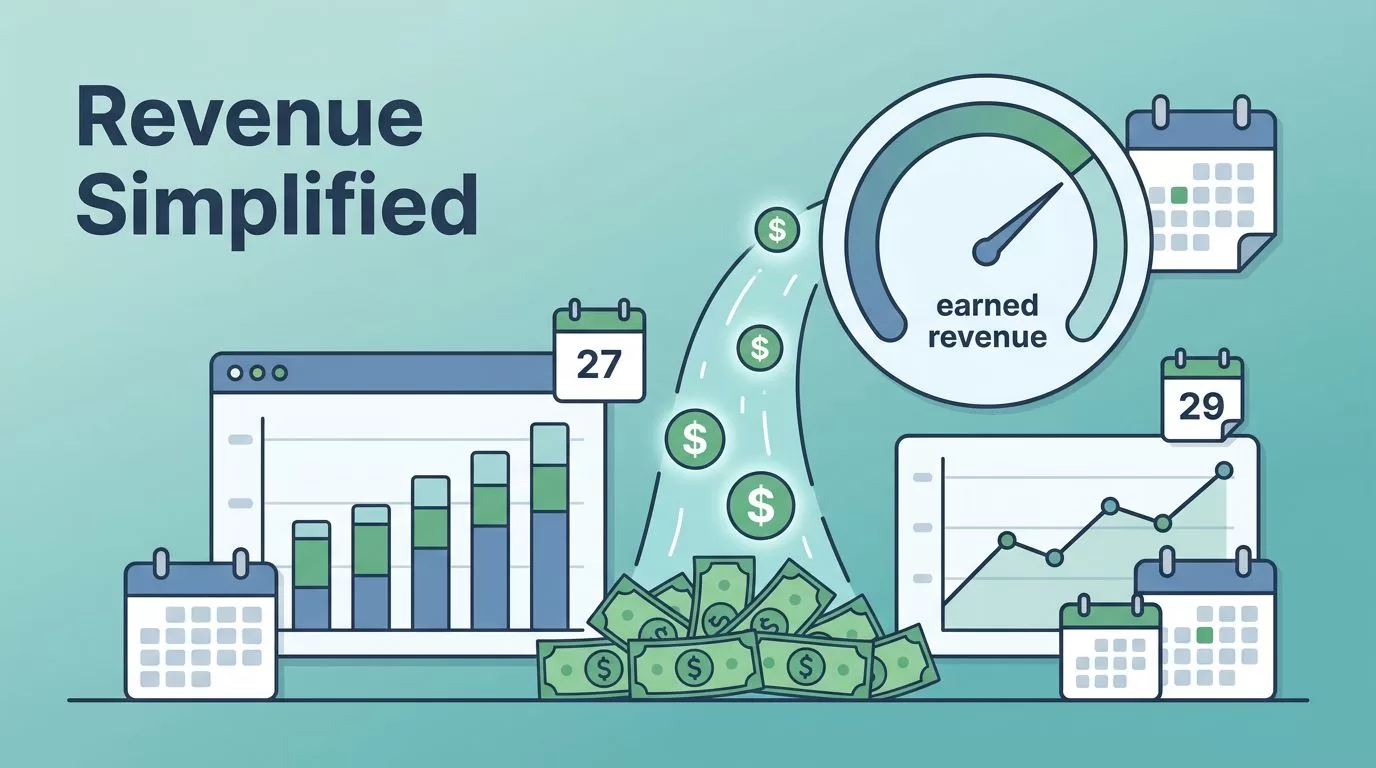
Cash and revenue rarely arrive together. A customer can pay for a full year today, and the business still earns the money month by month. SaaS revenue recognition is the set of rules for deciding when subscription cash counts as earned revenue.
Upgrades, proration, churn, and contract edits turn a clean invoice into a muddy month-end close. This guide explains the core concepts, shows how common subscription events affect the schedule, and describes where Baremetrics fits. The guide also lists what a finance team must still review by hand.
What SaaS revenue recognition means
Revenue recognition is the timing rule for counting subscription money as earned. A customer who prepays for 12 months does not produce 12 months of revenue on day one. The unearned portion is deferred revenue. Stripe defines deferred revenue as money a company receives for goods or services not yet delivered or completed. The same page gives a SaaS example. A provider collects a full year fee at signup, holds the cash as a liability, and recognizes revenue month by month while the software stays available.
The opposite case is accrued revenue. Accrued revenue is income earned but not yet paid. Both concepts matter for SaaS because billing dates and service periods rarely match.
Cash in the bank is not the same as revenue earned.
Real subscriptions add complications. A customer starts on a monthly plan, upgrades mid-cycle, adds seats in month three, pauses in month six, and cancels before renewal. Each change affects timing. A spreadsheet maintained by hand breaks easily under this load.


ASC 606 and IFRS 15 in plain terms
ASC 606 is the US GAAP standard for revenue from customer contracts. IFRS 15 is the international counterpart. According to Stripe overview of revenue recognition methods, both standards were developed by the FASB and the IASB, and the core principle is to recognize revenue when control of a good or service passes to the customer. Baremetrics lists the same five steps in its own ASC 606 explainer.
- Identify the contract with the customer.
- Identify the performance obligations, which are the distinct promises in the contract.
- Determine the transaction price.
- Allocate the price across the performance obligations.
- Recognize revenue when or as each obligation is satisfied.
Each step has sub-issues. Bundled products, discounts, free trials, implementation fees, and usage charges all complicate steps two through four. Your accountant decides the policy. Software only applies the policy consistently.
A worked example of deferred revenue
Assume a customer pays $1,200 on January 1 for a 12-month plan. The service runs evenly across the year. The simplified schedule looks like this.
| Point in time | Cash collected | Revenue recognized | Deferred revenue balance |
|---|---|---|---|
| January 1 payment | $1,200 | $0 | $1,200 |
| End of January | $0 more | $100 | $1,100 |
| End of June | $0 more | $600 to date | $600 |
| End of December | $0 more | $1,200 to date | $0 |
Now assume the customer upgrades at the end of June and pays an extra $300 for the remaining six months. The extra $300 enters the deferred balance and is recognized at $50 per month through December. The example is simplified. Real contracts may call for different treatment of discounts, credits, and bundled services.
How common SaaS events affect recognition
Billing shows what was charged. Recognition shows when the charge is earned. The table below compares the two views for frequent subscription events.
| SaaS event | What billing shows | What recognition should reflect |
|---|---|---|
| Monthly subscription | One invoice for one month | Revenue earned across the month |
| Annual upfront payment | Cash collected at once | Revenue spread across 12 months, with the unearned balance held as deferred revenue |
| Mid-cycle upgrade with proration | Partial extra charge | Revenue tied to the remaining service period |
| Expansion revenue | Added seats or higher plan value | New revenue recognized over the revised term |
| Cancellation with a credit | Service ends, credit issued | Future recognition stops and the deferred balance adjusts |
| Failed payment | Open or overdue invoice | Depends on policy and collectibility, so confirm the treatment with your accountant |
Expansion revenue means new revenue from existing customers. Proration means a partial charge for part of a billing period. Both change the schedule midstream, so each change needs a clear effective date.
Where Baremetrics fits
Baremetrics connects to billing systems and builds subscription reports from payment events. The Baremetrics pricing page lists Stripe, Braintree, Chargebee, Recurly, Shopify, the Apple App Store, Google Play, QuickBooks Online, and Xero among supported integrations. Teams starting from Stripe can follow the Baremetrics Stripe integration setup before trusting the first sync.
On revenue recognition, the Baremetrics ASC 606 page says the product supports correct implementation of ASC 606 accounting. The page does not claim full automation, and the page recommends consulting a licensed accountant before adopting any process. Treat Baremetrics as a reporting layer on top of billing data. Do not treat Baremetrics as a replacement for an accounting system or for professional advice.
The tools described in the Baremetrics dashboard guide help explain movement after the close. Examples include MRR, lifetime value, average revenue per user, and the MRR movements of new, expansion, contraction, and churned revenue. A Control Center feed lists signups, payments, upgrades, downgrades, and cancellations. Smart Dashboards segment the numbers by plan, country, or other attributes.

What to review before trusting the numbers
Automation shortens the work but does not replace policy. Your accounting team should confirm how the business treats contract terms, discounts, credits, and bundled promises. A short monthly review keeps small data issues out of board reports and investor updates.
- Match service periods: compare invoice dates with the actual subscription term.
- Review proration logic: confirm upgrades and downgrades follow the contract and not guesswork.
- Check expansion and churn: make sure added revenue and lost revenue land in the right period.
- Watch account status: paused, delinquent, or canceled accounts should not keep recognizing future revenue unless policy allows.
- Reconcile totals: compare reported revenue and deferred balances with the general ledger.
Retention data also needs a cross-check. When churn rises, revenue reporting and retention reporting should tell the same story. Compare recognized revenue trends with the SaaS churn rate calculation in Baremetrics. When both views line up, confidence in the picture grows.
Common mistakes to avoid
- Treating bookings as revenue. A signed contract or a paid invoice is not earned revenue by default.
- Mixing MRR with recognized revenue. MRR is an operating metric. Recognized revenue follows accounting rules, and the two figures can differ in a given month.
- Ignoring effective dates. An upgrade on the 20th affects only the remaining days of the period.
- Changing definitions midyear. Switching how credits or pauses are treated breaks period comparisons.
- Skipping the ledger tie-out. Dashboard totals should reconcile with the accounting system each month.
A simple monthly close routine
- Sync billing data and confirm the connection shows no gaps.
- Pull the list of new, upgraded, downgraded, paused, and canceled subscriptions.
- Spot-check five to ten accounts against contracts and invoices.
- Compare the deferred revenue balance with the prior month plus new billings minus recognized revenue.
- Record exceptions and the decision made on each exception.
- Hand the reviewed figures to the accountant for the ledger entries.
Run the routine on one live billing source and one recent month first. A small pilot shows whether the reporting tool reduces noise without giving up control. Document the definitions used for each metric so the next close follows the same rules.
Who needs a formal revenue recognition process
A founder selling a handful of monthly plans can often manage with a simple schedule and an annual review by an accountant. The workload grows with annual prepayments, multi-seat contracts, custom discounts, and usage fees. Companies planning an audit, a fundraise, or an acquisition also face closer scrutiny of revenue timing. In those cases, agree on written policies early, keep contract files organized, and test the reporting tool against a sample of real accounts before relying on the tool at scale.
Pricing for Baremetrics scales with tracked annual recurring revenue, and plan tiers and add-ons change over time. Check the official pricing page for current terms before budgeting for any reporting tool.
Frequently asked questions
What is the difference between deferred and accrued revenue?
Deferred revenue is cash received before service is delivered. Accrued revenue is income earned before cash is received. Deferred revenue sits as a liability until earned.
Does Baremetrics automate revenue recognition?
Baremetrics says the product supports correct implementation of ASC 606 accounting. Confirm the exact reports and limits on the official Baremetrics site and with your accountant before relying on any report for financial statements.
Is ASC 606 the same as IFRS 15?
The two standards share a core principle and a five-step model. Differences exist in details, so check which standard applies to your business.
Should annual plans be recognized all at once?
No. A prepaid annual plan usually produces revenue over the service period, with the unearned balance held as deferred revenue. Your accountant confirms the policy for each contract type.
Can a spreadsheet handle SaaS revenue recognition?
A spreadsheet can work for a few simple contracts. Proration, expansion, pauses, and cancellations make manual schedules error prone as the customer count grows.
Conclusion
Billing records charges. Revenue recognition records when the charges are earned. SaaS companies need both views, and the views must reconcile each month.
Baremetrics can support the reporting side by connecting billing data to subscription dashboards. Accounting policy, ledger entries, and compliance remain the job of the finance team and the accountant. Pick clear definitions, review a sample of accounts every month, and verify any product claim on the official vendor pages before relying on the claim.

